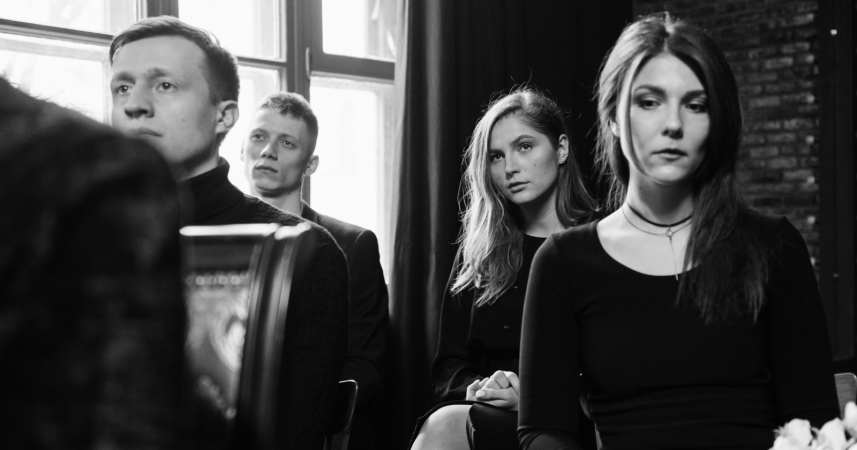
Funerals don’t reveal character or morality. They reveal conditioning. What feels like warmth to one family can feel like quiet chaos to another.
Funerals are strange social spaces.
Everyone is grieving, everyone is trying to be respectful, and yet the room is full of unspoken rules.
Most of those rules aren’t written down anywhere.
You only learn them by growing up around a certain type of family.
I’ve attended funerals across very different social circles.
Some were held in modest community halls with folding chairs and donated casseroles.
Others took place in hushed chapels where everything from the lighting to the flower arrangements felt choreographed.
What struck me wasn’t grief.
Grief looks the same everywhere.
What stood out were the behaviors people brought with them without realizing it.
Habits shaped by class, upbringing, and money.
Small things. Quiet things.
And in some cases, things wealthy families notice immediately, even if they never say a word.
Here are nine of them.
1) They treat the funeral like a social reunion
Have you ever walked into a funeral and immediately heard laughter?
Not cruel laughter. Familiar laughter. Catching up laughter.
For many lower-middle-class families, funerals double as reunions.
You haven’t seen Aunt Linda in ten years.
Cousins flew in from three states away.
This is where everyone finally crosses paths again.
So people talk. A lot.
They swap updates about jobs, divorces, kids, health issues, who moved where, who gained weight, who didn’t.
Wealthy families tend to find this jarring.
In more affluent circles, funerals are treated as contained emotional events.
You come to mourn. You express condolences. You leave.
The socializing happens later, privately, or not at all.
When conversation becomes animated or casual too early, it can read as disrespectful, even if that’s not the intent.
2) They openly comment on the body or appearance of the deceased
This one surprises people.
In many working- and lower-middle-class families, it’s normal to walk up to the casket and say things like:
He looks so peaceful.
They did a good job with her hair.
She doesn’t even look like herself.
These comments are meant to process shock and grief out loud.
In wealthier families, this kind of commentary is usually avoided.
The body is treated as something not to be discussed publicly.
Silence is seen as more respectful than observation.
So when someone vocalizes these thoughts, it can feel uncomfortable, even intrusive, to people from a different background.
Same grief. Different language.
3) They bring food without being asked
Food is love.
If you grow up in a family without much money, you learn early that you show up with something tangible.
A tray of baked ziti. A pie. Sandwich platters. Coffee. Soda. Anything.
At funerals, people bring food instinctively, even if there’s already catering.
Wealthy families often plan everything in advance.
Professional caterers. Staff. Timelines. There’s a sense that logistics are handled.
Unplanned food can feel disruptive to that order.
It creates questions.
Where does this go? Who asked for it? Is it appropriate?
For the person bringing it, it’s generosity.
For the host family, it can feel like an unexpected variable.
4) They talk openly about money and funeral costs
This one makes people squirm.
Lower-middle-class families are often very aware of what funerals cost.
They’ve had to be.
So conversations like these happen naturally:
That casket must’ve been expensive.
At least the church was free.
Thank God for the GoFundMe.
Cremation is so much cheaper.
Wealthy families usually avoid discussing costs at the event itself.
Money is either private or abstracted away.
Talking about it in the room feels crude to them.
But when money has always been tight, acknowledging the financial weight of death is part of processing it.
It’s not tacky where it comes from. It’s reality.
5) They dress emotionally, not strategically
You can often spot class differences in funeral attire.
Lower-middle-class mourners dress with sincerity, not calculation.
The black dress they already own.
The suit from weddings and interviews.
Shoes that are practical, not ceremonial.
Wealthy families tend to approach funeral attire with a quiet strategy.
Understated but tailored.
Conservative but expensive.
Nothing flashy, nothing worn.
When someone shows up slightly underdressed or visibly uncomfortable in formal clothes, it can stand out.
Not because it’s wrong, but because affluent spaces are deeply attuned to subtle uniformity.
6) They express grief loudly and physically
 Crying. Wailing. Hugging strangers. Needing to sit down suddenly.
In many families, grief is not managed. It’s released.
You cry when you feel it.
You collapse into someone’s arms.
You say things out loud that don’t sound polished.
Wealthy families often value emotional control in public.
Grief is real, but it’s contained.
Tears are quiet.
Bodies stay composed.
Support is offered subtly.
Neither is healthier than the other.
But when expressive grief meets restrained grief, there’s often silent shock on one side of the room.
7) They linger longer than expected
Lower-middle-class families tend to stay.
They stay after the service.
They stay after the burial.
They linger in parking lots, kitchens, and halls.
They talk. They sit. They don’t rush.
Leaving quickly can feel cold or disrespectful.
Wealthy families often move through funerals with more structure.
There’s a service. A reception. A departure.
Lingering without purpose can feel awkward or inefficient in those circles.
Time is segmented.
Grief is scheduled.
When people don’t leave, it can quietly disrupt expectations.
8) They use humor to cope, even early on
Dark humor shows up fast in some families.
A joke about how Uncle Mike would’ve hated this song.
A laugh about the terrible weather.
A sarcastic comment about the priest mispronouncing the name.
This isn’t cruelty. It’s survival.
In families where emotional heaviness has always been part of life, humor is how people breathe again.
Wealthy families often see humor at funerals as something that comes later.
At the wake. At home.
Not in the main event.
So when laughter appears early, it can feel inappropriate, even if it’s rooted in love.
9) They speak to everyone, regardless of social hierarchy
Finally, this might be the most quietly shocking of all.
Lower-middle-class people tend to talk to whoever is nearby.
Distant relatives. Old neighbors. The funeral director. The staff. Other mourners.
There’s less awareness of social rank and more focus on shared humanity.
Wealthy families often move within invisible lanes.
Certain people speak to certain people.
Conversations stay within familiar circles.
When someone crosses those lines without hesitation, it can feel unexpected.
Not rude. Just unfamiliar.
The bottom line
Funerals reveal things we don’t usually see.
Not character. Not morality. But conditioning.
Most of these behaviors aren’t wrong.
They’re not disrespectful.
They’re learned responses shaped by money, stress, community, and survival.
What one group sees as warmth, another sees as chaos.
What one sees as dignity, another experiences as coldness.
If there’s one thing I’ve learned, both in life and in rooms filled with grief, it’s this:
Everyone is doing their best with the rules they were taught.
And sometimes the most shocking thing isn’t what people do.
It’s realizing how invisible our own habits are until we see them through someone else’s eyes.
If You Were a Healing Herb, Which Would You Be?
Each herb holds a unique kind of magic — soothing, awakening, grounding, or clarifying.
This 9-question quiz reveals the healing plant that mirrors your energy right now and what it says about your natural rhythm.
✨ Instant results. Deeply insightful.