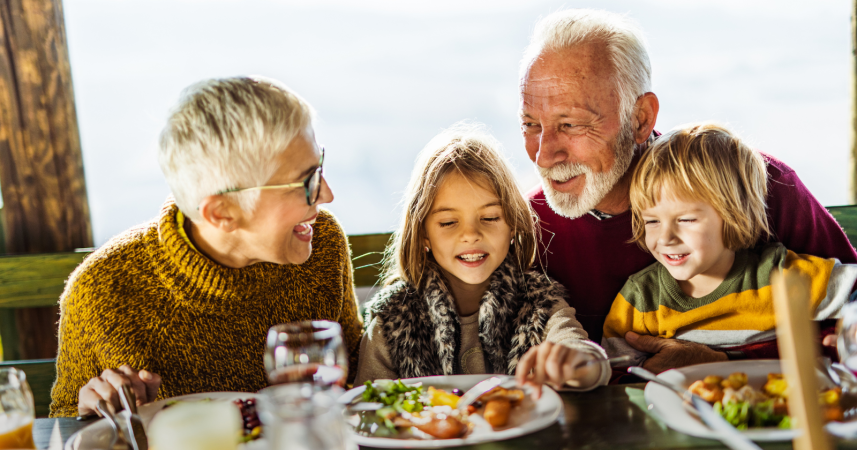
While they roll their eyes at cloth napkins and groan about the "phones in the basket" rule, there's a reason your millennial and Gen Z grandkids keep showing up for Sunday dinner—and it has nothing to do with the free food.

Add VegOut to your Google News feed. 
Last Sunday, I watched my granddaughter's boyfriend nervously adjust his napkin for the third time during dinner. He was trying so hard to follow what he clearly thought were our "formal" rules, while my granddaughter kept shooting him looks that said "just relax."
But here's what struck me: when I started telling the story about how her grandfather once drove three hours in a snowstorm just to bring me homemade soup when I had the flu, she stopped fidgeting with her phone. She leaned in.
And when I got to the part about him slipping on our front steps and landing face-first in the snow while still holding the soup container high above his head to save it, she laughed so hard she snorted.
These moments around the dinner table, these supposedly outdated boomer habits that make younger generations groan, create something they desperately need but would never ask for: a sense of belonging that extends beyond their Instagram stories.
1) Saying grace or having a moment of gratitude before eating
You know that awkward pause when everyone's seated and I ask them to join hands? The slight hesitation, the sideways glances, the barely suppressed sighs?
I see it all. But I also see what happens after. There's this collective exhale, this brief moment where everyone stops thinking about their notifications and deadlines and actually looks at each other. Whether it's a traditional prayer or just going around saying what we're grateful for, it creates a pocket of stillness in their chaotic lives.
My grandson once told a friend on speakerphone that our gratitude circle was "kind of cringe," but that same kid always makes sure to sit next to his little sister during it, squeezing her hand extra tight when she shares what she's thankful for.
2) Insisting everyone stays seated until everyone is finished
Remember when leaving the table before everyone was done eating was considered the height of rudeness? I still enforce this rule, much to the visible frustration of grandkids who've grown up eating in shifts, grabbing food between activities, treating meals like pit stops.
But something magical happens when they're "stuck" there. Conversations unfold that would never happen otherwise. Stories emerge. The grandson who usually communicates in grunts suddenly tells us about his history teacher who does impressions of historical figures.
The granddaughter who claims she "literally has nothing to talk about" ends up describing her friend's drama in vivid detail. They complain about this rule constantly, yet I've noticed they've started enforcing it themselves when friends come over.
3) Using the good dishes and setting the table properly
"Why can't we just use paper plates?" is a question I field at nearly every family gathering. The whole production of setting out the china, the proper silverware placement, the cloth napkins - it all seems so unnecessary to them.
But there's something about eating off real plates that signals: this matters. You matter. This time together matters enough to bring out the things we save for special occasions.
Last Thanksgiving, I overheard my college-aged granddaughter telling her roommate on FaceTime, "No, you don't understand, my grandmother has these plates that belonged to her grandmother.
Like, people have literally been eating Thanksgiving dinner off these exact plates for over a hundred years." There was pride in her voice, a connection to something bigger than herself.
4) Telling the same family stories over and over
How many times have they heard about their great-grandfather who built our first family home with his own hands? Or about the time their father tried to make breakfast in bed for me and nearly burned down the kitchen? Countless.
I watch them mouth the punchlines along with me sometimes, exchanging looks that say "here we go again." But these stories are their origin stories, their mythology.
They're learning who they come from, what stuff they're made of. Just last month, my granddaughter was struggling with a difficult decision about changing her major, and she suddenly said, "Well, Great-Grandpa started over at 40 when the factory closed, right? Started his whole business from nothing?"
She was drawing strength from a story she'd probably heard fifty times.
5) Making too much food and insisting everyone takes leftovers
The production of forcing Tupperware containers into already-full hands, insisting they need "just a little something" for the week ahead - I know they think it's excessive.
They joke about needing a separate car just for the food I send home. But those containers become midnight study snacks, they become the meal they share with a homesick roommate, they become the thing they eat when they're too broke or too tired to cook.
Food is love made tangible, and every container I press into their hands is me saying: I'm thinking about you even when you're not here.
6) Turning off the TV and banning phones during dinner
The collective panic when I announce "phones in the basket" is almost comical. You'd think I was asking them to hand over a vital organ. They argue about needing to be reachable, about important messages, about just quickly checking something. But once those devices are out of reach, something shifts.
They make eye contact. They actually respond to questions with more than monosyllables. They laugh at each other's jokes instead of just typing "lol." One evening, the power went out during a storm, and we ate by candlelight with no possibility of electronic distractions.
My teenage grandson later described it to his friend as "weirdly awesome," though he'd never admit that to me directly.
7) Lingering at the table after the meal is done
This might be the habit they find most puzzling - why stay seated when the eating is over? Why not immediately scatter to our separate corners? But this lingering, this gentle refusing to let the moment end, creates space for the conversations that matter.
It's during these extended sitting-around times that someone mentions they're worried about something, that someone shares good news they've been holding onto, that the silly jokes turn into deep laughter that makes your sides hurt.
It's civilization at its most basic - choosing to stay together a little longer even when there's no practical reason to do so.
Final thoughts
These dinner table rituals we boomers cling to aren't really about proper fork placement or clearing your plate.
They're about creating a space where time slows down, where the family becomes more than just people who share DNA or a Netflix password. Our grandkids might tease us, might exchange knowing looks when we bring out the cloth napkins, but they keep showing up.
They keep sitting down at our tables. And years from now, I have a feeling they'll find themselves setting the table just so, telling their own children to put their phones away, keeping everyone seated just a little bit longer.
Not because they have to, but because they finally understand what we've known all along: these moments matter, these rituals hold us together, and sometimes the most comforting things are the ones we're too cool to admit we need.
What’s Your Plant-Powered Archetype?
Ever wonder what your everyday habits say about your deeper purpose—and how they ripple out to impact the planet?
This 90-second quiz reveals the plant-powered role you’re here to play, and the tiny shift that makes it even more powerful.
12 fun questions. Instant results. Surprisingly accurate.