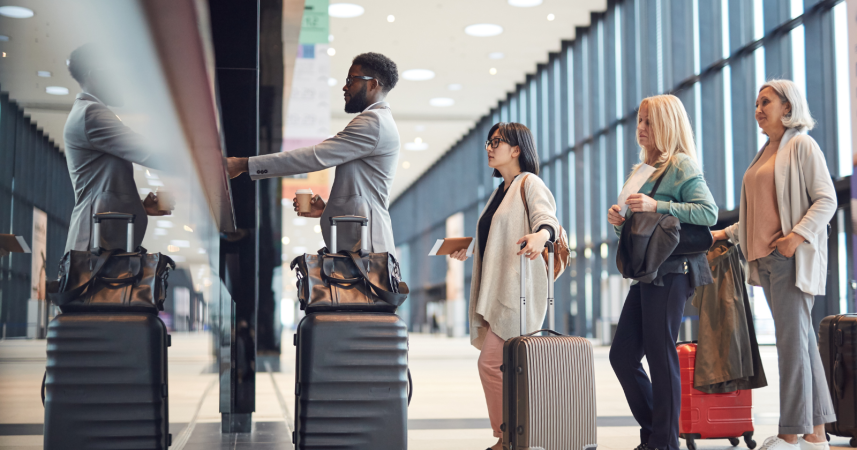
From printed boarding passes clutched like precious artifacts to overhead bin hovering that would make a helicopter pilot jealous, the generational divide at 30,000 feet reveals itself in seven surprisingly specific behaviors that have gate agents exchanging knowing glances and millennials documenting for TikTok.

Add VegOut to your Google News feed. 
The security line stretches ahead like a river of humanity, and there I am, watching a fellow traveler my age fumble with their boarding pass while simultaneously trying to manage a phone call, a coffee cup, and what appears to be every receipt they've collected since 1987. The TSA agent's smile grows increasingly strained.
Behind us, a twenty-something shifts their weight from foot to foot, their expression caught somewhere between amusement and exasperation.
I've been thinking a lot about generational differences lately, especially after my last few trips. As someone who spent decades teaching teenagers and now finds herself firmly in the boomer category, I've developed a unique perspective on how differently we all navigate the world.
And nowhere is this more apparent than at the airport, where stress levels run high and patience runs thin.
What fascinates me most is the disconnect between intention and impact. We boomers often think we're being helpful, prepared, or friendly, but the message that lands can be entirely different.
After several cross-country flights to visit my grandchildren this year, I've noticed some patterns that make me both cringe and chuckle in recognition.
1. The boarding pass archaeology expedition
We dig through our bags like we're searching for buried treasure, even though we had the boarding pass in our hands thirty seconds ago.
I watched a woman my age at the gate recently, and it was like witnessing myself in a mirror I didn't want to look into. She checked three different pockets, opened her purse twice, and finally found the pass tucked into the book she was reading.
Here's what we think we're communicating: "I'm organized and have everything right here somewhere."
What others see: someone who hasn't adapted to keeping essential items easily accessible in an age where efficiency is everything. The gate agent's practiced patience spoke volumes.
After that trip, I started using my phone's wallet feature, though I'll admit I still print a backup copy. Old habits and all that.
2. The overhead bin territory wars
There's something primal about the way we guard overhead bin space, isn't there? We arrive early, stake our claim, and then watch with eagle eyes as others approach "our" bin.
Last month, I caught myself actually standing up to supervise as someone placed their bag near mine, as if my presence would somehow protect my luggage from contamination.
We believe we're being responsible, ensuring our belongings are secure. But flight attendants see something else entirely: passengers who create bottlenecks and slow down boarding.
That young flight attendant who gently suggested I take my seat while she helped others with their bags? She wasn't being helpful so much as she was moving me along. The realization stung a little, if I'm honest.
3. The volume control mystery
Remember when phones were attached to walls and you had to speak up to be heard? That muscle memory hasn't left us. Whether we're talking to our seatmates or on a phone call at the gate, our volume tends to broadcast our conversations to everyone within a three-gate radius.
My moment of awareness came when I was telling my seatmate about my garden, how I maintain it every morning before the heat sets in. Harmless enough, right?
Except the person two rows ahead turned around with an expression that clearly said they hadn't signed up for my personal horticulture podcast. We think we're being friendly and sociable. What others hear is an involuntary invasion of their audio space in an already overwhelming environment.
4. The special request parade
"Could you check if there's a different meal option?" "Is there any way to change my seat to an aisle?" "Would it be possible to get an extra pillow?" We approach flight attendants with a litany of requests, often right in the middle of beverage service or safety demonstrations.
We genuinely believe we're just advocating for ourselves, exercising our right as paying customers. But flight attendants see passengers who haven't learned to use apps, online check-in, or advance seat selection. They see someone making their already demanding job harder.
I learned this the hard way when a flight attendant kindly but firmly told me that everything I was asking for could have been handled through the airline's app days before the flight.
5. The security checkpoint time warp
Despite all the signs, announcements, and years of post-9/11 travel, we still act surprised by security requirements. Belts, shoes, liquids, electronics, it's like we're hearing about these rules for the first time, every time.
We think we're being thorough and careful. What the TSA agents see is someone who hasn't internalized procedures that have been in place for two decades. After watching myself hold up the line while excavating my laptop from the depths of my bag, I finally invested in a TSA-friendly laptop case. Revolutionary, I know.
6. The gate-crowding phenomenon
When boarding group 3 is called, why do those of us in groups 5, 6, and 7 immediately stand up and hover near the gate like moths to a flame? This one puzzles even me, yet I find myself doing it too.
Perhaps we think we're being ready and attentive. But gate agents see a human wall that actually slows down the boarding process. Fellow passengers in earlier groups have to navigate through us like they're running a particularly passive-aggressive obstacle course.
After years of unconsciously contributing to this chaos, I now remain seated until my actual group is called. It feels almost rebellious.
7. The technology theater
We make a big show of trying to use airline apps and self-service kiosks, often abandoning them halfway through for human assistance. I once watched a man my age loudly narrate his entire struggle with a check-in kiosk to no one in particular, as if his commentary would somehow make the machine cooperate.
We think we're showing that we're trying to adapt, that we're not completely technology-averse. But airline staff see passengers who want credit for attempting digital solutions without actually committing to learning them. They see the theatrical struggle more than the genuine effort.
Final thoughts
These observations aren't meant to shame anyone, myself included. They're invitations to awareness. Each generation has its airport quirks, and younger travelers certainly aren't perfect either. But recognizing the gap between our intentions and our impact might help us travel more smoothly through both airports and life.
The truth is, adapting doesn't mean abandoning who we are. It means being mindful of how our habits affect others in shared spaces.
After my breast cancer scare years ago taught me to stop postponing joy, I also learned that joy includes making life a little easier for everyone around us, including overworked flight crews and fellow travelers just trying to get home.
What’s Your Plant-Powered Archetype?
Ever wonder what your everyday habits say about your deeper purpose—and how they ripple out to impact the planet?
This 90-second quiz reveals the plant-powered role you’re here to play, and the tiny shift that makes it even more powerful.
12 fun questions. Instant results. Surprisingly accurate.