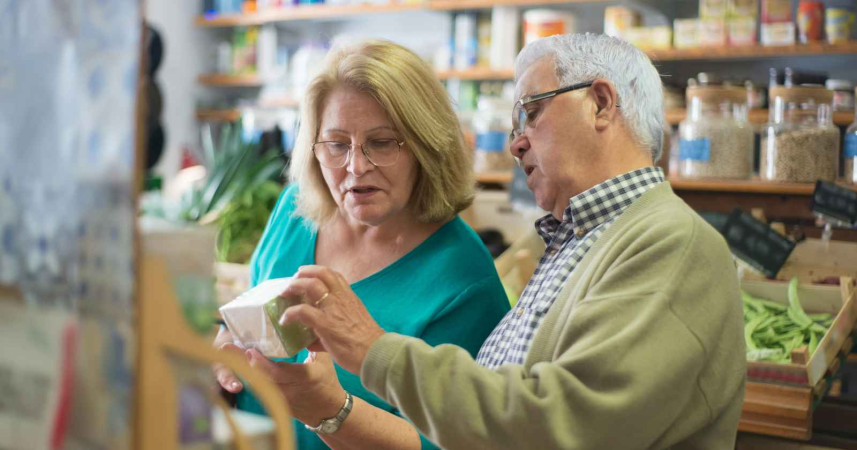
While younger shoppers tap impatiently behind them, these older customers aren't just being slow—they're the last practitioners of a sensory shopping ritual that connects us to thousands of years of human knowledge about food, from pressing avocados to chatting with butchers, that we've abandoned for algorithms and efficiency in just two decades.

Add VegOut to your Google News feed. 
The fluorescent lights hum overhead as I watch an older woman methodically work her way through the avocado display, her weathered fingers gently pressing each piece of fruit while a twenty-something with AirPods shifts impatiently behind her, phone in hand, grocery list glowing on an app.
The contrast strikes me every time I'm at the store: One generation touching, smelling, listening to their food; another trusting algorithms and convenience.
What looks like stubborn inefficiency might actually be the last remnant of a relationship with food that took thousands of years to develop and barely twenty to abandon.
1) They squeeze every single avocado in the pile
I used to roll my eyes at this too, until I realized what I was witnessing. These shoppers aren't being difficult when they press each avocado with practiced fingers.
They're applying knowledge passed down through generations about how to tell ripeness by touch, how different firmness serves different timeline needs. Tuesday's guacamole requires different fruit than Saturday's salad.
This tactical relationship with food, actually touching what you'll eat, seems foreign to those of us who trust strangers to pick our groceries through an app. But there's wisdom in those pressing fingers that no algorithm has yet replicated.
2) They chat with the butcher for 15 minutes about a roast
While the line grows behind them, they're discussing cooking times, asking about the source farm, requesting a specific thickness of cut.
I remember my own grandmother doing this, and now I understand: She remembered when butchers knew your family's preferences, when buying meat was a consultation, not a transaction.
Those questions about grain-feeding versus grass-feeding aren't small talk.
They're the remnants of when knowing your food's story mattered, when the person cutting your meat could tell you which pasture it came from. We've gained efficiency, but lost the oral tradition of cooking knowledge passed between butcher and cook.
3) They read every single ingredient on new products
That five-minute examination of a pasta sauce jar isn't confusion or poor eyesight. Watch closely and you'll see someone applying decades of knowledge about what real food contains.
They learned to cook when ingredients were simple: Tomatoes, basil, garlic, oil. Now they stand puzzled by maltodextrin and "natural flavors," remembering when food didn't need quotation marks.
Their scrutiny comes from an era when you knew what went into your body because you put it there yourself, ingredient by recognizable ingredient.
4) They smell the cantaloupe
Have you ever watched this ritual? Press the end, smell for sweetness, listen to the sound when tapped. My mother taught me this, though I rarely do it anymore, too self-conscious about looking old-fashioned.
But this sensory shopping, passed down through generations, means their nose knows ripeness better than any "best by" date.
It seems inefficient until you've thrown away three flavorless melons picked by appearance alone, realizing that maybe our ancestors knew something about food that can't be standardized or digitized.
5) They argue with the self-checkout machine
When they insist on human cashiers, it's not just technophobia or stubbornness. For them, buying food should involve human connection.
They remember when cashiers knew if your husband was sick by what you bought, when they'd mention sales on your regular items.
The efficiency of self-checkout strips away these micro-connections that made grocery shopping a community act, not just a chore to be optimized out of existence.
6) They buy ingredients, not meals
Their carts contain flour, butter, fresh vegetables, raw meat. Components, not products. They shop the perimeter of the store, avoiding center aisles filled with pre-made everything. Buying pre-chopped onions seems absurd when you own knives.
But this isn't judgment so much as bewilderment at paying triple for someone else to do work that takes two minutes, at choosing convenience over the meditative act of preparation.
They understand something we've forgotten: That the act of transforming ingredients into meals is where the love lives.
7) They know the names of checkout clerks
They call the cashier by name, ask about her daughter's college applications, remember she was sick last week. This isn't nosiness or time-wasting. It's the remnant of when stores were community spaces, when the same families shopped and worked there for generations.
These personal connections seem inefficient to those who view shopping as a task to minimize, not a thread in the fabric of community life.
But what if those few minutes of human connection are actually what kept neighborhoods feeling like neighborhoods?
8) They compare unit prices obsessively
That calculator or careful squinting at shelf tags? They're applying mathematics their parents taught them during leaner times. They know the larger size isn't always cheaper, that sales can be tricks, that unit pricing reveals truth.
This careful calculation comes from when every penny mattered, when feeding a family required strategic thinking that no app can replicate.
There's a kind of respect in this attention, an acknowledgment that food costs something and that cost deserves consideration.
9) They plan meals around sales
They build the week's menu from the circular, not from Pinterest. If beef is on sale, everyone's eating beef. If asparagus is cheap, everyone's getting asparagus.
This flexibility, cooking from what's available rather than shopping for specific recipes, represents a relationship with food based on seasonality and economy, not Instagram aesthetics.
It's a dance with availability that connects them to every generation before supermarkets made all foods available all the time.
10) They bring their own bags and remember when plastic was the "environmental" choice
Their collection of canvas bags isn't virtue signaling. They remember the shift from paper to plastic to save trees, then from plastic back to reusable.
They've lived through enough cycles to know that today's solution is tomorrow's problem.
Those worn bags carry the wisdom of someone who's learned that convenience always costs something, somewhere, to someone.
Final thoughts
These habits that slow us down and test our patience represent something profound we've lost: The understanding that food is relationship.
Relationship with the land, with the people who grow and sell it, with our own bodies and histories. When I see someone squeezing those avocados, they're not just checking ripeness.
They're participating in an ancient dance between human and food that no QR code can replicate.
Their slow, careful way through the store isn't obstruction; it's reverence for the act of feeding people you love. We've gained so much efficiency and convenience, but watching them shop, I wonder what we've traded for that speed, and whether the exchange was worth it.