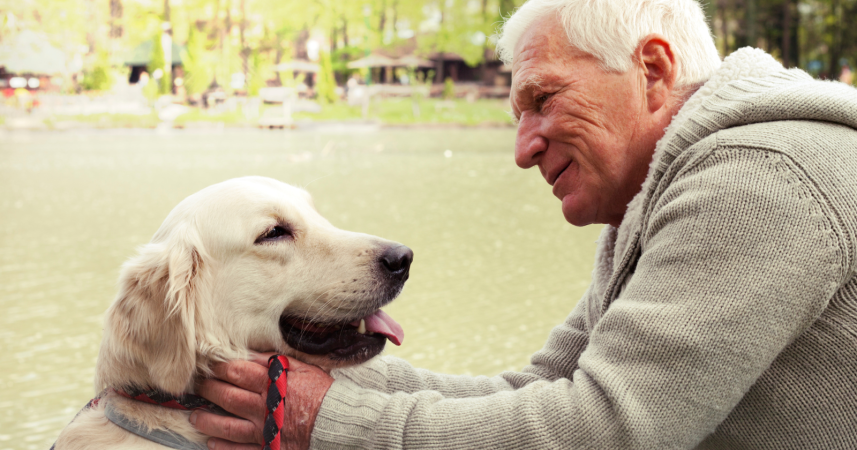
The psychology behind why your father sounds like a different person when he's talking to the dog

Add VegOut to your Google News feed. 
There's a guy in my cycling group who retired from corporate law about three years ago. Sharp mind. Polished. The kind of man who always had a firm handshake and a ready answer for everything.
Last Saturday, I watched him crouch down in a parking lot and talk to his golden retriever in a voice I've never heard him use with another human being. Soft. Unhurried. Almost tender.
His adult son called ten minutes later, and the voice changed completely. Measured. Careful. Like a man choosing every word from behind a desk that no longer exists.
I've been thinking about that contrast ever since. And the more I looked into it, the more I realized the explanation runs deeper than most of us expect.
1. The dog activates a caregiving system, not a performance system
When a retired man talks to his dog, his brain isn't running the same program it runs with his kids. Research published in the journal Science found that when dogs and humans gaze at each other, both experience a surge in oxytocin, the same hormone that bonds mothers to infants. The brain essentially treats the exchange like a parent-baby interaction.
With adult children, a completely different system kicks in. The brain is scanning for cues about whether it's needed, whether it's being judged, whether it should offer advice or stay quiet. The caregiving impulse is still there, but it's wrapped in decades of relational history, old missteps, and the lingering pressure to seem like you know what you're doing.
The dog just wants you to be present. The adult child, without meaning to, wants you to be competent.
2. Retirement strips the script he's been reading from for decades
For forty years, most men have a built-in answer to life's biggest question: who am I? The job handles it. The title. The role. The problem-solving.
Then retirement arrives and the script disappears. Research on retirement adjustment shows that losing the work role means losing a core source of identity, status, and that feeling of being useful. Men who tied their self-worth to professional competence often experience something close to grief when it's gone.
I spent 35 years in the restaurant business, and when I sold up, I had mornings where I'd stand in my kitchen not knowing what to do with my hands. Your dog doesn't know you used to run anything. Your dog just knows you're the person who shows up. For a man quietly mourning a version of himself that no longer exists, that simplicity can feel like relief.
3. His social world is shrinking, but nobody told him it would
Here's something that caught me off guard when I first read it. A longitudinal study found that men's emotional support networks shrink by roughly 50% between the ages of 30 and 90. Half the people you used to lean on, gone.
And here's the quiet part: most men don't replace those connections. After decades of activity-based friendships (golf, work, the pub), many realize those relationships had a built-in script. Remove the shared context, and two guys who talked every day for twenty years suddenly don't know what to say to each other.
Nobody prepared him for that gap. And a dog, without trying, fills part of it. Not as a substitute for human connection, but as the one relationship that never needed a script in the first place.
4. With adult children, every conversation carries invisible weight
I know something about this one from personal experience. For years after my divorce, conversations with my son carried a charge that neither of us could name. I was trying to prove I was still a good father. He was trying to figure out if I'd really changed. We loved each other, but every phone call had this invisible layer of performance underneath it.
That's the thing about parent-child relationships in adulthood. They're loaded with history. Old disappointments. Unspoken expectations. The times you weren't there. The times you tried too hard to make up for it.
A retired man talking to his adult child is often, on some level, still auditioning. Still trying to demonstrate that he was worth something. The dog never asked for that audition.
5. Dogs offer unconditional positive regard, and most men have never experienced it
Carl Rogers, the psychologist who pioneered client-centered therapy, believed that unconditional positive regard was essential for psychological health. It means being accepted without conditions, without needing to earn it.
Most men grow up in a world where love is conditional on performance. Be strong. Provide. Succeed. Don't fall apart. Even the people who love them most, partners and children, often relate to them through the lens of what they bring to the table.
A dog doesn't operate that way. A dog doesn't care about your bank account, your career trajectory, or the argument you had with your daughter last Thanksgiving. And for a man who has spent sixty-something years earning approval, the experience of receiving affection without a performance attached to it can be quietly profound.
6. The soft voice is the one that was always there, just buried
Here's what I think most people miss about the retired man and his dog.
That gentle, unguarded voice he uses? It was always there. Buried under decades of professional expectations, societal scripts about masculinity, and the silent pressure to always have it together.
The animal didn't create that softness. It just made it safe to use.
And that matters more than most people realize. When a man spends his whole life performing competence for the people around him, the act of dropping that performance, even for ten minutes on the couch with a warm body that expects nothing, is a kind of homecoming.
7. The real question isn't about the dog at all
If you've noticed this pattern in your father, your grandfather, or a man in your life who seems more emotionally open with the family pet than with you, the natural response might be to feel a little hurt.
But consider what the dog is actually revealing. Somewhere along the way, he learned that softness wasn't safe around people. That being gentle, unguarded, and emotionally present without a purpose or a point was something he could only risk with a creature who'd never judge him for it.
He doesn't love the dog more than he loves you. He just never had to earn the dog's respect. The question worth sitting with is whether we can make that kind of space for each other.
Final thoughts
I think about my cycling buddy in that parking lot sometimes. The way his whole posture changed when he knelt down to greet his dog. Shoulders dropped. Jaw unclenched. Thirty years of corporate armor, gone in a second.
And I think about all the retired men I know, including myself, who are quietly learning that the hardest part of this chapter isn't filling the time. It's figuring out who you are when nobody needs you to perform anymore. That's the real work of these years, and most of us weren't given a recipe for it.
If there's a man in your life who seems softer with the dog than with you, try not to take it personally. Try to see it for what it is: proof that the tenderness was always there. He just needs a few more people to make it safe enough to use.