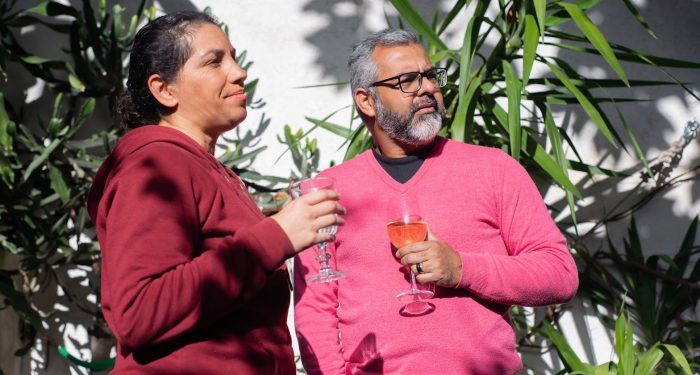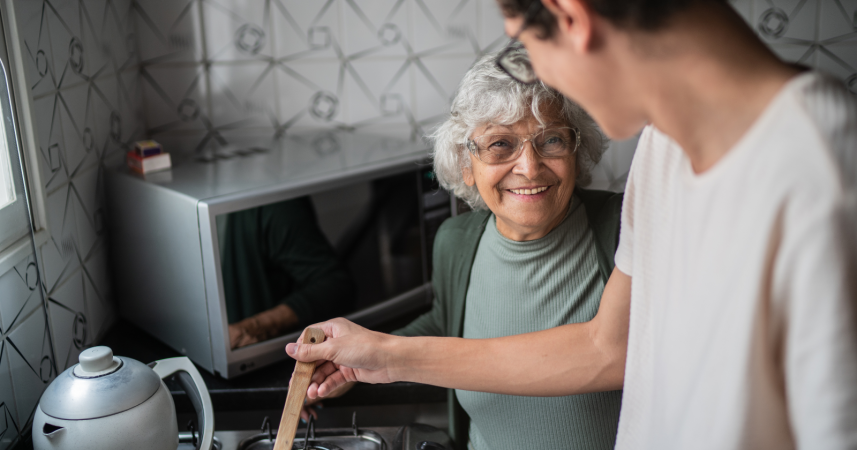
The psychology behind why your aging parent's portions keep growing, and what they're really asking for when they tell you to eat more.

Add VegOut to your Google News feed. 
Her kitchen is a conversation she doesn't know how to have any other way.
It hit me last Thanksgiving.
I was sitting at my parents' dining table, staring at a spread that could've fed a small neighborhood. Enchiladas, two kinds of rice, beans, a salad nobody asked for, and something new she'd been "experimenting with." There were four of us eating.
My mom kept circling back to the kitchen. Not to cook. Just to bring more. Another dish. Another side. A plate of sliced fruit "for later." And when I finally pushed back from the table, she looked at me with this expression I'd seen a hundred times before but never actually understood.
It wasn't disappointment about the food I hadn't finished. It was something else entirely.
The plate that says what words can't
I've been thinking about this a lot lately, and I'm pretty sure I'm not the only one.
There's a reason Psychology Today has explored how offering food functions as a core expression of love across cultures. Feeding someone goes way beyond hospitality. It's care made tangible. Effort you can taste.
An OnePoll survey of 2,000 Americans found that nearly two-thirds consider food their primary love language. Over half said they'd cooked or bought a meal specifically to say "I love you." That tracks.
But here's what nobody talks about. For aging parents, food carries a second purpose entirely. It's leverage against time. The one thing they can still do that makes you sit down, stay put, and be present in their house for a little longer.
The world gets smaller
When you're a kid, your parents' world feels enormous. They drive you places, make decisions, run the household. They're the center of gravity.
Then one day you realize their world has been quietly shrinking for years.
The National Institute on Aging has pointed out that as people get older, they often spend significantly more time alone than they did in earlier life, making them vulnerable to isolation, depression, and cognitive decline. Friends move away or pass on. Routines get smaller. The phone rings less.
Your parents might not tell you any of this. They might not even fully recognize it themselves. But their behavior shifts. The invitations get more frequent. The guilt about not visiting gets a little sharper. And the portions, without anyone discussing it, get bigger.
Because a bigger plate takes longer to eat. And longer to eat means longer at the table. And longer at the table means you're still here.
The identity question nobody prepares for
Psychologists call it role loss. When kids leave and careers wind down, parents often struggle with a version of the question we all dread: Who am I now? Research on the empty nest period shows that this transition can hit well-being hard, particularly for parents whose identity was closely tied to caregiving. The loss of that daily role creates a gap that's hard to fill with hobbies or social clubs.
Cooking fills that gap. Feeding you is the one parental act that still works exactly the way it always did. You're hungry (or she'll make you hungry). She provides. You eat. The transaction is complete. For a few hours, she's still your mom in the most fundamental, primal way possible.
Plenty of parents from that generation never went to therapy or read a self-help book. They don't have the vocabulary for attachment styles or love languages. But they have a kitchen and recipes they've been perfecting for decades. Those recipes are their entire emotional toolkit.
What we get wrong about the guilt trip
I used to get annoyed by it. The "you never visit" comments. The sighs when I said I had to leave early. The way she'd pack containers of food for me to take home like I was heading off to war instead of driving 45 minutes back to Venice Beach.
I thought it was manipulation. Or at least a kind of emotional clumsiness.
I was wrong.
What I was actually seeing was a woman whose primary method of connection was being slowly made irrelevant by the natural course of life. Her kids grew up. Her husband watches TV in the other room. And the one person she most wants to sit across from keeps checking his phone and talking about traffic.
That extra plate of food? Most of us read it as a guilt trip. But therapists would call it a bid for connection. A bid is any attempt to get attention, affection, or closeness from someone you care about. Sometimes bids are obvious. Sometimes they look like a second helping of enchiladas you didn't ask for.
The vegan complication
I should mention that going vegan eight years ago added a whole layer to this.
For my mom, cooking for her family was already her love language. When I took half her recipes off the table, she didn't hear "I've changed my diet." She heard "I don't want what you're offering." Which, in her emotional framework, translated to "I don't want your love."
It took years to untangle that. And honestly, I was part of the problem. I went through a phase where I was preachy about it, and there's nothing that shuts down a kitchen conversation faster than lecturing your mother about dairy while she's making her signature dish.
These days we've found a rhythm. She makes rice and beans (already vegan). She tries new vegetable dishes and asks for my opinion. She still slips cheese into things sometimes, and I've learned to just quietly set it aside rather than make a whole thing of it. The food matters less than the fact that she's still cooking for me. That's the part I almost missed.
The clock you can't ignore
Here's the thing I keep coming back to.
If you're in your forties and your parents are in their seventies, basic math tells you something uncomfortable. When you live in a different city and visit once a month, maybe twice, the remaining number of long, unhurried meals together is smaller than you think.
Say you visit twelve times a year and they have, optimistically, twenty good years left. That's 240 visits. Some will be holidays with twenty other people around. Some will be quick drop-ins. Some will be strained by whatever life throws at all of you.
Your parents might not be doing this math consciously. But something in them knows. Something in them has always known. That's why the portions keep growing.
Final thoughts
Last weekend I went over for dinner. No occasion. Just showed up.
My mom made enough food for eight people. I didn't say a word about it. I sat down, I ate slowly, and I asked her about the recipe. She lit up in a way that had nothing to do with cooking.
I think the hardest part of getting older is realizing your parents have been speaking to you in a language you didn't bother to learn. Something older than words. The language of a woman standing in her kitchen at 6 AM because her son is coming over and she wants everything to be ready. Not perfect. Ready. Because ready means she still has something to give. And giving is the only way she knows how to say the thing she actually wants to say.
So let her feed you. Stay for the second plate. Ask for the recipe even if you already know it. Because one day that kitchen will be quiet, and you'll wish you could hear her ask one more time if you wanted seconds.