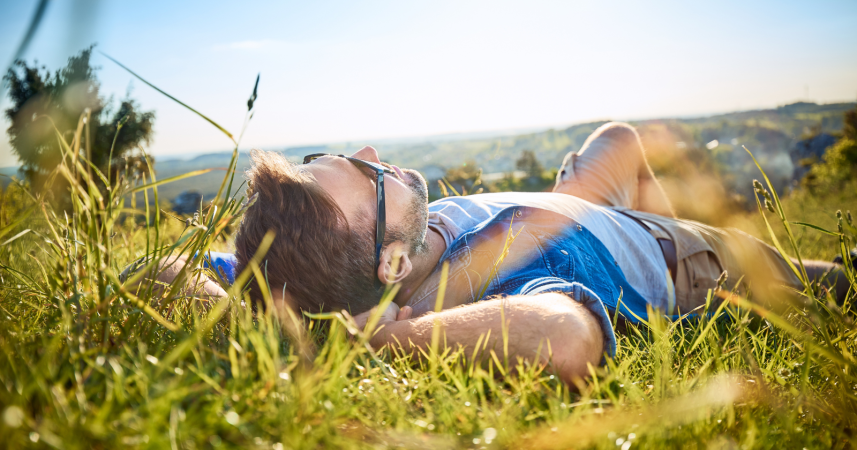
What happens when an internet insult becomes a medical prescription? A journey from 3 AM Reddit arguments to discovering why our brains desperately need what we've been avoiding.

Add VegOut to your Google News feed. 
Last winter, I found myself defending a minor plot point from a decade-old TV show to strangers on the internet at 3 AM. The debate had spiraled across platforms—Reddit to Discord to comment sections—each iteration more granular than the last. My apartment had become a command center of screens, each monitoring a different front of this utterly pointless debate.
"Touch grass," someone finally replied.
It stung because it was accurate. I hadn't been outside in three days. My world had compressed to the dimensions of my desk, punctuated only by the arrival of delivery drivers who I watched approach through my Ring camera to avoid actual human contact.
The phrase "touch grass" spread through gaming and online communities as a way to tell someone they'd lost perspective—that their online concerns had become so detached from reality they needed to literally reconnect with the physical world. It was an insult wrapped in advice, a Gen Z evolution of "get a life." But somewhere between its birth as a burn and its proliferation across the internet, something unexpected happened: scientists started proving it was actually good advice.
When my doctor prescribed what the internet prescribed
This past fall, my doctor did something I didn't expect during a routine check-up about my focus issues and chronic fatigue. She wrote on her prescription pad: "Nature exposure: 20 minutes, 3x weekly."
"This is evidence-based medicine now," she explained, pulling up studies on her tablet. "We're seeing better outcomes than with some pharmaceuticals."
I thought she was humoring me. She wasn't. A growing number of doctors have started prescribing nature exposure for everything from high blood pressure to anxiety disorders. The medical establishment had essentially validated an internet insult.
The research behind it is surprisingly robust. When neuroscientists at the University of Michigan studied how different environments affect cognitive function, they found that just looking at nature—not even being in it—improved working memory performance. The same restoration didn't occur when people looked at urban scenes.
But here's what really got my attention: the benefits showed up regardless of the weather, regardless of whether people enjoyed being outside, regardless of whether they considered themselves "nature people." It wasn't about becoming someone else. It was about giving your brain what it apparently needs.
Turns out, we're wired for this
We're living through the largest uncontrolled experiment in human history. For the first time, an entire species that evolved outdoors is living almost entirely inside. Our bodies, refined over millions of years to sync with natural light cycles and seasonal changes, are instead syncing with Netflix release schedules and Slack notifications.
This disconnect isn't just philosophical—it's biological. When researchers studied what happens to our brains when we view nature, they discovered something fascinating about the patterns we find in the natural world. Nature is full of what mathematicians call "statistical fractals"—patterns that repeat but never exactly. Think of how tree branches split: similar but never identical, ordered but never rigid.
Our brains process these patterns differently than the geometric repetition of built environments. Looking at natural fractals shifts our neural activity toward alpha waves—the same frequency associated with meditation and flow states. It's not that nature is mystically healing. It's that our brains evolved in natural environments, not concrete ones.
The Japanese have studied this more intensively than anyone. Their research into "forest bathing" revealed that trees release compounds called phytoncides—essentially airborne essential oils—that measurably boost human immune function. When they exposed human natural killer cells to these compounds in the lab, the cells became significantly more active. A three-day forest trip increased immune function for up to 30 days afterward.
This isn't alternative medicine. This is biochemistry—compounds from trees measurably affecting human immune cells, and we're the beneficiaries.
How I managed to fail at going outside
When I first attempted to follow my nature prescription, I made the mistake most type-A millennials would: I tried to optimize it. I downloaded apps. I researched the "best" nature spots. I scheduled it between meetings like another task to complete.
It didn't work. I'd stand in carefully selected green spaces, checking my watch, waiting to feel restored. Twenty minutes felt like an hour. I was outside but still trapped in my head, running through email responses and project deadlines while staring at objectively beautiful trees.
Then I stumbled across research that changed my approach entirely. A comprehensive study of nature interventions found something counterintuitive: the people who benefited most weren't necessarily those who spent more time in nature. They were the ones who paid attention to the nature already around them.
The study followed participants who were instructed to simply notice nature in their daily routines—the trees on their commute, the birds outside their window, the weeds growing through sidewalk cracks. Despite spending no additional time outdoors, these people showed significant improvements in well-being, connectedness, and life satisfaction. The control group, living the same lives in the same environments but without the instruction to notice, showed no change.
This wasn't about adding something to my life. It was about seeing what was already there.
What happened when I finally looked up
I began small. Instead of taking my coffee to my desk, I'd drink it by the window. Instead of scrolling during my walk to the subway, I'd count how many different shades of green I could spot. I started recognizing the regulars: the mourning doves that roosted on my fire escape, the ginkgo tree that turned impossibly yellow each fall, the hardy weeds that somehow thrived in the narrow strip between building and sidewalk.
The changes were subtle at first. I'd catch myself pausing mid-scroll to watch a bird do something ridiculous. I'd take the slightly longer route home because it passed a garden. My phone's screen-time reports showed a gradual decline—not from any conscious effort to use it less, but because I'd found something else that held my attention.
Three months in, the effects were measurable. My sleep improved—not dramatically, but consistently. The 3 PM attention crash that had plagued me for years softened. Most unexpectedly, I became better able to handle the very online stressors that had driven me indoors in the first place. Internet arguments seemed less urgent when I knew the mourning doves would be there regardless of who won.
The prescription is not a cure-all
I want to be clear: going outside didn't fix everything. It didn't cure my ADHD or eliminate work stress or make social media less toxic. Nature isn't a replacement for therapy, medication, or structural changes to how we live and work.
But it did something I didn't expect. It gave me a relationship with the physical world that existed outside the anxiety-achievement cycle that defined most of my waking hours. The mourning doves didn't care about my deadline. The ginkgo tree wasn't impressed by my follower count. The weeds growing through concrete didn't know or care that I existed, and somehow that was exactly what I needed.
"Touch grass" started as a way to tell someone they'd lost the plot. But maybe we've all lost the plot a little. Maybe the extremely online generation accidentally created the perfect meme for our moment—a three-word reminder that we're animals who need air and light and living things around us, even if we work in Python and communicate in emoji.
The science keeps accumulating, study after study confirming what our bodies have been trying to tell us: we need this. Not as a luxury, not as a productivity hack, but as a basic requirement for functioning in an increasingly abstract world.
So yes, touch grass. But more than that, notice it. Learn its moods and seasons. Find out what grows in the cracks of your particular corner of the world. Not because it will make you a better person or a more efficient worker, but because you're a human animal who evolved to pay attention to living things, and that machinery doesn't turn off just because you work remote.
The internet was right, even if it didn't mean to be. Sometimes the most sophisticated response to modern problems is also the simplest: go outside and actually see it. The grass will be there, doing its photosynthesis, completely indifferent to your problems. And that indifference, it turns out, might be exactly what we need.
If You Were a Healing Herb, Which Would You Be?
Each herb holds a unique kind of magic — soothing, awakening, grounding, or clarifying.
This 9-question quiz reveals the healing plant that mirrors your energy right now and what it says about your natural rhythm.
✨ Instant results. Deeply insightful.

Jordan Cooper
Jordan Cooper is a pop-culture writer and vegan-snack reviewer with roots in music blogging. Known for approachable, insightful prose, Jordan connects modern trends—from K-pop choreography to kombucha fermentation—with thoughtful food commentary. In his downtime, he enjoys photography, experimenting with fermentation recipes, and discovering new indie music playlists.
More Articles by Jordan