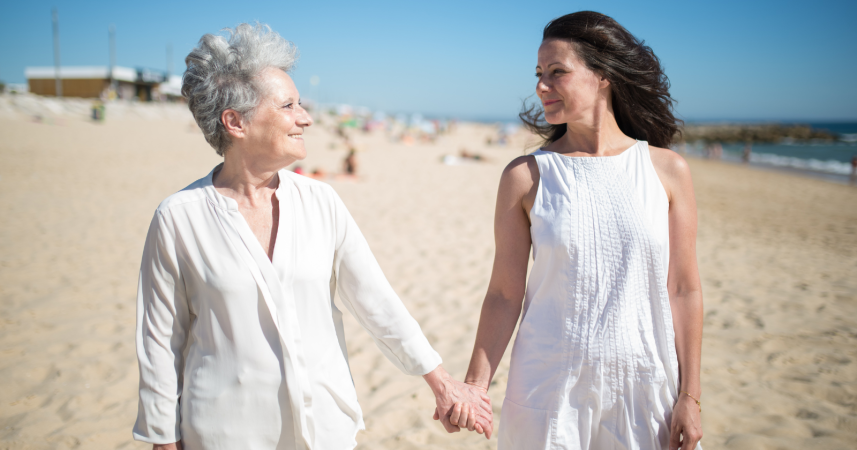
Despite spending decades together, most of us know shockingly little about the women who raised us—but if you can answer these questions instantly, you shared a connection that transcended the typical mother-child relationship.

Add VegOut to your Google News feed. 
The other evening, I found myself sitting cross-legged on my bedroom floor, surrounded by boxes of old photographs and letters. I'd been searching for a particular recipe card my mother had written decades ago, her careful cursive detailing how to make her famous lemon squares. As I sorted through the memories, I realized something that stopped me cold: I could still hear her voice, clear as day, telling me exactly how much lemon zest to add. "Not too much, dear, or it'll overpower the sweetness."
That moment made me wonder about the invisible threads that connect us to our mothers, long after they're gone. How well do we really know the women who raised us? And more importantly, what does that knowledge say about the relationship we shared?
I've been thinking about this a lot lately, especially after conversations with friends who struggle to recall basic details about their mothers' lives. It struck me that the depth of our knowledge often reflects the depth of our connection. So I've compiled eight questions that, if you can answer without hesitation, might reveal you shared something more precious than you realized.
1. What was her favorite song, and why did it matter to her?
Music has this remarkable ability to unlock the soul, doesn't it? If you know your mother's favorite song, you probably also know the story behind it. Maybe it was playing when she met your father, or perhaps it reminded her of her own childhood. My mother loved "Moon River" because she said it made her feel like anything was possible, even when she was just a young seamstress with big dreams.
Knowing this detail means she trusted you with a piece of her inner world. She didn't just play music around you; she shared what it meant to her heart.
2. What smell reminded her most of her childhood?
Scent memories run deeper than almost any other kind. They bypass our logical brain and go straight to our emotions. If your mother ever stopped mid-task to tell you about the lilacs that grew outside her bedroom window as a child, or how her grandmother's kitchen always smelled of cinnamon and yeast, she was inviting you into her earliest, most formative experiences.
This kind of sharing doesn't happen in casual conversation. It emerges in quiet moments of trust, when defenses are down and hearts are open.
3. What was her biggest fear about getting older?
Here's where things get vulnerable. Most people keep their deepest fears locked away, even from family. But if you know what kept your mother awake at night about aging, whether it was becoming irrelevant, losing her independence, or forgetting the faces she loved, then she saw you as someone safe enough to hold her worries.
I remember my mother confiding that she feared her hands would stop working well enough to sew. For someone whose creativity flowed through her fingertips, that vulnerability was profound.
4. Who was her best friend before she became a mother?
We often forget that our mothers had entire lives before us. Rich, full lives with friendships that shaped who they became. If you know about her college roommate who convinced her to take that art class, or her childhood friend who moved away but still wrote letters every Christmas, you understand that she wanted you to see her as a complete person, not just in her role as your mother.
5. What did she want to be when she was young, before life redirected her path?
Dreams tell us so much about a person's inner landscape. Maybe your mother wanted to be a dancer, a scientist, or a traveler. Perhaps she achieved those dreams in modified form, or maybe she set them aside for other priorities. Either way, if she shared these early aspirations with you, she was showing you the girl she once was, full of possibility and hope.
My mother once told me she'd wanted to design wedding dresses for movie stars. Instead, she hemmed pants and took in waists for our neighbors. But she never spoke of it with bitterness, only with a kind of gentle acceptance that taught me more about grace than any sermon could.
6. What was her mother like, in her own words?
The relationship between your mother and grandmother creates ripples that extend through generations. If you know how your mother truly felt about her own mother, the complicated mix of love, frustration, admiration, and sometimes disappointment, then you've been trusted with family truths that many never hear.
Understanding this relationship helps you understand your mother's parenting choices, her triggers, and her tender spots. It's like being given a map to her emotional terrain.
7. What was the hardest decision she ever had to make?
Life presents us all with crossroads moments. If your mother shared hers with you, whether it was choosing between career and family, deciding to leave a relationship, or making a difficult medical decision, she was acknowledging you as someone mature enough to understand that life isn't always clear-cut.
These stories often come with lessons attached, subtle teachings about values, sacrifice, and what really matters when everything is on the line.
8. What made her feel most alive?
This might be the most telling question of all. What lit her up from the inside? Was it dancing in the kitchen while cooking dinner? Reading poetry by candlelight? Growing tomatoes in her garden? If you can answer this without thinking, you didn't just observe your mother; you truly saw her.
Knowing what brought her joy means you paid attention to her as a person, not just as someone who took care of your needs. It means you noticed when her eyes sparkled and her shoulders relaxed.
Final thoughts
If you found yourself answering these questions easily, treasure that knowledge. It represents countless hours of real conversation, of presence, of mutual trust and respect. Not everyone gets this gift.
And if you struggled with some of these questions, there's no shame in that either. Relationships are complex, and sometimes circumstances, personality differences, or simple timing prevent these deeper connections. But if your mother is still with you, perhaps these questions might open new conversations. After all, it's never too late to truly know someone we love.