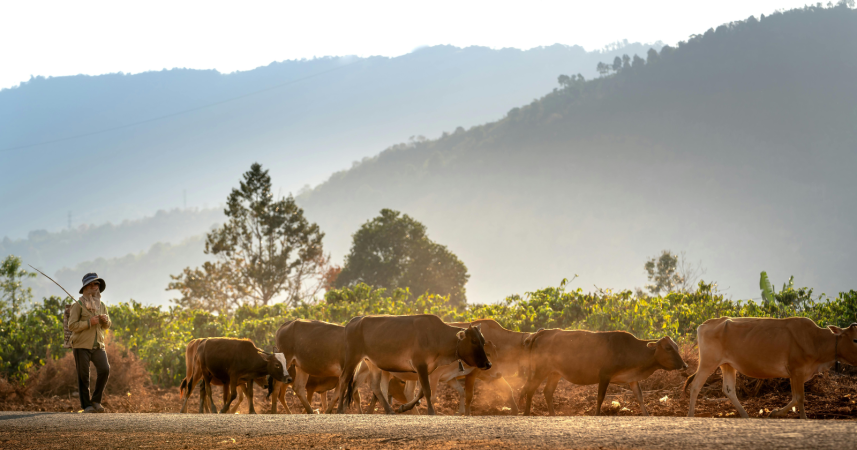
The burger on your plate might be connected to a forest that no longer exists, and the science behind that link is both fascinating and urgent.
Here's something that messed with my head when I first learned about it.
Every minute, the world loses forest area roughly equivalent to 40 football fields. And a massive chunk of that destruction traces back to one industry: animal agriculture.
We're not talking about some abstract environmental problem happening somewhere far away.
This is a global system where consumer choices in Los Angeles or London directly shape what happens to rainforests in Brazil or Indonesia.
The connection between your grocery cart and distant ecosystems isn't obvious. That's partly by design and partly because supply chains are genuinely complicated.
But once you see how the pieces fit together, it's hard to unsee.
So let's break down exactly how raising animals for food has become one of the primary engines of deforestation worldwide.
The Amazon's biggest threat isn't what you think
When people picture Amazon destruction, they often imagine illegal loggers or mining operations. Those are real problems.
But research from the UN Food and Agriculture Organization shows that agricultural expansion drives nearly 90 percent of global deforestation.
And within that category, cattle ranching dominates.
In Brazil specifically, cattle pasture accounts for roughly 80 percent of deforested Amazon land. That's not a typo.
Four out of every five acres cleared in the world's largest rainforest become grazing land for cows. The economics are straightforward if depressing.
Land is cheap after you clear it, beef prices are high, and enforcement of environmental laws remains inconsistent.
The scale is staggering. Brazil's cattle herd exceeds 200 million animals. That's nearly one cow for every person in the country, and those animals need space.
Soybeans: the hidden driver
You might think soybeans are a vegan thing. Tofu, tempeh, edamame.
But here's the twist: approximately 77 percent of global soy production goes to animal feed. Only about 7 percent gets eaten directly by humans. The rest becomes oil and other products.
This matters because soy cultivation has exploded across South America. The Cerrado, a vast Brazilian savanna with incredible biodiversity, has lost nearly half its native vegetation.
Much of that cleared land grows soybeans destined for chicken farms in Europe or pig operations in China.
The World Wildlife Fund identifies soy as one of the primary commodities driving habitat destruction globally.
So when someone argues that vegans are responsible for soy-related deforestation, the numbers tell a different story.
The overwhelming majority of that crop feeds livestock, not people eating plant-based diets.
Palm oil and the livestock connection
Palm oil gets plenty of attention for its role in destroying Indonesian and Malaysian rainforests.
Orangutan habitat disappearing for snack food ingredients makes for compelling imagery. But animal agriculture plays a role here too.
Palm kernel meal, a byproduct of palm oil extraction, has become a common livestock feed ingredient.
The dairy industry in particular uses significant quantities. As demand for cheap animal feed grows, so does pressure on tropical forests.
It's another example of how the system connects in ways that aren't immediately visible.
The interconnected nature of these supply chains means that focusing on any single commodity misses the bigger picture.
Animal agriculture creates demand across multiple deforestation-linked products simultaneously.
Why this keeps happening
Behavioral science offers some insight into why deforestation continues despite widespread awareness.
The psychological distance between consumer and consequence is enormous.
When you buy a package of ground beef, nothing about that experience connects you to a cleared forest thousands of miles away.
There's also the tragedy of the commons at work. Individual ranchers or farmers make economically rational decisions that collectively produce irrational outcomes.
No single actor feels responsible for the systemic result.
A comprehensive study published in Science found that animal products provide just 18 percent of global calories while using 83 percent of farmland.
That inefficiency is the core issue. We're using massive amounts of land to produce relatively small amounts of food. And when existing land isn't enough, forests pay the price.
What shifting demand actually changes
Here's where individual choices connect to systemic outcomes. When consumer demand for animal products drops in major markets, it affects the economics that drive deforestation.
European retailers demanding deforestation-free supply chains have already changed some industry practices.
Plant-based alternatives require dramatically less land. Growing crops for direct human consumption instead of cycling them through animals first is simply more efficient.
If global diets shifted significantly toward plants, we could actually restore forests rather than destroy them.
This isn't about perfection or purity. It's about understanding that our food system is a choice, not an inevitability.
The current arrangement destroys forests because we've built demand for products that require it.
Final thoughts
I started looking into this stuff years ago because I wanted to understand the actual impact of food choices.
Not the marketing claims or the tribal arguments, but the measurable reality.
What I found was a global system where eating patterns in wealthy countries directly shape landscapes on other continents.
Forests aren't just pretty. They're carbon sinks, biodiversity reserves, and climate regulators.
Losing them accelerates every environmental problem we're already facing. And animal agriculture remains the primary driver of that loss.
The good news is that this connection works both ways. The same supply chains that transmit destruction can transmit change.
Every meal is a small vote for the kind of food system we want. Enough small votes add up to shifted demand, changed economics, and eventually, forests that get to keep standing.
That's not naive optimism. That's just how markets work.