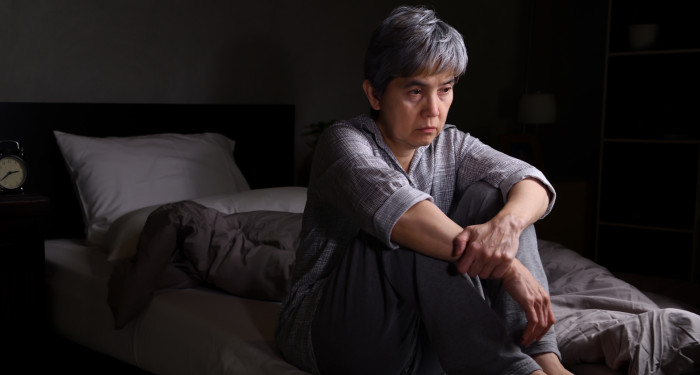
The emotional playbook they inherited looked like toughness. Decades of research suggests it was something far more costly.

Add VegOut to your Google News feed. 
There's a phrase I hear every Thanksgiving without fail.
My dad asks my grandmother how she's doing. She says, "Oh, I'm fine, honey." Then she changes the subject. She's been "fine" through a hip replacement, a flooded kitchen, and the loss of two close friends in one year. Always fine.
For the longest time, I thought that was what strength looked like. Turns out, behavioral science has a very different word for it.
The script nobody questioned
If you grew up watching your parents or grandparents hold it together no matter what, you probably absorbed a particular belief: emotions are a private inconvenience, best handled quietly and alone.
This wasn't accidental. The generation that came of age in the post-war decades inherited a very specific emotional playbook. Complaining was weakness. Crying was indulgent. The correct response to hardship was some version of "could be worse" followed by getting back to work.
Psychologist James Gross at Stanford calls this expressive suppression, the deliberate inhibiting of outward emotional expression. His research consistently shows that people who habitually suppress don't just hide what they feel. They experience less positive emotion, more negative emotion internally, and worse interpersonal functioning across the board.
The poker face comes at a cost. And an entire generation was trained to wear it from childhood.
When coping becomes identity
Here's what makes generational suppression so tricky to untangle. When you've been doing something your entire life, it stops feeling like a strategy and starts feeling like who you are.
Ask someone in their seventies why they don't talk about their struggles. Most won't say "because I was taught to suppress my emotions." They'll say "that's just how I am." The coping mechanism has been internalized so completely that it looks indistinguishable from personality. And their children often reinforce it, calling stoic parents "strong" and marveling at how they "never complain," not realizing we're celebrating a wound and calling it a trophy.
Research published in the journal Psychophysiology found that habitual emotional suppression is linked to increased cortisol reactivity during stress, elevated blood pressure, and heightened cardiovascular risk. The body keeps processing what the mouth refuses to say. All while the person insists they're "perfectly fine, don't worry about me."
The invisible curriculum
What gets less attention is how this emotional style gets passed down. Not through any deliberate lesson, but through thousands of small, everyday interactions.
A child scrapes their knee and hears, "You're okay, get up." A teenager loses a friendship and hears, "You'll get over it." A young adult mentions feeling anxious and hears, "What do you have to be anxious about?" Each response, delivered with genuine love, teaches the same thing: your feelings are an overreaction, and the correct move is to minimize them.
Researchers call this parental invalidation of emotions. Studies have found it serves as a direct pathway through which emotion dysregulation gets transmitted from one generation to the next. The cycle doesn't require cruelty. It just requires a household where nobody ever learned a different way.
The "it could be worse" trap
Of all the phrases in the generational suppression toolkit, "it could be worse" might be the most damaging precisely because it sounds so reasonable.
On the surface, the phrase offers perspective, a reminder that suffering exists on a spectrum and yours isn't at the worst end. But used habitually, especially with children, it trains people to rank their own pain against imagined others and conclude that their feelings don't qualify for attention.
This creates adults who genuinely cannot identify what they feel because they've spent a lifetime telling themselves it doesn't count. They sit in a therapist's office at fifty-five and say, "I don't even know why I'm here. Other people have it so much worse." Meanwhile they haven't slept properly in a decade.
The phrase was a survival tool for times when emotional support simply wasn't available. But survival tools used past their expiration date become something else entirely.
What therapists are now recognizing
There's a growing awareness in clinical psychology that what looks like resilience in older generations often meets the criteria for chronic emotional avoidance.
True resilience, as behavioral scientists define it, involves the ability to experience difficult emotions, process them, and adapt. It requires flexibility. The person can feel the pain, sit with it, and eventually integrate the experience into a broader understanding of their life.
What many older adults demonstrate instead is rigidity. Emotions get locked away rather than processed. Pain gets denied rather than integrated. And the "bouncing back" everyone admires is often a refusal to acknowledge that anything happened in the first place.
A systematic review on resilience found that trait emotion suppression does not actually confer it. People who suppress don't cope better. They just appear to, because the damage accumulates where nobody can see it.
The generational disconnect
This is where things get complicated for families.
Younger generations have grown up with a radically different emotional vocabulary. They talk about boundaries, triggers, nervous system regulation. They go to therapy. They name their feelings with a specificity that would make their grandparents deeply uncomfortable.
When these two frameworks collide at the dinner table, misunderstanding follows fast. The older generation hears their children talk about anxiety and thinks, "We survived so much worse and never complained." The younger generation watches their parents deflect every emotional question and thinks, "Why won't they just be honest?"
Neither side is wrong, exactly. But they're operating from entirely different emotional operating systems. One was built around the idea that feelings are dangerous and should be contained. The other around the idea that feelings are information and should be explored. Getting those two systems to communicate takes patience that neither side was taught to have.
The body doesn't lie
I think about my grandmother and her perpetual "fine." She's not lying. She genuinely believes she is fine, because she's spent seventy-plus years defining fine as "not actively falling apart in public." Her threshold for acknowledging struggle is so astronomically high that anything below a full crisis simply doesn't register as a problem.
But her body tells a different story. The chronic tension in her shoulders. The insomnia she's had since her forties. The way she startles at loud noises and immediately pretends she didn't. These are the physical signatures of emotions that had nowhere to go.
Research consistently shows that suppressed emotions don't disappear. They get rerouted into the body's stress response systems, showing up as muscle tension, digestive issues, chronic pain, and cardiovascular strain. The generation that prided itself on never burdening anyone with their feelings has been burdening their own bodies instead.
Final thoughts
I don't think my grandmother's generation was weak. I think they were dealt a hand that required extraordinary endurance, and they played it the only way they knew how. The problem is that endurance got confused with emotional health, and a survival strategy got handed down as a value system.
The most useful thing we can do isn't to judge them for it. It's to recognize the pattern clearly enough that we don't unconsciously repeat it. To notice when we're about to say "I'm fine" when we're not. To catch ourselves ranking our pain against someone else's and deciding ours doesn't count.
The generation that taught us to push through was doing its best with what it had. We honor that by learning what they couldn't: that feeling the pain is not the opposite of being strong. It might actually be the whole point.
What’s Your Plant-Powered Archetype?
Ever wonder what your everyday habits say about your deeper purpose—and how they ripple out to impact the planet?
This 90-second quiz reveals the plant-powered role you’re here to play, and the tiny shift that makes it even more powerful.
12 fun questions. Instant results. Surprisingly accurate.