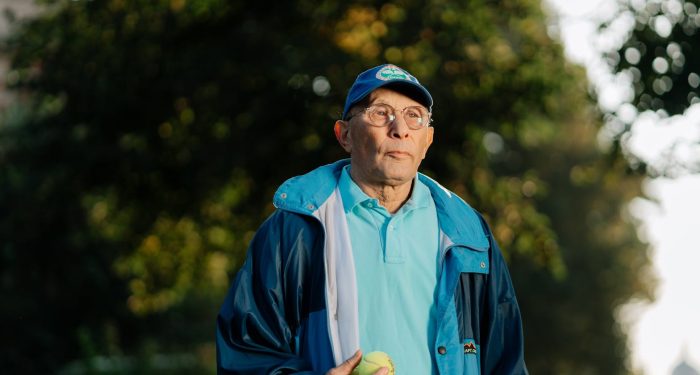
For decades, these men have performed the same exhausting magic trick—transforming joy into jaw clenches, grief into garage projects, and love into twenty-dollar bills slipped to grandchildren with instructions not to tell.

Add VegOut to your Google News feed. 
Picture a 62-year-old man at his granddaughter's birthday party. The cake comes out, and something wells up in his chest. Instead of letting that feeling bloom into tears of joy, he excuses himself to check on the parking situation. By the time he returns, jaw tight and eyes carefully dry, the moment has passed. Another feeling successfully dodged, another memory half-lived.
I've watched this scene play out a hundred different ways. The man who storms out of his retirement party because someone gave a heartfelt speech. The grandfather who responds to his wife's cancer diagnosis by obsessively researching lawn mowers online. The father who hasn't hugged his adult son in twenty years but will drive three hours to help him move a couch.
These aren't cold men. They're men who learned early that the entire spectrum of human emotion had to be compressed into two acceptable outlets: silence or anger. Everything else was trained out of them before they turned ten.
He physically leaves the room when conversations turn emotional
Watch him at family gatherings. The moment someone starts crying, whether from joy or sadness, he finds urgent business elsewhere. The garage suddenly needs organizing. The car requires checking. The recycling must go out immediately, even though pickup isn't until Thursday.
It's not rudeness; it's panic dressed as purpose. After decades of having only two acceptable emotional outlets, he's developed an entire choreography of exits. He'll mutter something about "letting you all talk" as if emotion is a foreign language he was never taught to speak.
During my restaurant years, I watched older male customers literally flee their tables when their wives started crying over good news or bad. They'd suddenly need the restroom, need to make a phone call, need to check the meter. Anything but sit with feeling.
We grew up in houses where our fathers disappeared the moment our mothers' voices cracked with emotion. We learned that real men don't engage with tears. They find something useful to do with their hands instead. The garage, the basement, the backyard became our emotional bomb shelters.
His jaw clenches when he should be crying
You can see it at funerals, hospitals, anywhere grief lives. That telltale muscle working overtime in his cheek, teeth grinding behind closed lips, the physical effort of converting sorrow into something more acceptable. He's turned his face into a dam, holding back decades of unshed tears.
He might clear his throat repeatedly, cough unnecessarily, anything to explain why his voice sounds strange. He's learned that tears are weakness but anger is strength, so every sadness gets rerouted through fury's circuitry. Ask him how he feels about losing a friend and he'll tell you about the incompetent doctors, the broken healthcare system, the unfairness of it all. Anger being the only vocabulary he has for pain.
I spent years perfecting this particular magic trick myself. Transform grief into rage, sadness into irritation, fear into aggression. It works, sort of, the way covering a broken window with cardboard works. It keeps the rain out but not the cold.
He has exactly three responses to any emotional situation
His emotional range runs from silence to rage with no stops in between. Ask how his day was: "Fine." Tell him his adult child is struggling: "They'll figure it out." Push for more, for actual feeling, and watch him detonate over something completely unrelated. Suddenly it's about the dishes in the sink or the neighbor's dog barking.
This isn't stubbornness; it's linguistic poverty. He literally doesn't have words for the spectrum between "fine" and "furious." Nobody taught him to say "I'm disappointed" or "That hurt my feelings" or "I'm scared." Those phrases were trained out of him by age ten, replaced with shoulder shrugs and slammed doors.
Now trying to learn emotional vocabulary feels like learning Mandarin. Possible, but exhausting, foreign, almost shameful. So he sticks with what he knows: silence until the pressure builds, then explosion, then back to silence. Rinse, repeat, die without ever saying what he meant.
He has mysterious physical ailments during emotional times
His back goes out the week of his retirement. He gets debilitating headaches during family conflicts. His stomach acts up whenever relationship tensions rise. Every feeling he couldn't express got stored in muscle and bone, accumulated interest on emotional debt he never learned to pay.
The doctor finds nothing wrong, recommends stress management, maybe therapy. He scoffs. Stress? He's handled real stress. Built businesses, survived divorces, raised children. What he can't admit is that feeling stress and processing emotion are different skills entirely. One he mastered through gritted teeth; the other he never learned at all.
So his body speaks what his mouth cannot. I'm overwhelmed becomes sciatica. I'm sad becomes insomnia. I'm afraid becomes that persistent cough that arrives with family holidays. The body always keeps the score, and his has been tallying for sixty years.
He has exactly one real friend, maybe
If he's lucky, there's one guy, usually from decades ago, who knew him before all his armor calcified. They don't talk about feelings exactly, but they talk around them. They mention divorces while discussing sports. They acknowledge health fears through jokes about getting old.
But ask him about making new friends, real friends, and watch him struggle. How do you build intimacy when vulnerability feels like stepping into traffic? He might have golf buddies or guys from the gym, but they talk about weather and politics and nothing that matters. He's desperately lonely but calling it loneliness would require admitting need.
The loneliest men I knew in the restaurant were the regulars who came in alone, sat at the same spot, ordered the same meal, and never really talked to anyone beyond pleasantries. Surrounded by people but absolutely isolated, protected by invisible walls they'd spent a lifetime building.
He shows love through projects, criticism, or money
His "I love you" sounds like "I noticed your tire pressure was low, so I filled them." His concern manifests as criticism: "You should really change your oil more often." His affection arrives as checks, gift cards, paid bills. Love converted into currency because money is safer than feeling.
Watch him with grandchildren. He wants to connect but doesn't know how, so he builds them shelves, fixes their bikes, slips them twenty-dollar bills with gruff instructions not to tell their parents. He sits at the edge of their play, desperately wanting to join but not knowing how to enter that emotional space.
He grew up believing that provision was love's only legitimate expression. Now his family has everything they need except him. His actual presence, his actual feelings, his actual heart. He's there but not there, present but absent, loving but unable to say so in any language but labor and cash.
Final words
These men aren't broken; they're products of their programming. They did exactly what they were taught: endure, provide, protect, never burden anyone with something as selfish as feelings. They converted a full spectrum of human emotion into a binary code because that's what survival looked like in their generation.
Some of us eventually crack open, usually when life forces the issue through divorce, death, or diagnosis. The work of learning to feel at 56 is like learning to walk again, clumsy and embarrassing but necessary.
The alternative is dying with your jaw clenched, surrounded by people who loved you but never knew you, because you never learned how to tell them who you were. That's a tragedy worth preventing, even if prevention means starting today, starting scared, starting with just one feeling you've never named before.
If You Were a Healing Herb, Which Would You Be?
Each herb holds a unique kind of magic — soothing, awakening, grounding, or clarifying.
This 9-question quiz reveals the healing plant that mirrors your energy right now and what it says about your natural rhythm.
✨ Instant results. Deeply insightful.

Gerry Marcos
Gerry spent 35 years in the restaurant business before trading the kitchen for the keyboard. Now 62, he writes about relationships, personal growth, and what happens when you finally stop long enough to figure out who you are without the apron. He lives in Ontario with his wife Linda, a backyard full of hot peppers, and a vinyl collection that’s getting out of hand.
More Articles by Gerry