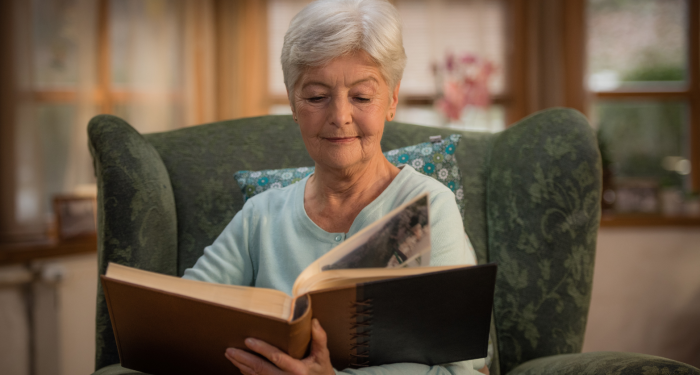
She had perfected the art of holding everyone else together while quietly falling apart in bathroom stalls and parked cars — a performance forty years in the making that nobody recognized as anything but strength.

Add VegOut to your Google News feed. 
Last week at the grocery store, I ran into my neighbor who lost her husband six months ago. She was examining avocados with the kind of focus that suggests she was really examining something else entirely. "You're doing so well," I told her, that automatic phrase we offer like a blessing or a Band-Aid. She smiled, selected two avocados, and said, "Oh, you know, keeping busy." Later, I saw her sitting in her car in the parking lot, head against the steering wheel, shoulders shaking. She stayed there for twenty minutes before driving home with her groceries and her practiced smile back in place.
Most people think women who seem fine after their husbands die have some special reservoir of strength, some genetic gift for resilience. They don't understand that what looks like strength is actually forty years of rehearsal. Forty years of smiling through parent-teacher conferences when your marriage is crumbling. Forty years of making dinner while your mother is dying in hospice. Forty years of being the stable one, the reliable one, the one who keeps the world spinning while quietly falling apart in bathroom stalls and parked cars.
The invisible curriculum we never signed up for
When my first marriage ended, I was twenty-eight with two small children and a teaching certificate that still felt crisp in my hands. My son was five, my daughter barely two. I remember standing in my kitchen at 2 AM, baby on my hip, trying to figure out how to fix a leaking faucet because there was no money for a plumber and no husband to call. The baby was crying, the water was dripping, and somewhere in that moment, I learned my first lesson in performed competence: you can be simultaneously drowning and functioning.
"Mommy's fine," became my refrain. Fine while making seventeen peanut butter sandwiches a week with the last of the grocery money. Fine while teaching full days and grading papers until midnight. Fine while my son's small shoulders carried weight they were never meant to bear because I needed him to be the "big boy" when he was really just a little boy who needed his mom to fall apart sometimes too.
How teaching taught me to perfect the performance
Thirty-two years in the classroom gave me a master class in being fine while the world burns. Have you ever tried to teach Shakespeare to sixteen-year-olds the morning after a miscarriage? Or explained the importance of thesis statements while your mother forgets your name in a nursing home across town? I have. I did it with a smile and clear lesson plans and remembered to return essays on time.
The classroom became my stage, and I learned that sometimes the performance of normalcy is what keeps the world from tilting off its axis. My students needed me to be steady, predictable, present. They had their own chaos at home. The quarterback whose father was dying of cancer still needed someone to check his homework. The quiet girl whose mother drank still needed someone to notice her poetry was brilliant.
I learned to recognize my own performance in theirs, the way we all become actors in our own survival stories.
When love comes quietly the second time
At forty-three, I thought I was done with romance. Then I accidentally outbid a man named James on a weekend getaway at a school charity auction. When I offered to split it with him over coffee, I had no idea I was splitting my life into before and after.
James loved differently than I'd been loved before. No grand gestures, no dramatic declarations. He fixed my porch light without being asked. He brought me tea while I graded papers. He touched my shoulder lightly when he passed behind my chair. After years of emotional hurricanes, I had to learn to recognize love in consistent quietness.
When Parkinson's found him fifteen years into our marriage, I discovered new depths of being fine. I learned to tie his shoes while chatting about the news, as if my heart wasn't breaking. I researched medications with the thoroughness I once reserved for lesson plans. I held him through tremors and helped him shower and told him every day that he wasn't a burden, even when we both knew he felt like one.
"I'm sorry you have to do this," he'd whisper.
"I'm not," I'd answer, and tried to mean it.
The particular loneliness of performed strength
The night James died, I held his hand and told him it was okay to go. I'd practiced those words for months, knowing he was waiting for permission. After his last breath, I sat with his body for an hour, memorizing his hands, the silver of his hair, the way his face finally looked peaceful.
Then the performance began again. I called our children with steady voice. Made arrangements with clear thinking. Wrote an obituary that captured him perfectly. At the funeral, I was the one comforting others, sharing funny stories to lighten the mood, making sure my grandchildren were fed and the coffee was hot and everyone had tissues.
I was so convincingly fine that after three months, people stopped calling.
The gift of other women who understand
Virginia Woolf wrote that "Women have served all these centuries as looking-glasses possessing the magic and delicious power of reflecting the figure of man at twice its natural size." But what happens when the man is gone and we're left reflecting nothing but our own exhaustion?
I found my answer in a widow's support group that meets Tuesday mornings in a church basement that smells like old coffee and new grief. Here, Helen can say she hates her husband for dying and everyone nods. Patricia can admit she's forgotten what his laugh sounded like. Joan can confess she's started dating and feels simultaneously like a teenager and a traitor.
These women understand the bone-deep exhaustion of strength. They've all been the family cornerstone, the emotional infrastructure, the one who schedules the funeral while everyone else falls apart. We sit in our circle and finally admit what we can't say anywhere else: we're tired of being strong.
Watching the pattern repeat itself
Last month, I watched my daughter juggling a crying baby, a work call, and dinner preparations all at once. Her husband was traveling, again. She was smiling, again. Everything was "fine," again.
"You don't have to be okay all the time," I told her.
She laughed, but it had edges. "Says the woman who worked two jobs and never complained."
How do I tell her that I did complain, just never where she could hear? That I screamed into pillows and cried in the car between my teaching job and my evening shift at the department store? That I wrote furious letters I never sent and broke dishes in the backyard when the pressure became too much? I wasn't fine. I was just fine enough to keep everyone else from falling apart.
Learning to let the mask slip
At seventy, I'm finally learning the difference between being fine and being honest. My journal entries have evolved from simple survival notes to complex admissions. This morning I wrote: "I am angry that James left me with this silence." Yesterday: "I am grateful for coffee and crossword puzzles." Tomorrow, who knows?
When my hip hurts, I say so now. When I need help with groceries, I ask. When I don't want to attend the church social, I stay home without manufacturing an excuse. Revolutionary acts for a woman who spent decades apologizing for taking up space.
What the garden knows about survival
Every morning, I tend the garden James and I planted together fifteen years ago. Visitors think it's effortless, this tangle of roses and lavender and forget-me-nots. They don't see the hours of weeding, the careful pruning, the constant vigilance against aphids and drought.
The garden, like the lives of the women I know, appears to thrive naturally. But I know better. I see the careful cultivation behind every seemingly easy bloom. I recognize the work that goes into making survival look like grace.
Final thoughts
The truth about being fine is that it's both a gift and a theft. A gift we give others so they can fall apart safely. A theft from ourselves of the right to be human, messy, broken. We're the women who mastered the art of the ten-minute breakdown in the bathroom. Who can plan a funeral while packing school lunches. Who know that sometimes being fine is just another word for survival.
But we're also the women who survived. Who raised children alone and buried husbands and found ourselves still standing. We learned that hearts can break and keep beating, that you can be shattered and whole simultaneously.
When people tell me how well I'm doing, how strong I am, I still smile and nod. But now I also know the truth: I'm not fine. None of us are. We're just practiced in the art of standing up when we want to lie down. And maybe recognizing that performance, honoring it while also setting it aside sometimes, is its own form of grace.