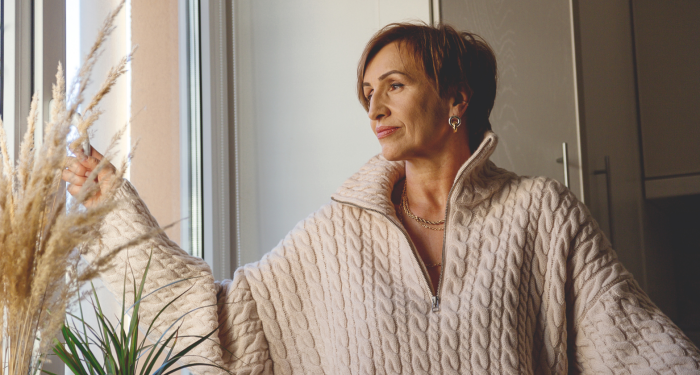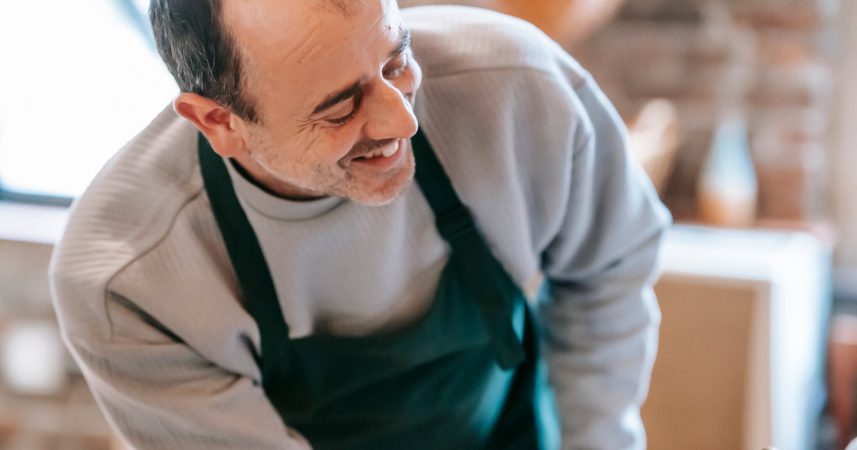
He's standing in his empty kitchen at 6 PM, staring at vegetables he's never cooked before, and for the first time in forty years, the silence isn't telling him to hurry up and be somewhere else.

Add VegOut to your Google News feed. 
I watched a man in his late fifties at the grocery store last week, standing in front of the tofu display like it was written in hieroglyphics. He had that look — part determination, part bewilderment — of someone about to do something completely foreign to their nature. His cart held fresh vegetables, whole grains, and a cookbook titled "Real Food for Beginners." I recognized myself in him from fifteen years ago, when I realized I'd been living on restaurant leftovers and Linda's cooking for too long.
The kitchen becomes yours at the strangest moment
After thirty-five years in the restaurant business, you'd think I'd know my way around a home kitchen. But professional cooking and home cooking are different beasts entirely. One is performance, the other is practice. When you're standing alone in front of your stove at 6 PM with no one to cook for but yourself — that's when something shifts.
I know dozens of men going through this right now. We're all roughly the same age, all suddenly aware that we've been passengers in our own kitchens for decades. My neighbor started with YouTube videos and a rice cooker. My cycling buddy bought an Instant Pot and treats it like a science experiment. Me? I started with scrambled tofu that could have doubled as construction material.
The thing is, we're not learning to cook because our wives stopped cooking for us or because we're helpless. We're learning because for the first time in our adult lives, we have permission to take up space in a room we've only ever passed through. The kitchen — that command center of family life where we grabbed coffee and rushed out, where we sat at the counter while someone else orchestrated dinner — suddenly becomes ours to claim.
You discover cooking is actually about time
When you run a restaurant, time is your enemy. Every second counts, every delay costs money, every moment of stillness is waste. You eat standing up, if you eat at all. Food becomes fuel, cooking becomes labor, and somewhere along the way, you forget that a meal can be a meditation.
Now I spend entire Sunday afternoons making sauce. Just sauce. I roast tomatoes low and slow, caramelize onions until they're jammy and sweet, let garlic turn golden in olive oil. There's no ticket rail demanding this sauce in eight minutes. No server tapping their foot. Just me, the cutting board, and all the time in the world.
My son calls while I'm cooking sometimes, and we talk through the entire prep. He tells me about his daughter's soccer game while I julienne vegetables. I hear about his work struggles while bread dough rises. These conversations couldn't have happened during my restaurant years — I was always rushing, always half-listening, always with one eye on the clock.
The farmers' market becomes your social hour
Saturday mornings at the farmers' market, you'll find us — the late-fifties early-sixties crowd, mostly men, examining heirloom tomatoes like they're rare gems. We ask questions we would have been embarrassed to ask five years ago. What do you do with kohlrabi? How do you know when an avocado is perfectly ripe? Can you really taste the difference between these three kinds of basil?
The vendors know us now. They save things for us, suggest recipes, ask about last week's experiments. There's Tom, who discovered mushrooms at 58 and now forages his own. There's Marcus, recently divorced, who's teaching himself to pickle everything. We trade recipes and disasters with equal enthusiasm.
This is community building in slow motion, one overpriced bunch of organic carrots at a time. We're not networking or competing or proving anything. We're just middle-aged men learning to feed ourselves properly, and somehow that's become its own form of brotherhood.
Your body starts thanking you in unexpected ways
I went plant-based at 47, partly for health, partly because Linda had been vegan for years and I was tired of making two dinners. The restaurant staff thought I'd lost my mind. My father, who considered meat the foundation of civilization, took it as a personal betrayal.
But here's what nobody tells you about changing how you eat in middle age: your body has been waiting for this. The afternoon energy crashes disappear. The inflammation in your knees from decades of standing on restaurant floors calms down. You sleep better. You wake up actually hungry for breakfast instead of just needing coffee to function.
More than that, though, cooking real food — shopping for it, preparing it, sitting down to eat it without the TV on — changes your relationship with your body. You start noticing what makes you feel good versus what you've been eating out of habit. You realize that half your "aging" symptoms were just the accumulated effects of decades of treating your body like a machine that runs on whatever's fastest.
You teach your grandchildren what you couldn't teach your kids
My granddaughter stands on a stepstool beside me, stirring pancake batter with the focus of a neurosurgeon. She's four. When my son was four, I was working Saturday brunches, Sunday dinners, every holiday that paid time-and-a-half. I justified it as providing, as building something, as being responsible. I missed his childhood one dinner service at a time.
Now I have time to let her crack eggs badly, to let flour fly everywhere, to answer her seventeen questions about why pancakes have bubbles. We make pizza from scratch, and she tells everyone at preschool that her grandpa lets her make "the pizza leaves" grow in his garden. She knows what fresh basil smells like, what real tomatoes taste like, how bread dough feels when it's ready.
This is what redemption looks like: teaching your grandchildren what you were too busy to teach your children, and watching your children forgive you for it without ever saying the words.
The silence stops being lonely
Here's the truth about being a man in his early sixties whose kids have moved out: the silence is overwhelming at first. You've spent decades surrounded by noise — family chaos, work demands, the constant hum of being needed. Then suddenly, it's just you and the kitchen at 6 PM, and the quiet feels like judgment.
But slowly, if you let it, that silence transforms. It becomes space to think, to experiment, to mess up without anyone watching. You burn the rice and no one complains. You oversalt the soup and learn from it. You plate a single serving with the same care you once reserved for special occasions, because you're finally understanding that every meal you make for yourself is a small act of self-respect.
Final words
Last night, I made dinner for one — Linda was at her sister's. Miso-glazed eggplant, perfectly steamed rice, a simple cucumber salad. I plated it carefully, opened a good bottle of wine, lit a candle. Five years ago, this scene would have felt pathetic to me — a man alone at his dining table, making ceremony out of solitude.
Now I know better. This isn't about falling apart or filling time or proving I can survive without someone cooking for me. This is about finally, at 62, learning to nourish myself with the same care I've given to everyone else. It's about discovering that cooking a real meal, sitting down to eat it, cleaning up afterward — this simple rhythm — is its own form of meditation, its own path to becoming whole.
The men I know who are going through this transformation aren't having a crisis. We're having a revelation. We're learning that tending to ourselves — our health, our creativity, our need for good food eaten slowly — isn't selfish or silly. It's what should have been happening all along. We just needed an empty house and a quiet kitchen to finally hear what our lives have been trying to tell us: slow down, pay attention, feed yourself well. There's still time to get this right.