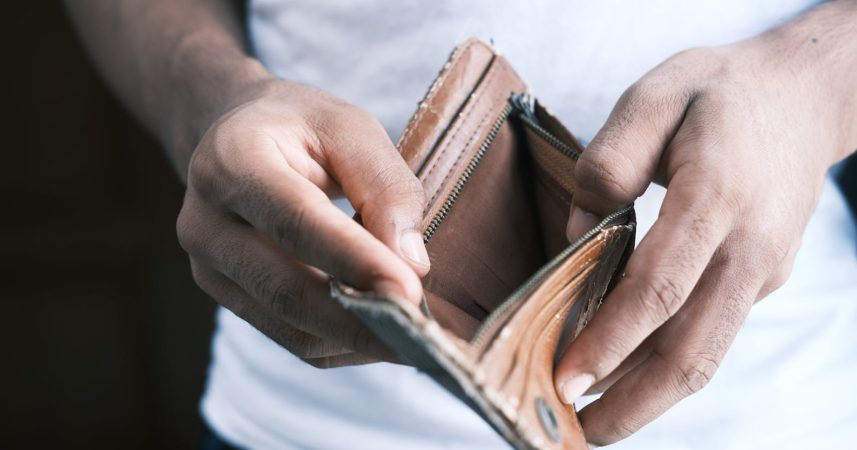
The hypervigilance that once helped you survive poverty doesn't simply vanish when your bank account grows—it lives on in every hesitation before buying coffee, every saved plastic container, and every wave of guilt when you finally spend money on yourself.

Add VegOut to your Google News feed. 
I still check my bank account balance before buying a $4 coffee.
This isn't because I can't afford it. I've been fortunate enough to build a stable freelance writing career over the years. But somewhere deep in my nervous system, there's still that kid from suburban Sacramento watching his grandmother stretch every dollar to raise four kids on a teacher's salary.
And I'm not alone in this. Look around any office or coffee shop, and you'll spot us—the ones who still save every plastic container "just in case," who feel physically uncomfortable throwing away leftovers, who get anxious spending money even when our bank accounts tell us we're fine.
The thing nobody really talks about? How poverty rewires your brain in ways that persist long after your financial situation improves. It's not just about being "careful with money." It's deeper than that.
Your body keeps the score (and so does your wallet)
Have you ever noticed how some people who grew up with financial instability can't seem to relax about money, even when they're doing well?
There's actual science behind this. Alejandra Rojas, a finance expert, explains that "Financial trauma refers to the emotional and psychological distress caused by past financial instability, economic discrimination, or chronic scarcity."
This isn't just theory. I see it in my own behavior patterns. Even now, at 44, with steady income from my writing, I still feel my chest tighten when unexpected expenses come up. My rational brain knows I can handle it. But my nervous system? It's still running old software from decades ago.
The hypervigilance around money becomes part of your identity. You become the person who always knows exactly how much is in their checking account. The one who mentally calculates the cost of everything, even when you're not the one paying.
The invisible rules you can't break
Growing up with financial stress creates an entire rulebook in your head that you might not even realize you're following.
Never order the most expensive thing on the menu. Always check the clearance rack first. Buy the store brand. Save those twist ties—you might need them someday. Don't throw away containers. That shirt with the small hole? It's still good for wearing around the house.
I've mentioned this before, but these aren't just habits. They're survival mechanisms that got hardwired into us during formative years. And here's what's fascinating: even when we logically know we don't need to follow these rules anymore, breaking them feels wrong. Almost dangerous.
Last month, I bought a pair of quality hiking boots without checking three different stores for the best price. It felt like rebellion. That's how deep this programming goes.
When success feels like borrowed time
Here's something I've noticed among friends who've also experienced financial instability: we're all waiting for the other shoe to drop.
You could have six months of expenses saved, a steady income, and good prospects ahead. But there's still that voice whispering that it could all disappear tomorrow. That this stability is temporary. That you need to save every penny because the lean times will return.
Leon Hilbert, a psychologist, captured this perfectly: "If you have five final demands in the drawer, you feel you have lost control. That reinforces procrastination, which in turn has negative consequences because you aren't paying your bills."
Even when those final demands are long gone, the feeling of being on the edge remains. You might have money now, but your nervous system is still braced for impact.
The guilt that comes with having "enough"
This might be the hardest part to explain to someone who hasn't lived it. When you finally have financial stability, there's often overwhelming guilt that comes with it.
Why should I have enough when others don't? Who am I to buy organic vegetables when some families can barely afford groceries? How can I justify this purchase when I know what it's like to count coins for gas money?
My grandmother still volunteers at the food bank every Saturday, well into her eighties. When I visit, I go with her. Seeing families there reminds me how thin the line can be between stability and struggle. It keeps me grounded, but it also reinforces those deep-seated fears about money.
The guilt becomes another layer of the financial trauma. You're caught between wanting to enjoy your hard-earned stability and feeling like you don't deserve it, or that enjoying it somehow betrays where you came from.
Rewriting the money story in your head
So how do we start to heal from this? How do we teach our nervous systems that we're safe now?
First, recognize that these patterns served a purpose. They kept you or your family afloat during difficult times. Thank them for their service, genuinely. They're not character flaws—they're evidence of resilience.
Research from the Future Business Journal found that "Financial hardship acts as a partial mediator in these relationships, with the indirect effect of a lack of self-control being more pronounced than that of a lack of self-efficacy."
In other words, it's not about lacking self-control. It's about how financial hardship literally changes the way we process decisions and relate to money.
Start small. Maybe it's buying the name-brand cereal you wanted as a kid. Or getting the medium coffee instead of the small. Notice the discomfort that comes up. Sit with it. Remind yourself that you're safe.
I've started doing something that helps: I set aside a small amount each month specifically for "unreasonable" purchases. Things I don't need. Things that past-me would never have bought. It's not about the items themselves—it's about teaching my nervous system that abundance is real and safe.
Wrapping up
If you're reading this and recognizing yourself, know that you're not alone. That anxiety you feel about money, even when you have it? That's not weakness or ingratitude. It's your nervous system doing what it learned to do to keep you safe.
Healing from financial trauma takes time. Some days, I still feel like that kid watching his grandmother clip coupons at the kitchen table. Other days, I can buy lunch without checking my bank balance first.
Progress isn't linear. You might always be more careful with money than someone who grew up with financial security. That's okay. Maybe that carefulness is part of what helped you build the stability you have now.
The goal isn't to become careless with money. It's to find a middle ground where you can be responsible without being controlled by fear. Where you can enjoy what you've worked for without guilt. Where your nervous system can finally, slowly, start to believe that you're going to be okay.
Because you are. Even if your body hasn't quite caught up to that reality yet.