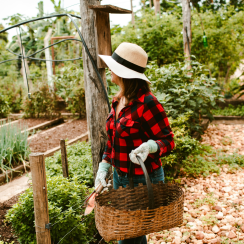
She drove to lunch rehearsing cheerful stories about her garden and mystery novels, practicing her smile at red lights, because four years after losing her husband, the truth of her grief-hollowed days would burden her already exhausted daughter more than this carefully crafted performance of happiness ever could.

Add VegOut to your Google News feed. 
The car was still warm from my drive when my daughter called. "Mom, you seem really happy," she said, and I could hear her settling into her own car for the commute home. "Like, genuinely happy. It's so good to hear."
What she didn't know is that I'd spent the whole drive over to our lunch date practicing how to look like I was—checking my smile in the rearview mirror at red lights, rehearsing cheerful anecdotes about my garden and the new mystery novel I'm reading. Because the woman I actually am right now would frighten her.
The art of protective pretending
I've become an excellent actress at 72. Not the kind who wins awards, but the kind who shields the people she loves from truths that would only burden them. Some mornings I wake up and spend the first ten minutes searching for a reason to get out of bed. Four years after losing my husband to Parkinson's, I still set out two coffee cups before remembering. Grief doesn't actually shrink—you just grow larger around it, like tree bark healing over a wound.
But my daughter doesn't need to know this. She has her own battles—a teenage daughter testing every boundary, a demanding job, and that particular exhaustion from trying to be everything to everyone. I recognize it because I lived it for decades.
When her father left us—she was three, her brother was six—I became a master of manufactured happiness. Single mother, full-time teacher, part-time tutor, weekend house cleaner. I smiled through parent-teacher conferences where I sat on the wrong side of the desk. I smiled through food stamps and secondhand clothes. I smiled until smiling became armor.
This feels different though. Back then, I was protecting young children from adult worries. Now I'm protecting my adult child from the fear that her mother is disappearing, becoming one of those widow statistics she probably reads about—isolated, depressed, forgotten.
When the performance becomes the truth
She doesn't need to know about last month when I didn't leave the house for a week except to get the mail. Or that I have entire conversations with my husband's photograph. Or that I've started avoiding mirrors because the woman looking back seems like a stranger wearing my mother's face.
The practiced happiness isn't entirely false. There are genuine moments of light—my youngest grandchild's laugh when I teach her to make cookies and let her lick the spoon, the perfect pink of my roses that I've cultivated for fifteen years, Thursday coffee with my neighbor where we solve the world's problems and gossip about the new couple down the street. These moments are real. I just amplify them during phone calls, stretch them to cover the darker spaces.
I learned this skill during my teaching years, standing before teenagers who could detect authenticity—or its absence—like bloodhounds. You couldn't fake it entirely with them. But you could choose which parts of yourself to reveal. They didn't need to know I'd cried in my car that morning because my son needed new shoes and payday was a week away. They needed to know that literature could change their lives, that their essays mattered, that someone believed in them.
Different faces for different spaces
Thirty-two years of teaching taught me that we all perform different versions of ourselves for different audiences. The widow at grief support group can admit to sleeping in her late husband's shirt. The grandmother must be the keeper of traditions and baker of cookies. The mother must be strong enough to lean on but not so fragile as to cause worry. The friend at book club can confess that wine helps more than it should some evenings.
With my daughter, I perform most carefully. She calls it happiness, and I let her. Because she needs a mother who is thriving, not just surviving. She needs to believe there's life after loss, joy after grief, purpose after the primary roles fade away.
Maybe if I pretend long enough, it will become true. That's what happened after her father left—I pretended to be strong until one day I actually was.
The irony isn't lost on me. I spent decades teaching students to find their authentic voice in writing, to dig deeper, to tell hard truths. "The personal essay requires radical honesty," I'd write on their drafts. Yet here I am, constructing elaborate fictions for the people I love most. Perhaps that's its own kind of truth—the truth that love sometimes means shielding others from our sharpest edges.
The gift of a reassuring lie
Yesterday, after our lunch, my daughter hugged me longer than usual. "I'm so glad you're doing well, Mom," she said. "After Dad died, I worried... but you're really okay, aren't you?"
I held my brilliant, exhausted, worried daughter and gave her the gift she needed. "I'm more than okay, sweetheart. I'm happy."
The woman I actually am would frighten her. She would recognize too much of herself in my exhaustion, my grief, my struggle to find meaning in this unwanted chapter. She would see her future mapped in my present—the loneliness that comes even when surrounded by people who love you, the way time accelerates and crawls simultaneously after seventy, the invisibility that falls over women of a certain age like an unwanted cloak.
So I protect her from that woman. I give her the mother who gardens and reads, who bakes bread on Sundays and volunteers at the library. The mother with wisdom to share and stability to offer. The mother who has made peace with her past and embraces her future.
Maybe that's the greatest lesson my years have taught me: that love is sometimes a performance we perfect through practice, until even we can't tell where the acting ends and the truth begins.
Tomorrow I'll wake at dawn and spend that first hour with tea and my journal. I'll write three things I'm grateful for, as I've done every morning since my husband died. I'll tend my garden before the heat sets in. I'll call my daughter on Sunday and tell her about the watercolor class where I'm learning to embrace imperfection, how her daughter reminds me of her at that age.
All of it will be true. None of it will be the whole truth.
Final thoughts
After our call ended, I sat in my cooling car for a moment longer. The practiced smile slowly faded, and I allowed myself to just be—tired, grieving, uncertain. Then I adjusted my rearview mirror, checked my face one more time, and drove home.
Because being a mother means knowing when to reveal yourself and when to conceal, when honesty helps and when it harms. The woman I actually am right now might frighten my daughter, but the woman I choose to be for her? That woman gives her hope. And perhaps that's the most honest love I can offer—the kind that carries her forward even when I struggle to carry myself.
What’s Your Plant-Powered Archetype?
Ever wonder what your everyday habits say about your deeper purpose—and how they ripple out to impact the planet?
This 90-second quiz reveals the plant-powered role you’re here to play, and the tiny shift that makes it even more powerful.
12 fun questions. Instant results. Surprisingly accurate.