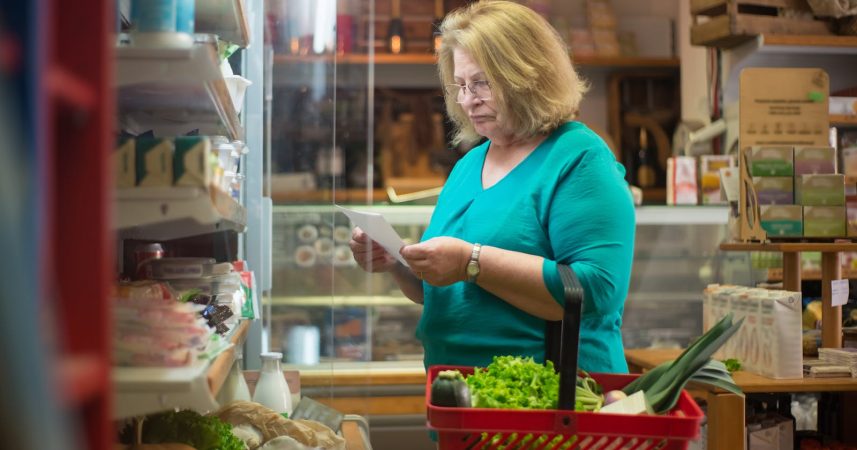
At 70, I've discovered that making people wait while I write checks isn't about being old-fashioned — it's the last stand against a world that wants me to become invisible, processed like a barcode instead of seen as a human being.

Add VegOut to your Google News feed. 
Last week at the grocery store, I watched a man in his thirties practically vibrate with impatience while an elderly gentleman counted exact change at the register. The younger man's fingers drummed against his thigh, his eyes rolled skyward, and he muttered something about "getting with the times." I wanted to tap him on the shoulder and tell him that someday, if he's lucky, he'll be old enough to understand that time isn't something to race through — it's something to inhabit.
I'm 70 years old, and yes, I write checks at the grocery store. Every single time. The eye rolls don't escape me. Neither do the dramatic sighs or the way people suddenly become fascinated with their phones when they realize they're stuck behind the check-writing lady. But here's what those impatient souls don't understand: This isn't about being stuck in the past. This is about claiming my right to exist at human speed in a world that's forgotten what that means.
The machine wants us to disappear
There's a particular kind of invisibility that comes with age, especially for women. It starts subtly — servers hand the check to your younger dining companion, store clerks look past you to help the next customer, conversations flow around you like you're furniture. The world begins treating you like you're in the way, an inefficient relic gumming up the works of progress.
The grocery store has become ground zero for this battle between human pace and machine efficiency. Self-checkout stations multiply like rabbits. Contactless payment is king. And those of us who dare to pull out a checkbook? We might as well be suggesting we pay with chickens and grain.
But here's the thing — I know how to use technology. My granddaughter and I video chat every Sunday. I manage my retirement accounts online. I can order groceries for delivery when my arthritis flares up, though I rarely do because I need the ritual of choosing my own tomatoes, of running my fingers over the peaches to find the perfect ones.
Writing checks isn't about inability. It's about insisting on interaction, on acknowledgment, on the radical act of taking up time and space when the world would prefer you didn't.
What we lose when we optimize everything
Do you remember when paying for groceries was a social exchange? The cashier knew your name, asked about your sick husband, remembered you preferred paper bags. There was a rhythm to it, a dance of humanity that couldn't be rushed without losing something essential.
I taught high school English for over three decades, and I watched this same optimization creep into education. Standardized tests replaced essay discussions. Digital submissions replaced the intimate act of handing in paper with still-warm ink. Efficiency became our god, and we sacrificed depth at its altar.
When I write a check, I'm forcing a pause in the relentless march of efficiency. The cashier has to look at me, speak to me, wait for me. For those three or four minutes, I exist. I'm not a bar code or a tap or a swipe. I'm a person conducting business with another person, the way humans have done for millennia.
Sometimes the young cashiers are confused — they've never seen a check before. I guide them through it gently, the same patience I once used teaching teenagers to decode Shakespeare. These moments of teaching, of connection, they matter more than the thirty seconds we might save with a card tap.
The dignity of taking your time
My second husband developed Parkinson's in his final years. Everything slowed — his walk, his speech, his ability to button his own shirt. The world grew impatient with him too. People would finish his sentences, walk around him on sidewalks, look away when he took too long to count money.
I learned something profound watching him navigate those years with grace: Moving slowly isn't just a physical necessity for some of us. It's an act of resistance against a world that measures worth by speed and productivity.
When I stand at that register, carefully writing the date, the amount, signing my name in the cursive they don't even teach anymore, I think of him. I think of my mother in her final years, folding and refolding her napkin with infinite care, asserting her agency in the smallest gestures. I think of all of us who've been told we're taking too long, moving too slowly, holding up the line.
Virginia Woolf once wrote about the importance of having money and a room of one's own. I'd add to that: the importance of having time of one's own, unchoreographed by efficiency experts and optimization algorithms.
What the young don't know yet
That impatient person behind me in line — the one checking their phone, shifting their weight, radiating hurry — they don't know yet that time isn't linear when you're older. When you've buried parents, outlived spouses, watched children become strangers and then find their way back to you, time becomes something else entirely. It's not a resource to be maximized. It's a gift to be savored.
I've earned my slowness. Earned it through decades of rushing — rushing to get the kids to school, rushing to grade papers, rushing through dinner to get to parent-teacher conferences. I've done my time in the cult of busy. Now, in what my doctor cheerfully calls my "golden years," I've decided that gold doesn't tarnish when you take your time examining it.
Last month, I was writing my check when the woman behind me, probably in her forties, actually reached around me to put her items on the belt. The entitlement of it, the assumption that my time and space were less important than her efficiency, sparked something in me.
"I'll be just a moment," I said, not unkindly but firmly, the same voice I used to quiet a classroom. "We all get our turn."
She had the grace to look embarrassed. But I wonder if she'll remember that moment when she's 70, when the world starts treating her like an obstacle instead of a person.
The revolution of refusing to disappear
There's a radical power in refusing to be processed. Every check I write is a small declaration: I am here. I take up space. My time matters as much as yours. The machine can wait.
Some days, I catch a glimpse of understanding from unexpected places. A young mother, juggling a baby and groceries, who smiles and says, "Take your time." A teenage cashier who asks about my handwriting, marvels at the loops and flourishes. An elderly man who nods in solidarity as he pulls out his own checkbook.
We're a resistance movement, we check writers. We're the ones who still send handwritten thank you notes, who read entire newspaper articles instead of headlines, who know that some things shouldn't be compressed into the time it takes to tap a screen.
Final thoughts
Next Tuesday, I'll be back at that register with my checkbook. I'll take my time writing the date, the amount, my signature that's grown a bit shakier but still carries the authority of seven decades of living. The line will form behind me. Someone will sigh. The machine of efficiency will grind its gears.
And for those few minutes, I'll be magnificently, stubbornly, gloriously human. Not because I can't adapt to the digital age, but because I've chosen which parts of it deserve my adaptation. At 70, that choice — the power to decide when to hurry and when to hold firm — is perhaps the greatest dignity I possess.
The world can wait. It's good for it.
What’s Your Plant-Powered Archetype?
Ever wonder what your everyday habits say about your deeper purpose—and how they ripple out to impact the planet?
This 90-second quiz reveals the plant-powered role you’re here to play, and the tiny shift that makes it even more powerful.
12 fun questions. Instant results. Surprisingly accurate.