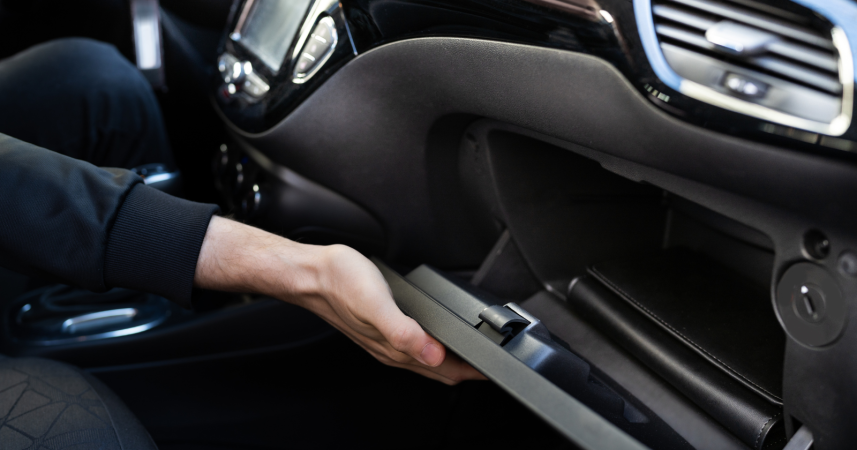
A small compartment that holds an entire worldview about preparedness and provision.
The glove box is a dad's command center, eight cubic feet of controlled chaos that reveals everything about how he moves through the world. For lower-middle-class fathers, it's not just storage—it's a survival kit for an economy that doesn't offer second chances. Every item tucked away represents a lesson learned, usually the hard way.
These aren't the glove boxes of men with AAA Premier memberships and comprehensive insurance. These are the mobile toolkits of fathers who've learned that self-reliance isn't a philosophy—it's a financial necessity. Open that latch and you're looking at a manifesto written in napkins and expired coupons.
1. Napkins from every fast-food place within twenty miles
Not one or two—hundreds, compressed into geological layers. McDonald's from three years ago, Subway from last week, that local pizza place that closed during COVID. They're free, they're useful, and taking a handful costs nothing but pride, which was surrendered long ago.
These napkins are currency in the economy of making do. They're tissues for kids' noses, cleanup for spilled coffee, emergency toilet paper when the gas station's out. Every stack represents a meal bought, a small luxury justified, a moment when feeding the family meant drive-through math: what fills the most stomachs for under twenty bucks?
2. A tire pressure gauge from the auto parts store
Not digital, not fancy—the pencil kind that cost $1.99 in 1987 and still works. He checks the tires religiously because he knows that proper inflation means an extra two miles per gallon, and those miles add up when you're driving a fifteen-year-old car another 100,000 miles.
This is preventive maintenance as financial strategy. New tires cost what he makes in a week. Running them properly inflated might buy another six months, maybe a year. That gauge has saved more money than any investment app ever could.
3. Registration and insurance papers from the last three years
Current ones on top, but the expired ones stay, creating a paper trail of continuous coverage. Never a gap, never a lapse, because getting insurance back after a lapse costs more than keeping it during the lean months when you probably shouldn't be driving anyway.
These papers are proof against worst-case scenarios, evidence of responsibility when one traffic stop could spiral into disaster. They show continuity, stability, the kind of person who keeps their paperwork straight even when everything else is falling apart.
4. A folded twenty-dollar bill hidden behind old receipts
Not wallet money—emergency money. Gas-light-came-on-and-payday's-tomorrow money. Kid-needs-lunch-money-and-the-account's-overdrawn money. It's been spent and replaced a dozen times, but it's always there, a tiny insurance policy against the moments when plastic won't help.
This hidden twenty represents the thin margin between okay and crisis. It's peace of mind measured in gallons of gas, in one more day of making it work. It stays hidden because if everyone knows about it, it's already spent.
5. A flashlight that needs batteries and loose batteries that might not work
The flashlight's been there since the car was bought. The batteries roll around like dice, corroded at the ends, expiration dates worn off. But together, sometimes, if you bang them just right, they produce enough light to change a tire or check under the hood.
This is optimism despite evidence: the belief that broken things might work when you need them. It's the same faith that keeps jumper cables with frayed insulation, the umbrella with two broken spokes. Not quite functional but not quite garbage, existing in the purgatory of "might come in handy."
6. Business cards from every mechanic who ever gave a fair quote
Tony's Auto Repair. Mike's Muffler. That guy who works from his home garage on weekends. Each card represents a relationship, a negotiation, a moment when someone cut him a break. These aren't Yelp reviews—they're alliances in the ongoing war against automotive entropy.
These cards map a shadow network of informal economy, where cash means discounts and knowing someone means payment plans. The official dealership service center might as well be Mars. These guys, though—they understand that "it just needs to pass inspection" is a complete repair philosophy.
7. Coupons sorted by expiration date in a rubber band
Oil changes, brake checks, buy-one-get-one tires. Some expired but kept anyway because sometimes they still honor them if you ask nicely. The sorting system is precise—a financial calendar of future savings, of maintenance deferred until the coupon makes it possible.
This isn't extreme couponing; it's survival economics. Every dollar saved is a dollar earned, and he knows exactly when Jiffy Lube runs their specials, when Firestone does free inspections. The rubber band holds it all together like a tiny business plan.
8. A multi-tool that was definitely a Father's Day gift
Knife, pliers, screwdriver, bottle opener—fourteen functions, realistically uses two. It was probably the kids' idea, bought at Walmart with mom's money, wrapped in newspaper comics. It's not the best tool for any job, but it's better than no tool, and that's usually the choice.
This multi-tool is love made practical, a child's understanding that dad fixes things, that dads need tools. He carries it even though he has better tools at home because gifts from your kids are sacred, especially when they're trying to help you be who they think you are.
9. A phone charger that only works at the right angle
The cable's wrapped in electrical tape where it started splitting. You have to position it just so, maybe wedge it against something. It charges slowly, sometimes not at all, but a new one costs twenty dollars and this one isn't completely dead yet.
This is the physical manifestation of "making it work"—the daily negotiations with broken things that define lower-middle-class life. It's knowing exactly how to prop, twist, and angle things into functionality. The charger works if you know its secrets, and he does.
Final thoughts
These glove boxes are archives of a particular kind of American fatherhood—one built on preparation for problems you can't prevent but might survive. Every item represents a small victory over entropy, a tiny rebellion against an economy that would prefer you just buy new, call professionals, pay full price.
The lower-middle-class dad's glove box isn't about having the right things—it's about having something, anything, that might help when help isn't coming. It's a museum of almost-solutions, of making do, of the quiet heroism of keeping a family moving forward on a budget that doesn't include margins for error.
These fathers learned long ago that nobody's coming to save you, that self-reliance isn't a virtue but a necessity, that the difference between disaster and inconvenience often lives in that latch compartment. They stock their glove boxes like they're preparing for a siege because, in a way, they are. Every day is a small battle against breakdown, and that cluttered glove box? That's their arsenal, humble but essential, ready for whatever the road throws at them next.