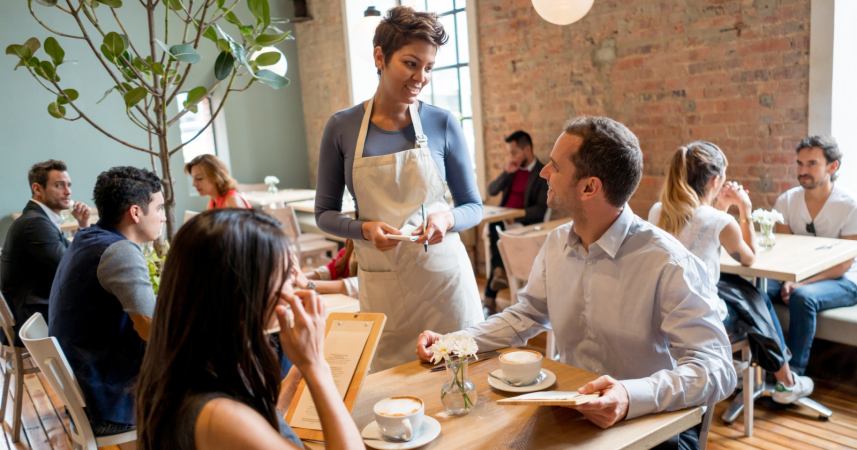
The invisible fraternity of people who stack their plates and know exactly when the kitchen is about to close.

Add VegOut to your Google News feed. 
We were halfway through dinner when my date started doing it—quietly consolidating our plates, scraping food remnants onto one dish, stacking everything into a precarious but perfectly balanced tower at the table's edge. "You've waited tables," I said. It wasn't a question. She laughed, caught. "Four years through college. You?" "Bartender, three years." We shared the knowing look of veterans who'd survived the same war, fought in different trenches.
There's an invisible fraternity among those who've worked food service, a set of behaviors so ingrained they become permanent parts of our restaurant DNA. We move through dining rooms like former residents returning to a childhood home—we know which floorboards creak, where the drafts come from, what happens when you flip that particular switch. These aren't learned mannerisms we can turn off; they're muscle memories that announce our service-industry past more clearly than any résumé.
The fascinating thing about embodied knowledge is how it persists long after the context that created it disappears. Years, even decades after our last shift, we still move through restaurants with the hyperawareness of someone who knows exactly what's happening on the other side of those swinging doors. We can't help it. Once you've seen how the sausage is made—literally and figuratively—you never quite become a civilian again.
1. You stack and organize your plates like you're auditioning for dish pit
The meal ends and you immediately begin the ritual: scraping remaining food onto one plate, nesting smaller dishes inside larger ones, aligning silverware in parallel formation on top. Napkins get bundled, not balled. Everything moves to the table's edge, positioned at the exact angle that makes it easiest for someone to grab while walking past.
You're not trying to do the server's job—you know they have a system, and sometimes your "help" might even disrupt it. But the compulsion is stronger than logic. Your hands move without consulting your brain, executing a choreography you performed thousands of times when every second saved meant you might actually get a break, when efficiency was the only thing standing between you and total chaos.
A server once caught me mid-stack and said, "Let me guess—BOH or FOH?" (Back of house or front of house, for civilians.) "FOH," I replied. "I could tell," she said. "BOH folks stack for maximum density. FOH stacks for easy carrying." She was right. Even our plate-stacking tells stories about which side of the pass we worked.
2. You read the room's energy like a weather system
You walk into a restaurant and immediately know: the kitchen is behind. Maybe it's the server's slightly too-bright smile, the manager's rapid rounds between tables, or the way completed appetizers sit for thirty seconds too long at the pass. You know when the hostess is new (she's gripping that iPad like a life preserver), when there's drama in the kitchen (servers emerge from the back with that particular tight-lipped expression), when someone important just walked in (sudden straightening of spines, managers materializing from nowhere).
This hypervigilance isn't anxiety—it's pattern recognition developed over hundreds of shifts where reading the room meant the difference between good tips and getting stiffed. You learned to spot the table that's going to be difficult before they've opened their mouths, to identify the exact moment when friendly conversation becomes a cry for help, to know when the kitchen is about to go down in flames just from the sound of metal on metal.
My partner finds it unnerving. "How did you know our food was about to come out?" Because I heard the particular rhythm of plates being plated, saw our server's preparatory glance toward the kitchen, noticed the expediter moving with the urgency that means a big order is ready. You can take the person out of food service, but you can't take the radar out of the person.
3. You tip like someone who's lived on tips
Twenty percent is your baseline, not your ceiling. Bad service might take you down to eighteen percent, but only if it's genuinely terrible—and even then, you're calculating whether it's the server's fault or if they're drowning in a badly managed situation. You tip on alcohol, tip on takeout, tip on coffee. You know that in many states, tipped workers make $2.13 an hour before tips. You know what it's like to have a bad night mean you can't make rent.
But it's not just the amount—it's how you tip. Cash whenever possible, because you know credit card tips might not hit until the next pay period. You write the tip amount clearly, draw lines through empty spaces so no one can add numbers. On large bills, you might even write "CASH" on the tip line and hand the server bills directly, making eye contact so they know it's theirs, not the table's change.
You also know the secret codes. A penny under an upside-down glass doesn't mean what civilians think it means. You know which holidays are the best for tips (Mother's Day brunch) and worst (New Year's Eve). You know that the person who insists on handling the check but asks everyone else what they think about the tip is going to stiff your server.
4. You order with surgical precision
"I'll have the burger, medium, no modifications, and a beer—whatever's easiest to pour." You speak clearly, make eye contact, and deliver your order in the exact format that makes it easiest to punch into the POS system. You know your server is holding five tables' worth of orders in their head, so you don't bury the lede with stories about your gluten sensitivity before revealing you're ordering the pasta.
When dining with groups, you subtly organize the ordering, making sure everyone's ready when the server arrives. You know the special hell of standing tableside while six people suddenly decide they need to re-read the entire menu. You answer questions in the order they're asked. You consolidate requests. You never, ever say "I'm still deciding" after the server has already started taking orders.
A friend once asked why I order so "aggressively efficiently." Because I've stood there, pen in hand, while table six had a philosophical debate about what "medium-rare" really means, knowing table four's food is dying under the heat lamp and table two is trying to flag me down and the host just sat me three more tables. Every second counts in ways civilians never understand.
5. You never, ever show up within an hour of closing
The posted hours might say "Open until 10 PM," but you know the truth. At 9:15, the kitchen starts breaking down the line. By 9:30, servers are doing side work, hoping they won't get sat again. At 9:45, everyone is watching the door, praying you don't walk through it. You know because you've been the one reorganizing the walk-in at 11 PM because a table came in at 9:59 and ordered appetizers, entrees, and dessert.
When you do eat out, you check the hours obsessively. If a place closes at 10, you're there by 8:30 at the latest, and you're efficient about it. You know your late arrival doesn't just affect your server—it's the dishwasher who has to stay late, the line cooks who can't start cleaning, the manager who can't do their counts. You know the cascade effect of that one late table.
You also know the flip side—the beautiful synchronicity of a restaurant closing smoothly, everyone moving through their shutdown routines like a well-rehearsed dance. You've felt the particular satisfaction of turning off the lights on time, of walking out together into the night, free. You won't be the reason someone else doesn't get that feeling.
6. You treat your server like a professional, not a servant
You make eye contact. You say "please" and "thank you" but not performatively—just as professional courtesies between adults doing their jobs. You never snap, wave frantically, or grab a passing server. You know they've developed peripheral vision that could rival a fighter pilot's; they know you need something. They'll get there when they can.
When something goes wrong, you explain the issue without emotion or accusation. "Hey, this came out cold" not "This is cold!" You know the difference between a server mistake and a kitchen mistake, and you don't punish one for the other. You know that sending food back means your server has to have an uncomfortable conversation with an already stressed cook, so you only do it when necessary.
Most tellingly, you know when to disappear. After ordering, you lean back, creating space. You pause conversations when the server approaches. You hand over finished plates rather than making them reach across. These micro-movements, invisible to most, are noticed and appreciated by every server you encounter. It's the physical vocabulary of someone who knows exactly how hard this job is.
Final thoughts
These behaviors aren't affectations or performances—they're the permanent marks left by an experience that shapes you at a molecular level. Working food service teaches you things about human nature, about systems under pressure, about your own capacity for endurance that no other job quite replicates. It's physically demanding, emotionally exhausting, and psychologically complex in ways that people who've never done it can't fully grasp.
But here's what's beautiful about this invisible fraternity: the recognition is immediate and the bond is real. When your server notices you stacking plates and says, "You've been there," it's not just an observation—it's an acknowledgment of shared experience. When you tip in cash and make eye contact, you're saying "I see you" in a way that transcends the transaction.
These behaviors are our secret handshakes, our tribal markings, our way of saying: I know what you're going through. I know the ache in your feet, the burn on your arms, the mental gymnastics of keeping fifteen orders straight. I know the relief of a good tip and the rage of being treated like furniture. I've been there, and I remember.
We can't help these behaviors any more than we can help breathing. They're written into our muscle memory, carved into our social DNA. Years later, decades later, we still move through restaurants like ghosts of our former selves, unable to fully return to civilian life. And honestly? Most of us wouldn't have it any other way.
What’s Your Plant-Powered Archetype?
Ever wonder what your everyday habits say about your deeper purpose—and how they ripple out to impact the planet?
This 90-second quiz reveals the plant-powered role you’re here to play, and the tiny shift that makes it even more powerful.
12 fun questions. Instant results. Surprisingly accurate.