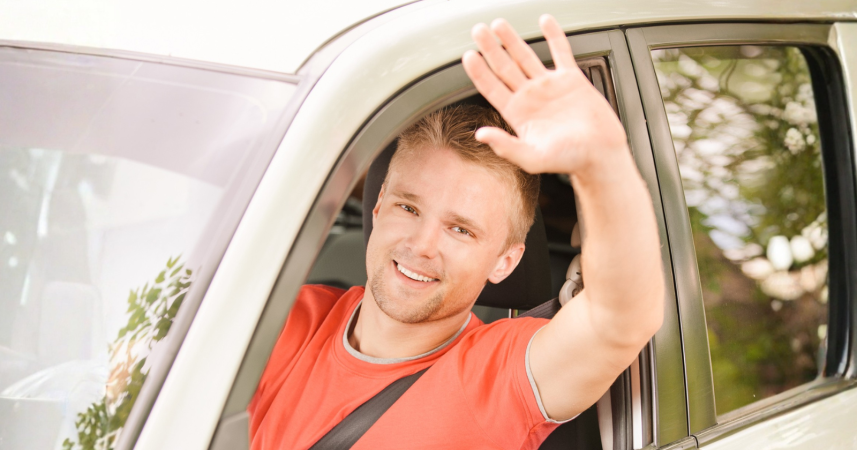
A wave thank you is a tiny behavioral breadcrumb that often leads to bigger patterns you wouldn't expect.
Traffic has a funny way of turning strangers into tiny, unplanned social experiments.
One person inches forward like they are trying to win a chess match, while another hangs back and makes space like they have nowhere else to be.
Then there is that small moment that feels weirdly human: someone lets you merge, and you lift a hand and wave thank you.
It is such a small gesture, but it usually is not random.
In my experience, people who do that quick thank-you wave tend to carry certain traits into the rest of their life too, more like a pattern-of-behavior way.
Here are seven characteristics I often see behind that simple wave:
1) Awareness of others
You cannot wave thank you if you are not paying attention to the fact that someone helped you.
That sounds obvious, but look around next time you drive.
Plenty of people merge like the other car is an inanimate object.
They take the space, keep their eyes forward, and move on.
No acknowledgment, and no sign they even registered another human made a choice.
The thank-you wavers tend to have a wider lens.
They notice the small interactions that keep things moving.
This kind of awareness shows up outside the car too.
They pick up on who is being talked over in meetings, notice when a friend gets quiet, and catch the subtle vibe shift at dinner when someone is uncomfortable with the topic.
It is just attention, and attention is a rare currency now.
We live in a world where your phone is constantly trying to steal your focus.
So, when someone is present enough to see a kind gesture in traffic, it is often because they practice presence in other areas, too.
2) Comfort with micro-connection
Some people treat public life like a series of walls.
Others move through the world leaving tiny bridges behind them.
The drivers who wave thank you usually fall into the second group.
They are comfortable with micro-connection in a “we are sharing this space together” way.
Those tiny moments of connection matter more than we think.
They are like social WD-40 as they reduce friction.
When you wave to a driver, you are basically saying, “I see you. I appreciate you.”
That is a small dose of social safety because it tells the other person they are not just dealing with a robot in a metal box.
People who are good at micro-connection tend to be easier to live with.
They do not treat politeness like it is beneath them and, honestly, that makes the world feel less cold.
3) A bias toward gratitude
A merge is not a life-changing gift.
It is a minor courtesy, which is exactly why the thank-you wave says something.
It shows a person has a low threshold for gratitude.
They do not save appreciation for only the big moments as they notice the small stuff, and that matters because gratitude is not just a vibe.
It is a habit, and the people who practice it tend to have better relationships.
They tend to handle stress better and feel less like life is happening to them.
If you are vegan like me, you get used to noticing small kindnesses in everyday settings.
Someone checks the ingredients without rolling their eyes.
A friend chooses a restaurant with actual options, and a host asks what you need instead of making it a debate.
That kind of awareness makes gratitude feel natural, and that same muscle shows up on the road.
A quick wave is basically gratitude in its simplest form: Recognition without a speech.
4) Emotional self-regulation
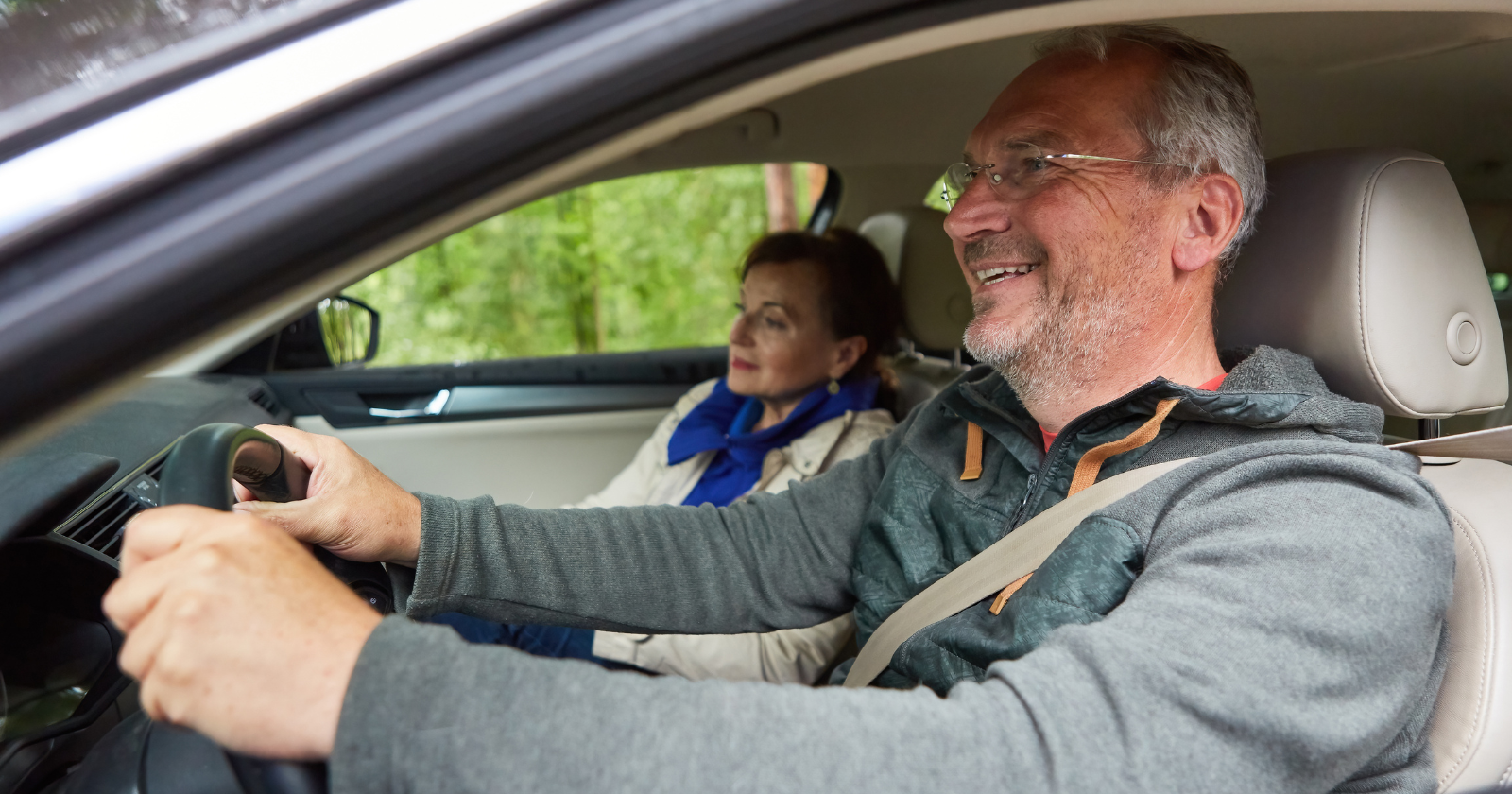
Here is a question: Have you ever been cut off in traffic and felt your entire nervous system light up?
It happens fast: Heart rate up, jaw tight, and the urge to “teach them a lesson” by speeding up or tailgating.
Suddenly, you are starring in your own action movie.
The people who wave thank you tend to regulate better.
Why? Because to wave, you have to stay out of fight mode.
The wave is a pro-social move.
It is the opposite of “me versus you,” and “we are cooperating.”
That usually comes from emotional control.
The ability to pause and choose a response.
Also, people who are tense and reactive often interpret neutral events as hostile.
They assume the other driver is trying to disrespect them.
So, even when someone is kind, it does not land but a regulated person can actually receive the kindness.
They can feel the moment for what it is, and respond with warmth.
That same skill plays out everywhere.
In relationships, it is the difference between snapping and asking a calm question.
At work, it is the difference between sending a spicy email and taking a walk first.
On the road, it looks like a simple wave.
5) Respect for social rules
I am talking about the unwritten social rules that make society feel livable.
Things like taking turns, not blasting music on the subway, not acting like your time is more important than everyone else’s, cleaning up after yourself, and saying thank you.
The wave is part of that informal social contract as it is a sign that the person respects the idea of shared rules, even when no one is forcing them.
Nobody is going to ticket you for not waving.
You could ignore the other driver and nothing would happen.
So, when someone still acknowledges the courtesy, it is often because they value the social glue itself.
Yes, I know there are exceptions.
Some people are shy, have anxiety, and were taught to keep their hands on the wheel.
As a general pattern, the wave tends to show a person cares about being a good participant in the system.
It is the same kind of person who returns a shopping cart.
The same kind who holds the door without making it a performance and signals when they change lanes, even when there is no one around.
It is about respect.
6) A cooperative mindset
Driving can bring out a very weird version of capitalism.
Everyone competing for space, everyone optimizing for “me,” and everyone acting like a lane is a personal asset.
However, the reality is, traffic works best when people cooperate.
The thank-you wave is a little marker of that.
It is “I see the collaboration.”
People who naturally cooperate tend to do better in groups.
They understand that life is not a solo sport and look for win-win outcomes.
When someone lets you merge, they are giving up a tiny advantage.
They could have closed the gap, but instead chose smooth flow over tiny dominance.
When you wave, you reinforce that behavior and you reward cooperation.
That is powerful.
If you have ever traveled in places where driving is more chaotic, you can feel the difference when cooperation disappears.
In some cities, merging becomes a battle of willpower as horns become language and eye contact becomes a dare.
In places where cooperation is more common, driving feels less like combat and more like shared movement.
People who wave tend to prefer the second world.
They are the kind of person who asks, “How do we make this easier for everyone?” not “How do I win this interaction?”
7) Quiet confidence
This one surprises people because a wave looks small and polite.
Insecure people sometimes avoid small gestures because they feel exposed.
Waving feels like admitting you needed help and acknowledging that someone else had power in the moment.
Confident people do not worry about that.
They are comfortable being human and can accept a courtesy without turning it into a status contest.
Quiet confidence also shows up in how someone navigates minor social moments.
They can say sorry without spiraling, thank you without feeling weak, and give someone else credit without feeling like they are losing.
The wave is effortless, just a simple acknowledgment.
If you think about it, that is what confidence looks like a lot of the time: Calm, grounded, and unbothered by tiny power dynamics.
You do not have to prove anything because you just participate.
Closing thoughts
A wave thank you is not a personality test, obviously, but it is a clue.
A tiny behavioral breadcrumb that often leads to bigger patterns: Awareness, connection, gratitude, self-control, respect, cooperation, and quiet confidence.
So, the next time someone lets you merge, try the wave because it trains you to notice goodness in small places.
If you are already a waver, keep doing it.
The world could use more people who know how to say “I see you” in two seconds flat.
Just launched: Laughing in the Face of Chaos by Rudá Iandê
Exhausted from trying to hold it all together?
You show up. You smile. You say the right things. But under the surface, something’s tightening. Maybe you don’t want to “stay positive” anymore. Maybe you’re done pretending everything’s fine.
This book is your permission slip to stop performing. To understand chaos at its root and all of your emotional layers.
In Laughing in the Face of Chaos, Brazilian shaman Rudá Iandê brings over 30 years of deep, one-on-one work helping people untangle from the roles they’ve been stuck in—so they can return to something real. He exposes the quiet pressure to be good, be successful, be spiritual—and shows how freedom often lives on the other side of that pressure.
This isn’t a book about becoming your best self. It’s about becoming your real self.