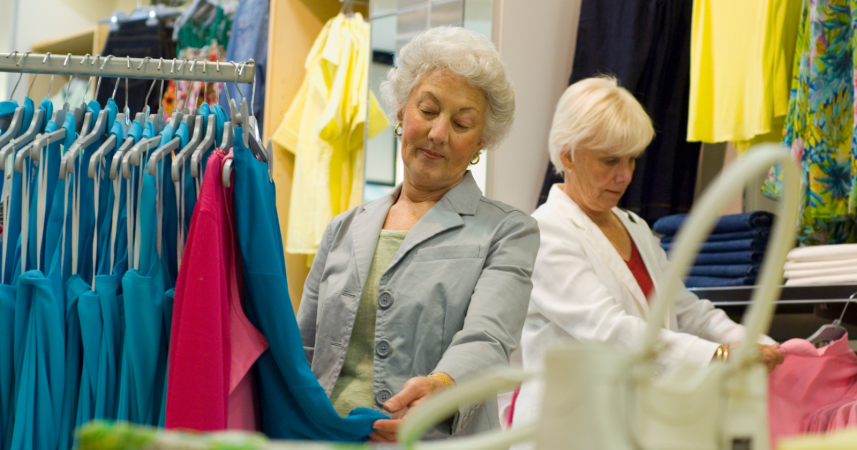
Walking through Forever 21 last week, clutching a sequined crop top while a teenage sales associate watched in bewilderment, I realized my shopping habits were revealing something I'd been refusing to admit about aging.

Add VegOut to your Google News feed. 
Last week, I found myself in the fluorescent glare of Forever 21, clutching a sequined crop top like it was a life raft. The teenage sales associate watched me with barely concealed confusion as I asked if they had it in a size that might actually cover my midriff.
Walking out empty-handed, I caught my reflection in the storefront window and had to laugh. What exactly was I trying to prove?
The truth is, getting older involves a thousand tiny negotiations with ourselves about who we used to be versus who we're becoming. And sometimes, those negotiations happen in the most unexpected places - like the stores we choose to frequent.
After years of observing friends, family, and yes, myself, I've noticed that certain shopping habits can signal a reluctance to embrace the natural evolution of our lives.
Now, before you think I'm suggesting we all need to shop exclusively at stores with "mature" in the name, let me be clear: this isn't about giving up on style or resigning ourselves to elastic waistbands.
It's about recognizing when our shopping patterns might be keeping us stuck in a version of ourselves that no longer fits - literally or figuratively.
1. Forever 21 and similar fast fashion chains
Remember when disposable fashion felt liberating? Twenty-dollar dresses that lasted exactly as long as the trend itself? At some point, though, the appeal of cheaply made clothing starts to feel less like freedom and more like desperation.
Walking through Forever 21 at our age often means squinting at tiny print on care labels, wondering if that polyester blend will survive more than three washes, and realizing that "distressed" denim looks different when your knees actually are distressed.
The shift away from fast fashion isn't about age - it's about wisdom. We've lived long enough to understand the value of quality over quantity, to appreciate fabrics that breathe and seams that hold.
When I finally gave up my regular Forever 21 pilgrimages, I discovered the joy of owning five really good shirts instead of fifteen that pill after the first wash.
2. Victoria's Secret
There's something particularly poignant about watching women our age navigate Victoria's Secret, past the glitter lotions and push-up bras designed for bodies that haven't yet discovered gravity's full potential. I used to be one of them, convinced that the right underwire could restore what time had shifted.
But here's what I've learned: comfort and confidence are far sexier than any amount of padding or lace that leaves marks on your skin.
The day I discovered lingerie brands that understood how bodies actually change over time was revolutionary. It turns out that feeling supported doesn't have to mean feeling squeezed, and beauty doesn't require discomfort.
3. Hollister and Abercrombie & Fitch
Walking into Hollister feels like entering a nightclub at 10 AM - dark, loud, and slightly disorienting.
These stores, with their aggressively youthful branding and sizing that seems to shrink each year, aren't just selling clothes. They're selling a very specific version of youth that becomes increasingly uncomfortable to inhabit as we age.
I once watched a friend my age trying to squeeze into Hollister jeans, muttering about how the sizes must run small. The truth was harder to admit: these stores aren't meant for us anymore, and that's okay.
There's a certain dignity in shopping where the music doesn't give you a headache and you don't need your phone flashlight to read the price tags.
4. Hot Topic
Do you remember when being alternative felt like a personality? Hot Topic was where we went to broadcast our individuality through mass-produced rebellion.
But continuing to shop there past a certain age starts to feel less like maintaining your edge and more like refusing to evolve.
The irony is that true individuality at our age doesn't require a uniform. We've earned the right to be eccentric without needing to announce it through graphic tees featuring bands whose members are now younger than our children.
Authenticity doesn't come from a store that sells it by the yard.
5. American Eagle
American Eagle occupies this strange middle ground - not quite as young as Forever 21, but still firmly planted in the territory of youth. The problem isn't the clothes themselves, which can be perfectly nice. It's what shopping there regularly might say about our relationship with aging.
When I see women our age loading up on American Eagle's distressed denim and collegiate sweatshirts, I wonder what they're trying to recapture. Is it the feeling of possibility that comes with youth? The sense that all options are still open?
Because here's the thing: different options are open to us now, ones that couldn't have existed in our younger years.
6. Urban Outfitters
Urban Outfitters is perhaps the most seductive trap because it markets nostalgia so brilliantly. Those record players, the vintage-inspired clothing, the carefully curated quirk - it all appeals to our sense of having been there first. But there's a difference between appreciating vintage and trying to inhabit someone else's discovery of it.
The last time I was in Urban Outfitters, I overheard a young employee explaining the "retro" appeal of something I'd actually owned in its first incarnation. It was a gentle reminder that this space wasn't crafted for my nostalgia but for someone else's imagination of it.
7. Brandy Melville
Perhaps no store on this list is quite as obviously not-for-us as Brandy Melville, with its infamous "one size fits most" policy that really means "one size fits some."
Yet I've seen women my age hovering near the racks, perhaps shopping for daughters or granddaughters, but sometimes trying to convince themselves that they, too, might fit into that singular size.
The cruel mathematics of Brandy Melville - where "most" explicitly excludes most adult women's bodies - makes shopping there an exercise in self-punishment. Why would we subject ourselves to that when we've finally reached an age where we can reject arbitrary standards?
Final thoughts
After giving up my teaching career and those beloved high heels that my knees could no longer support, I learned something valuable about letting go. It's not defeat; it's evolution. My cottage garden has taught me this too - some plants need to be pruned back to flourish, and clinging to dead blooms prevents new growth.
The stores we choose to shop in are just one small part of how we present ourselves to the world, but they can be telling. When we insist on shopping in spaces designed for people decades younger, we might be signaling not youthfulness but fear - fear of irrelevance, of invisibility, of change itself.
But here's what I've discovered: the most magnetic people our age aren't the ones desperately clutching at youth. They're the ones who've learned to inhabit their current age with grace, humor, and authenticity. And you definitely won't find that at Forever 21.
If You Were a Healing Herb, Which Would You Be?
Each herb holds a unique kind of magic — soothing, awakening, grounding, or clarifying.
This 9-question quiz reveals the healing plant that mirrors your energy right now and what it says about your natural rhythm.
✨ Instant results. Deeply insightful.

Marlene Martin
Marlene is a retired high school English teacher and longtime writer who draws on decades of lived experience to explore personal development, relationships, resilience, and finding purpose in life’s second act. When she’s not at her laptop, she’s usually in the garden at dawn, baking Sunday bread, taking watercolor classes, playing piano, or volunteering at a local women’s shelter teaching life skills.
More Articles by Marlene