
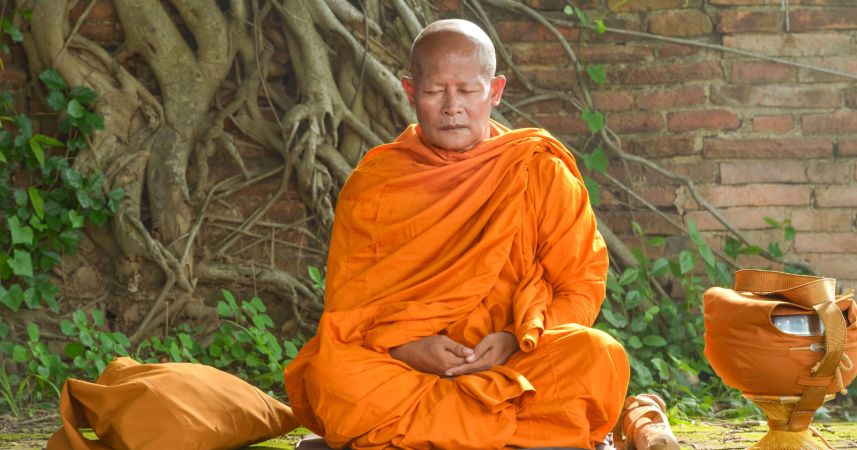
A Buddhist monk told me true productivity feels like still water, not white-water rapids—and new workplace research suggests he’s exactly right.
Tokyo’s Marunouchi Line at rush hour is a study in controlled chaos — suits, smartphones, the polite jostle of 900,000 daily riders.
Wedged between briefcases one Tuesday evening, I noticed a man in saffron robes, back arrow-straight, eyes half-closed. While everyone else swiped frantically, he seemed almost… offline. When the train hissed to a stop at Kōrakuen, we spilled onto the platform together.
On impulse, I asked — in admittedly clumsy Japanese — what a Buddhist monk was doing in the belly of commuter frenzy.
He laughed softly. “Observing busyness,” he answered, switching to English.
Over green tea at a station café, he introduced himself as Tetsu Anami, a Zen priest from a nearby temple. I asked how he stayed serene in the urban churn. His answer rerouted my notion of efficiency:
“A mind that rushes cannot finish what it starts. Calm is the shortest path to completion.”
I expected philosophy — I didn’t expect a productivity axiom. Days later, I discovered hard data that echoed his claim.
Calm over chaos: what the research says
1) Mindfulness boosts measurable work output
Aetna’s mindfulness program often gets cited in wellness decks, but the details deserve a closer look.
The insurer enrolled 12,000 employees in an eight-week course that blended guided meditation, mindful-eating demos, and short breath-awareness sessions at the start of meetings.
Post-program surveys showed participants averaged 62 extra productive minutes per week — a figure Aetna’s analysts valued at about $3,000 in annual output per employee. Their healthcare costs dipped by $2,000 each, largely from lower stress-related claims.
Follow-up at the six-month mark found the gains sustained even when formal classes ended, suggesting the habit stuck.
External auditors confirmed the methodology, noting improvements in email turn-around time and meeting-to-decision ratios.
While skeptics argue self-selection bias, Aetna compared results against a control group of similar size that received only gym stipends and saw no equivalent boost.
In real-world P&L language, calm literally added hours to the workweek.
2) Attention without adrenaline
Caffeine spikes attention; mindfulness refines it.
A 2024 study found mindfulness interventions significantly improved executive function, working memory, and cognitive flexibility — comparable to the impact of a moderate night’s sleep.
Crucially, brain-imaging sub-studies revealed lower activation of the amygdala (our alarm bell) and stronger connectivity in the dorsolateral prefrontal cortex (our planning hub) during cognitive tasks, implying the mind was focused without a stress surge. Participants also reported fewer intrusive thoughts and faster recovery from distractions.
Researchers noted benefits peaked under conditions of “parasympathetic dominance”—the low-arousal state monks cultivate.
Translation: adrenaline-free focus lasts longer and demands less metabolic cost than white-knuckle intensity, making calm a more sustainable fuel for knowledge work.
3) Less stress, better decisions — even after a 15-minute pause
Harvard Business Review spotlighted a series of experiments led by behavioral scientist Andrew Hafenbrack in which managers and MBA students completed a short, 15-minute breath-focused meditation before tackling complex business problems.
The meditators were more likely to avoid the “sunk-cost” trap (sticking with a bad investment just because money has already been spent) than the control groups, who simply relaxed or read the news.
They also finished the task faster and with fewer calculation errors, despite feeling less anxious on state-anxiety scales.
Follow-up trials with working executives replicated the accuracy gains under tight time pressure, showing that a brief dose of calm can outperform white-knuckle urgency when the stakes involve real money and deadlines.
In other words, pausing pays off — not as a luxury, but as a precision tool that cuts costly mistakes.
Why calm trumps busy (the monk’s model)
Tetsu sketched a circle on a napkin. “Imagine productivity as water,” he said. “When the surface is still, it reflects clearly, and you can see the bottom. When you stir it, visibility disappears.”
He described three pillars of calm efficiency:
-
Single-task immersion – Finish one micro-goal before touching the next.
-
Micro resets – 90-second breaths between tasks to flush adrenaline.
-
Compassionate pacing – Accept slower starts to avoid mid-day crashes.
It sounded airy until I tried it. The very next week, I swapped multitasking for Tetsu’s “one-task circle.” My email backlog shrank faster, and I felt less drained.
Silicon Valley’s silent adoption
Mindfulness may look ancient, but tech giants treat it like R&D.
Google’s “Search Inside Yourself” program now runs in various offices worldwide, with internal surveys linking it to more than a 30% drop in reported burnout.
At LinkedIn, employees earn “mindful minutes” badges in their performance dashboards, nudging participation through gentle gamification.
Even Apple’s campus meditation rooms include biometric mats that sync HRV data to the Health app, letting engineers track calm the way they track steps.
Venture capital firm Felicis went further, requiring founders in its portfolio to attend a quarterly mindfulness retreat or forfeit a wellness stipend — arguing investor returns improve when CEOs debug their own stress loops.
Calm, once fringe, is now table stakes in the most competitive coding cultures.
Even the workplace yoga and meditation have nearly doubled among U.S. employees over the past decade, correlating with stress-related healthcare costs trending downward.
Wider impact: how to engineer productive calm
Quiet practices might look personal, but their ripple effects stretch across balance sheets, healthcare budgets, and even climate initiatives (lower office energy costs when email volume drops, anyone?).
- Replace status-meet scrums with 5-minute silence windows. Teams at Aetna began meetings with quiet breathing; agenda times dropped 20%.
- Audit notification loads. Researchers found that batching Slack pings reduces task-switch cost, saving up to 40 % of mental energy.
- Embed “monk modes.” Companies like SAP schedule two-hour no-meeting blocks, reporting a jump in deep-work KPIs.
- Offer micro-mindfulness apps instead of energy drinks. Aetna’s ROI numbers suggest it’s cheaper—and healthier—than stocking office fridges with caffeine.
My personal takeaway
I left Tokyo with a business card made of handmade washi paper. On the back, Tetsu had written a single kanji: 静—sei, the character for calm. It now lives taped to my laptop.
Whenever deadlines crowd my screen, I tap that card, inhale to a count of four, exhale to six, and let my parasympathetic system do the heavy lifting.
The result isn’t slower work—it’s cleaner code, tighter prose, emails that land the first time. Calm turned out to be a force multiplier for focus, not a brake on ambition.
I still chase big goals, but I pursue them like still water: deep, reflective, and—thanks to one monk on a packed train—immeasurably productive.
If You Were a Healing Herb, Which Would You Be?
Each herb holds a unique kind of magic — soothing, awakening, grounding, or clarifying.
This 9-question quiz reveals the healing plant that mirrors your energy right now and what it says about your natural rhythm.
✨ Instant results. Deeply insightful.












