After three months of eating insects and mystery meat across Southeast Asia to prove how adventurous I was, a Vietnamese grandmother served me plain chicken soup—and completely exposed that I'd been faking open-mindedness the entire time.

Add VegOut to your Google News feed. 
You know that smug feeling when you order the "weird" thing on the menu? The one where you pat yourself on the back for being so adventurous while your friends stick to pad thai?
Yeah, I was that guy.
For three months backpacking through Southeast Asia, I'd been collecting culinary badges like a food scout. Fried crickets in Bangkok? Check. Century eggs that looked like they'd survived an apocalypse? Double check. Mystery meat from a Laos night market that I'm 70% sure wasn't dog? Triple check with a side of prayer.
I thought I was crushing this whole open-minded traveler thing. Then a grandmother in a tiny Vietnamese village served me a bowl of soup that completely shattered my illusion.
The performance of being adventurous
Here's what nobody tells you about eating bizarre foods while traveling: it can become its own form of close-mindedness.
Every time I posted another photo of myself chomping down on something that would make my mom gag, I wasn't really experiencing the food. I was experiencing the story I'd tell later. The likes I'd get. The reputation I was building as someone who'd "eat anything."
During my years living in Thailand, I'd learned enough about Southeast Asian cuisine to appreciate the complexity behind what tourists often dismiss as "weird." Working in luxury F&B had taught me that every dish has a story, a purpose, a cultural significance that goes way deeper than shock value.
But somewhere along my backpacking trip, I'd forgotten all that. I'd turned into a caricature of the open-minded traveler, more concerned with proving something than actually experiencing anything.
The village that changed everything
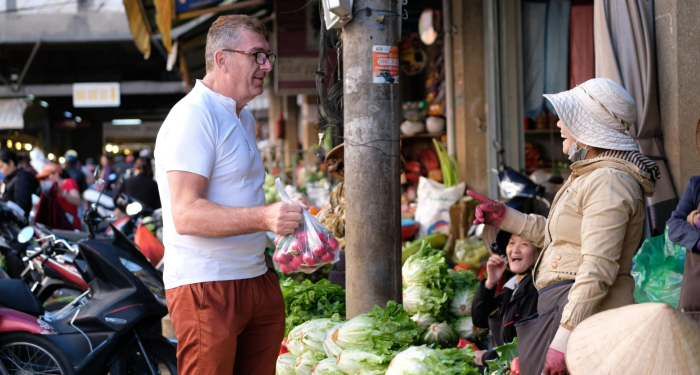
Three weeks into Vietnam, I found myself on a motorbike heading to a village whose name I couldn't pronounce if you paid me. My driver, a friend of a friend, had promised to show me "real Vietnamese food." Not the stuff they serve tourists. Not even the stuff they serve in Hanoi.
The village was the kind of place where chickens outnumbered people and everyone over 40 remembered the war firsthand. My driver led me to his grandmother's house, a modest structure that had probably looked exactly the same for decades.
She greeted us with the kind of warmth that transcends language barriers. Within minutes, she was bustling around her outdoor kitchen, preparing what I assumed would be another addition to my collection of extreme eating experiences.
Then she placed a bowl in front of me.
It was... soup. Just soup. Clear broth with some herbs, a few pieces of what looked like chicken, and rice noodles. Nothing Instagram-worthy. Nothing that would impress anyone back home.
When ordinary becomes extraordinary
My first instinct was disappointment. Where was the challenge? The adventure? The story?
But the grandmother was watching me with such anticipation that I couldn't help but pay attention as I took my first spoonful.
The broth hit different than anything I'd tasted in three months of "adventurous" eating. It was subtle but complex, familiar but surprising. Each sip revealed another layer. Star anise. Cinnamon. Something earthy I couldn't place.
The grandmother started talking rapidly in Vietnamese, gesturing at the bowl. My driver translated: she'd been making this recipe the same way for 50 years. The bones had simmered for 12 hours. The herbs came from her garden. The chicken was from the coop I'd passed on the way in.
As she spoke, I realized something that made me feel like a complete ass. This wasn't just soup. This was her life's work. Her mother's recipe. Her daily meditation. Her love language.
And I'd almost dismissed it because it wouldn't make a good story.
The difference between trying and tasting
Here's what I learned in that moment: there's a massive difference between eating something to prove you can and eating something to understand it.
For three months, I'd been putting things in my mouth without ever really tasting them. I was so focused on the act of consumption that I'd forgotten about the experience of it.
Think about it. When was the last time you really tasted something? Not just identified the flavors or decided if you liked it, but actually let it tell you its story?
That grandmother's soup forced me to slow down. To shut up. To stop performing and start experiencing.
The more I ate, the more I understood. This wasn't just about the food. The way she served it, the order she brought out the accompaniments, the specific herbs she added to my bowl but not my driver's. Every detail was intentional, personal, communicative.
The trap of performative open-mindedness
We live in an age where open-mindedness has become a performance art. We showcase our tolerance, our adventurousness, our willingness to embrace the unfamiliar. But are we actually open, or are we just open for the camera?
During my time in Bangkok, I'd watched countless tourists do exactly what I'd been doing. Eating bugs for the gram. Trying durian for the story. Treating entire cultures like content opportunities.
The thing is, when you're performing open-mindedness, you're actually closing yourself off to genuine experience. You're so busy documenting your adventurousness that you forget to actually have the adventure.
That soup wasn't adventurous by any metric I'd been using. But it required more open-mindedness than any insect I'd crunched or fermented thing I'd swallowed. It required me to shut down my ego, my need for validation, my addiction to extremes, and just be present with what was in front of me.
What real open-mindedness tastes like
Since that day, I've completely changed how I approach not just food, but experiences in general.
Real open-mindedness isn't about seeking the most extreme option. It's about approaching the ordinary with extraordinary attention. It's about letting go of your preconceptions about what's worth experiencing.
That grandmother didn't serve me bugs or blood or anything else that would shock my Western palate. She served me her truth. And that required more courage on both our parts than any extreme eating challenge ever could.
When you're truly open, you don't need to prove it. You don't need to document it. You don't need to turn it into a story. You just need to be present enough to receive what's being offered.
Final thoughts
Looking back, I'm grateful for all those insects and fermented mysteries I consumed. Not because they made me more adventurous, but because they led me to that village, that grandmother, that bowl of soup that changed how I see everything.
These days, when I write about food or travel or personal development, I try to remember that lesson. The most profound experiences rarely look profound from the outside. They don't photograph well. They don't make good party stories.
But they change you in ways that no performative adventure ever could.
Sometimes the bravest thing you can do is stop trying to be brave. Sometimes the most open-minded approach is to admit your mind has been more closed than you thought.
And sometimes, a simple bowl of soup from a grandmother who doesn't speak your language can teach you more about life than any book, guru, or extreme experience ever could.
The real question isn't whether you're willing to eat the bug. It's whether you're willing to stop performing long enough to taste it.
What’s Your Plant-Powered Archetype?
Ever wonder what your everyday habits say about your deeper purpose—and how they ripple out to impact the planet?
This 90-second quiz reveals the plant-powered role you’re here to play, and the tiny shift that makes it even more powerful.
12 fun questions. Instant results. Surprisingly accurate.