While most new vegan travelers pack their suitcases with protein bars and rehearsed speeches about factory farming, the ones who learn this counterintuitive approach end up having locals eagerly share their grandmother's secret vegetable recipes instead of awkwardly defending their dinner choices.

Add VegOut to your Google News feed. 
Look, I get it. When you first go vegan, you want to tell everyone. You've discovered something that feels profound, maybe even life-changing, and keeping quiet about it feels like betrayal.
I spent my first three years as a vegan being that guy. The one who couldn't shut up about factory farming at dinner parties. The one who made my grandmother cry at Thanksgiving because I wouldn't touch her famous stuffing.
After eight years of being vegan and traveling through over 100 countries, I've watched countless new vegans make the same mistake I did. They treat their dietary choice like a personality trait that needs constant defending. They walk into every restaurant, every family gathering, every street food market ready for battle.
And they spend their entire trip exhausted from fighting a war that doesn't need to exist.
The single piece of advice that changes everything
Here's what I tell every new vegan traveler: Stop explaining yourself.
That's it. Just stop.
No manifestos. No documentaries on your phone ready to show. No statistics about water usage. No apologetic explanations about why you can't eat what's offered.
When someone offers you food you don't eat, smile and say "Thank you, but I'm good." If pressed, "I don't eat that, but I appreciate it." End of conversation.
The moment you launch into explanations, you've already lost. You've turned a personal choice into a public debate. You've made someone else's hospitality about your ideology. And worst of all, you've guaranteed that every meal for the rest of your trip becomes a negotiation.
Why new vegans can't help themselves
Remember when you first discovered that thing that changed your perspective? Maybe it was a book about behavioral psychology, or meditation, or CrossFit. For a while, it was all you could talk about, right?
Going vegan often triggers the same response, but amplified. Because food is so central to culture and connection, changing how you eat feels like changing who you are. And when you're still figuring out this new identity, you feel compelled to justify it constantly.
I've mentioned this before, but identity shifts make us temporarily insufferable. We're not trying to be annoying. We're trying to convince ourselves as much as anyone else that we've made the right choice.
In unfamiliar countries, this gets worse. You're already navigating cultural differences, language barriers, and social norms you don't fully understand. Adding dietary restrictions to that mix can make you feel like you need to over-explain just to be understood.
But here's what actually happens when you do that.
The apologetic vegan spiral
You know the type. They enter a restaurant in Bangkok or Barcelona and immediately launch into their spiel. "I'm so sorry, I'm vegan, I know it's complicated, do you have anything without meat or dairy or eggs or fish sauce?"
The server looks confused. Not because they can't accommodate you, but because you've turned ordering food into an emotional transaction.
Now every meal becomes this dance of apology and explanation. You're not just ordering food anymore. You're performing your dietary identity for an audience that didn't buy tickets.
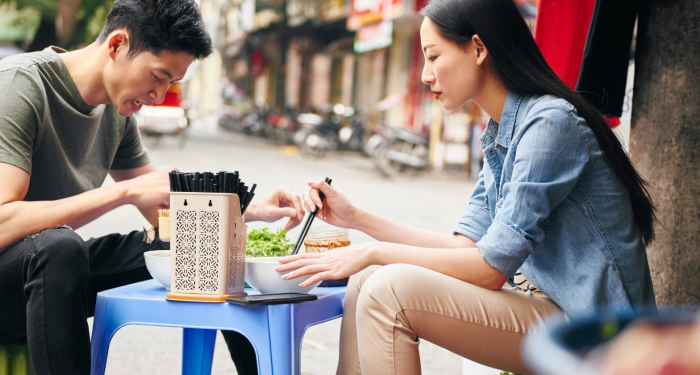
I watched a fellow traveler in Vietnam spend twenty minutes explaining veganism to a street food vendor through a translation app. The vendor just wanted to know if she wanted tofu or not.
By the end, both of them looked exhausted, and she barely touched the food because she'd worked herself into anxiety about whether it was "really" vegan.
Compare that to my friend who simply pointed at the vegetable spring rolls and smiled. No drama. No dissertation. Just lunch.
Food is connection, not ideology
What changed everything for me was realizing that most people offering food aren't trying to challenge your beliefs. They're trying to connect with you.
When that Italian grandmother insists you try her ragù, she's not attacking veganism. She's offering love through food. When the Japanese host presents you with sushi, they're sharing their culture, not testing your convictions.
The moment you understand this, everything shifts. You stop seeing these moments as battles to win and start seeing them as connections to navigate with grace.
How to actually navigate food while traveling vegan
Learn to say "no thank you" warmly in the local language. Not "no thank you because..." Just "no thank you." Practice until it sounds natural, not defensive.
Research before you arrive, not after you're seated. Know what local dishes are accidentally vegan. Most cultures have plant-based foods that aren't labeled as such because they're just... food.
Find the phrases that work. "I eat very simple food" works better than "I'm vegan" in most of Asia. "No animal products, please" is clearer than ideological labels in South America.
Stop treating restaurants like conversion opportunities. The waiter doesn't care why you're vegan. They just need to know what you want to eat.
And please, for everyone's sake, stop posting those "being vegan in [country] is SO HARD" social media updates. You chose this. Own it without the martyrdom.
When to break your own rules
After my grandmother cried that Thanksgiving, something broke in me. Not my commitment to veganism, but my need to make it everyone else's problem.
Sometimes the kindest thing you can do is quietly work around the situation without making it the center of attention. Eat before the family gathering. Bring a dish to share. Focus on the sides.
There's more courage in navigating these moments with grace than in standing on principle every single time.
The unexpected side effect of shutting up
Here's what nobody tells you: When you stop explaining yourself, people become genuinely curious instead of defensive.
I can't count the number of times someone has noticed what I'm eating and asked about it naturally. These conversations are completely different from the forced explanations. They're curious, not confrontational. They lead to recipe exchanges, restaurant recommendations, and genuine cultural exchange.
But these conversations only happen when you're not forcing them.
Wrapping up
After 100 countries, the pattern is crystal clear. The vegans who thrive while traveling are the ones who treat their diet like a personal choice, not a public statement. They navigate food cultures with curiosity instead of defensiveness. They understand that every meal doesn't need to be a teaching moment.
You want to know the irony? The vegans who talk about it the least often inspire the most change. Because they show, rather than tell, that this way of eating is just... normal. Not a sacrifice. Not a struggle. Just a choice that doesn't require constant explanation or apology.
So if you're planning to travel as a new vegan, practice this: Order your food, enjoy your trip, and save the advocacy for people who actually ask. Trust me, you'll have more energy to actually enjoy the places you're visiting. And isn't that why you're traveling in the first place?
What’s Your Plant-Powered Archetype?
Ever wonder what your everyday habits say about your deeper purpose—and how they ripple out to impact the planet?
This 90-second quiz reveals the plant-powered role you’re here to play, and the tiny shift that makes it even more powerful.
12 fun questions. Instant results. Surprisingly accurate.