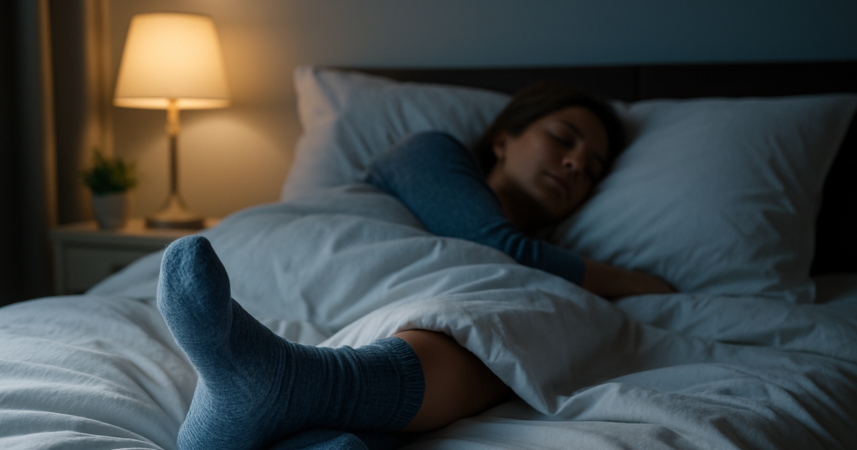
Warm toes, faster zzz’s: seven psychology-backed traits of sock-sleepers—and how to try the trick without overheating.

Add VegOut to your Google News feed. 
Here’s a confession I didn’t expect to make on the internet: I sleep with socks on when the weather turns.
Not every night—just when the room’s a little too crisp or my feet feel like two small ice packs.
The first time I tried it, I fell asleep so fast it felt like a cheat code. The cook in me thought, “Right, this is basically pre-warming the plates before service—same food, better experience.”
And yes, there’s real science behind it.
Warming your feet increases blood flow in your extremities, which helps your core temperature drift down—the exact signal your brain uses to switch into sleep mode.
In one controlled study, people who wore “bed socks” fell asleep about 7.5 minutes faster, slept 32 minutes longer, and woke up less often than when they went sockless. The effect tracks with a well-established sleep mechanism called the distal-to-proximal temperature gradient (the warmer your hands/feet relative to your torso, the faster you tend to conk out).
So who are the people who swear by socks in bed?
Based on the research (and a lot of late-night kitchen-brain experimentation), they usually share a few traits.
1. They prioritize falling asleep fast
Sock-sleepers tend to be outcome-driven about sleep. They don’t want a vibe; they want results. Physiologically, they’re tapping into a simple lever: warm the extremities, the blood vessels open (vasodilation), heat escapes, core temp dips, and sleep shows up.
That distal-to-proximal gradient is one of the best predictors of how quickly you nod off.
It’s why a warm bath or heating pad on the feet can work, too—you’re manipulating the same system.
If you’re curious, you don’t need fuzzy novelty socks to test the effect. A thin pair of bed socks or a short warm foot soak can give you the same thermoregulation nudge.
Even mainstream outlets have started to point this out, noting that while the studies are small, the mechanism is solid and the downside risk is minimal for healthy people.
2. They build rituals—and stick to them
People who wear socks to bed often treat sleep like an athletic performance: same pre-game routine, same outcome. In sleep medicine, that’s called sleep hygiene, and consistent routines are a cornerstone.
The National Sleep Foundation emphasizes regular timing and repeatable wind-down habits as levers for better sleep quality. If pulling on socks is part of the cue stack that tells your brain “we’re shutting down now,” that habit is doing real work.
It’s the hospitality mindset, honestly. Great restaurants run on rituals—mise en place, fire times, plate checks. Sock people are applying the same logic to bedtime.
3. They’re thermally sensitive (and pay attention to their bodies)
Some of us are simply more sensitive to temperature swings—especially in our hands and feet.
The sleep-science literature is full of references to how a warmer “distal” temperature (hands/feet) relative to “proximal” areas predicts faster sleep onset.
People who notice they sleep better with warm toes are basically good at interoception: reading their internal signals and acting on them.
In older adults and in some insomnia cases, that heat-loss response can be blunted, which may be why targeted warming helps certain groups more than others.
This is where socks shine: they’re a small, reversible tweak that turns “I feel chilly” into “I’m out in five minutes.”
4. They use comfort as a stress regulator
Quote I love: “Pressure can be calming.” It shows up everywhere—from a hand on your shoulder to the way a snug duvet can quiet a racing mind.
Research on self-soothing touch finds it can reduce stress-hormone responses to tough moments.
Weighted blankets—the more dramatic cousin of sleep socks—have randomized evidence for improving insomnia severity in some clinical populations, likely by providing steady pressure that downshifts the nervous system.
Socks aren’t a weighted blanket, but the tactile comfort sits on the same continuum: warm, gentle, predictable.
If your brain treats “soft, warm socks” as a safety cue, you’ll slide into sleep more easily. That’s psychology doing what it does best—linking a sensation to a state.
5. They’re prone to cold feet (sometimes literally)
There’s also a less romantic explanation: some people just run cold in the extremities.
Conditions like Raynaud’s phenomenon involve exaggerated blood-vessel narrowing in fingers and toes, especially with cold exposure, which can make feet feel numb or painfully chilly.
Cold hands/feet are also linked with a longer time to fall asleep—no surprise if your heat-loss system can’t get going.
Warm socks (not tight ones) are a practical workaround; medical sources even suggest heated socks for some Raynaud’s patients.
Quick caution: if you have circulatory issues or foot skin infections, talk to a clinician before making socks a nightly thing. Better to be safe and sleep well than guess and guess wrong.
6. They like cool rooms—but cozy bodies
If you share a bed, you know the thermostat wars. Sock-sleepers often solve it by keeping the room cool (which most sleep experts recommend) while warming the part that bothers them most: the feet.
The Sleep Foundation notes that many people sleep best in the mid-60s °F (about 18–20 °C), and warming the feet can help you reach sleep faster even in a cooler room. That way your partner gets their alpine breeze, and you get your fast pass to dreamland. Sleep Foundation
I do this in winter: cool air, warm toes, heavy duvet. It’s like eating gelato in February—contrast makes it better.
7. They’re evidence-minded (and myth-resistant)
Any time socks and sleep trends pop up online, the “socks boost orgasms by 30%” claim starts making the rounds.
Fun headline, shaky evidence.
The widely shared stat seems to trace back to a small neuroscience presentation about comfort in a lab setting, and fact-checkers have since flagged that there’s no robust evidence that socks directly increase orgasm probability like a magic trick.
If warmer feet make you feel more comfortable and less distracted, sure, that can help intimacy—but that’s a comfort effect, not a superpower. Sock people, in my experience, care more about what’s true than what’s viral.
Being myth-resistant is a great sleep trait in general. You test small changes, you keep the ones that work, you ignore the noise.
Bottom line
If you want the headline version of the science, it’s this: warm feet help you fall asleep faster by letting your core temperature fall.
Sock-sleepers aren’t weird — they’re strategic. They tend to value routines, read their bodily cues, and use comfort as a tool—not a crutch.
The psychology and physiology point the same way: a little warmth at the edges makes it easier for the center to let go. If that sounds like your kind of experiment, start tonight with a breathable pair in a cool room and see how fast you drift.
And yes, this lines up with life outside the lab.
In my old kitchens, we pre-warmed plates not to be fancy but to preserve the temperature gradient—hot stays hot, cold stays cold—so the dish hits the table at peak.
Sleep has a temperature dance, too. You don’t have to memorize the distal-to-proximal gradient to benefit from it; you just have to give your body the cue.
What’s Your Plant-Powered Archetype?
Ever wonder what your everyday habits say about your deeper purpose—and how they ripple out to impact the planet?
This 90-second quiz reveals the plant-powered role you’re here to play, and the tiny shift that makes it even more powerful.
12 fun questions. Instant results. Surprisingly accurate.