A data-driven shortlist of 10 retire-abroad sweet spots—ranked by real 2025 costs, not hype. Find out where your budget actually breathes.

Add VegOut to your Google News feed. 
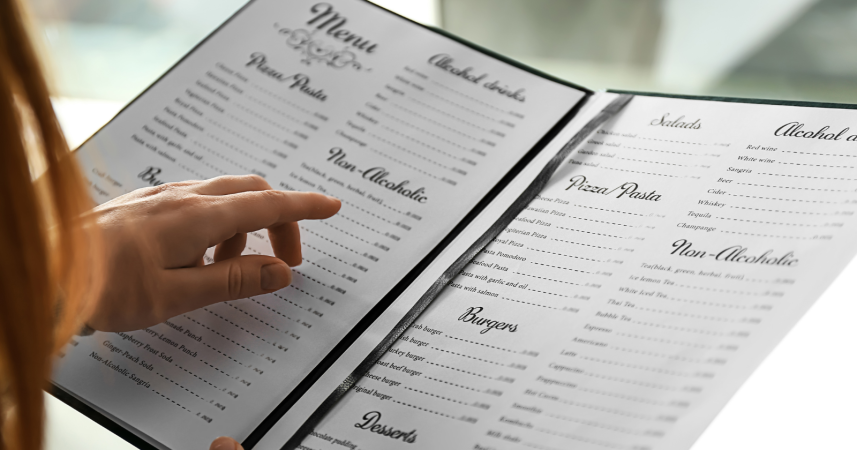
Some people skim menus like they’re scanning for land from a ship: top left, down the middle, done.
If you’re the person who flips to the back page first—or scrolls straight to the bottom—you’re doing something more interesting.
After a decade of café hopping across countries (and a frankly indecent number of pastry counters), I’ve noticed a pattern: end-to-start menu readers share certain psychological quirks.
None of them are “good” or “bad.” They’re simply the ways your brain saves you from choice overload and marketing theater.
Here’s what psychology suggests you’re signaling when you start where most people finish—and how to make that trait work for you (and your dinner).
1. You resist anchoring—and marketing knows it
Menu designers bank on anchoring and primacy effects: the first price you see creates a reference point, and the items you encounter earliest loom larger.
When you head to the end, you quietly break that spell. You’re opting out of the “$42 steak sets the tone so the $29 pasta feels cheap” trick. You’re also less swayed by the prettiest fonts and prime real estate.
This isn’t contrarian for sport—it’s cognitive self-defense.
You want your appetite, not the layout, to drive the decision.
Use it: keep scanning bottom-up for the items with fewer adjectives and more specifics (cut, method, provenance). Those tend to be the honest dishes that don’t need fireworks to sell themselves.
2. You’re a planner who treats meals like stories
People who peek at the end of the menu first often peek at the end of novels, too (no judgment—I see you).
In food terms, that means starting with desserts, sides, or “afters” so you can plan the arc. This is future-oriented behavior, the same impulse behind setting alarms or packing the night before: you’re preventing regret by shaping the end before you commit to the beginning.
Psychologically, you’re practicing a form of goal shielding.
You don’t want to arrive at the end stuffed and wistful, so you budget attention and appetite.
Use it: if a dessert is non-negotiable (hello, olive-oil cake), split a starter or pick a lighter main. Future-you thanks present-you for the precommitment.
3. You prefer data to dazzle (high need for cognition)
Starting at the bottom is a little nerdy—in the best way.
Menus often tuck allergens, substitutions, cooking methods, and “chef’s notes” near the footer. End-first readers gravitate toward the fine print because they like the puzzle more than the billboard.
That’s need for cognition: enjoyment of thinking through details rather than being swept along by vibes.
Use it: scan for signals of craft—house-fermented, hand-cut, cooked over fire, made to order. Ask one precise follow-up question (“Is the broth chicken or kombu-based?”). You’ll order smarter without becoming the table’s cross-examiner.
4. You manage choice overload by chunking
When a menu runs long, the brain melts a little.
End-to-start readers often counter choice overload by chunking: dessert → mains → starters, or chef’s specials → pastas → salads.
Working backward gives you smaller, themed piles instead of one big avalanche.
This is classic cognitive off-loading: you create lanes for your attention so you don’t burn glucose on indecision. Use it: decide the section before the dish.
“I’m in a soup mood” is half the choice.
Then apply a quick rule (brothy over creamy; vegetable-forward over heavy) and you’re eating while everyone else is still debating “what they’re in the mood for.”
5. You price-check without being cheap (hello, mental accounting)
End-caps often hide smaller plates, sides, and the “light fare” that play nicer with budgets and appetites.
If you naturally scan there, you’re using mental accounting: matching hunger, price, and value without drama.
It’s not stingy — it’s sane.
You’d rather assemble a plate you love than overbuy a main you don’t finish.
Use it: build your own “main” from two small plates and a side (grilled veg + lentils + salad), or split a bigger dish and add one interesting side. You get variety, satiety, and a check that reflects intention, not inertia.
6. You have an explorer’s streak (variety seeking, openness)
Plenty of restaurants stash the odd ducks—seasonal experiments, limited runs, regional throwbacks—near the end or on the last column.
If you instinctively look there, you’re probably higher in openness to experience and variety seeking. Your palate likes a plot twist: bitter greens, pickled things, smoky oils, crunchy-soft textures.
Use it: adopt a “one safe, one wild” rule. If your main is classic, let your starter/side be weird (the charred cabbage with chili crisp, the citrus-marinated beets).
If you go wild on the main, bookend with comfort. You’ll get the dopamine of novelty with the calm of familiarity.
7. You self-advocate—kindly (regulatory focus)
People who read bottom-up often have a prevention focus in crowds: they watch for constraints (allergens, heat levels, up-charges), not because they’re negative but because they plan to stay comfortable.
That makes you the friend who quietly checks if the broth is vegetarian or the dressing has anchovy before the rest of the table orders.
Use it: phrase questions in ways servers love: “Which dishes are naturally vegan?” beats “Can you remove everything?” Or “Is there a way to get that chili oil on the side?”
You’ll get better answers—and sometimes off-menu kindness—because you’re collaborating, not negotiating.
Bonus micro-signals your menu habit gives away
-
You like endings tidy. Glancing at desserts first scratches the itch of knowing how the scene closes.
-
You’re less impulsive than you look. Skipping primacy bias reduces “I’ll just get the first thing that sounds good” ordering.
-
You’re comfortable ignoring the crowd. Everyone else coos over the top-left signature dish; you’re happily reading the coda.
Make your end-to-start style work even harder
1) Ask for the “little menu.” Lots of places keep a quiet list: off-menu veggies, a simple broth, a plain grilled protein, sorbets. Your detail-minded style pairs beautifully with this insider lane.
2) Order in phases. If the bottom told you dessert is a must, don’t force a heavy main. Start with a side and a small plate; order more if needed. Restaurants aren’t exams—you can add pages.
3) Share the map. You’re great at spotting value and curiosities. Offer one helpful line to the table (“The last page has the seasonal veg—there’s a charred leeks thing I’m into”). Then let people do their chaos.
4) Use the “two-question” rule. End-first readers can drift into interrogation. Cap yourself at two questions—one about composition, one about portion/heat. If you still can’t decide, ask for the server’s favorite in the category you’ve chosen.
5) Keep a tiny memory bank. When you discover a “last-page legend,” jot it in your notes app under the restaurant’s name. You’ll skip the decision tax next time and look like a regular who knows things (because you do).
A tiny story to close
On a rainy night in Porto, I picked up a laminated menu the size of a placemat and went straight to the last column.
Tucked at the bottom was “tomate assado com azeite fumado”—baked tomatoes with smoked olive oil and breadcrumbs. It read like a whisper next to all the capital-letter SEAFOOD. I ordered it with a simple caldo verde and a glass of house red.
My friend went first-column big: a grilled fish that flopped over the plate like a celebrity.
Halfway through, he traded me bites and said, mouth full of smoky crumbs, “I never would’ve seen this.” That’s the whole point. Reading end-to-start won’t save every meal, but it will save you from default experiences.
It’s a small act of sovereignty in a world that loves to tell you where to look.
So yes—if you start at the end, psychology says you’re a planner, a skeptic, a gentle contrarian, a variety seeker, a detail lover, a budget whisperer, and a decent teammate at the table.
Keep the habit.
Just promise me one thing: if the last line mentions olive-oil cake, read it twice. Then plan accordingly.
Related Stories from VegOut
- Children who were praised for being mature beyond their years almost never experienced that as a compliment — they experienced it as confirmation that their childhood was already over and nobody was coming to give it back
- There's a version of niceness that belongs to people who learned early that being liked was safer than being honest - and they've been performing warmth for so long they can't tell where the performance ends and they begin
- The loneliest moment of my adult life wasn't when I was alone - it was sitting in a room full of people who knew my name but not my mind, and realising I'd been curating a version of myself that was impossible to actually connect with