Fifty happy marriages shared one secret: a daily doorway hello that turns a house back into a home.
I thought the answers would be all over the map.
Weekend getaways. Shared hobbies. Date nights with candlelight and high-proof cocktails. But after asking fifty happily married couples—people who still smiled when they said their partner’s name—one theme kept showing up like clockwork.
Every single one of them named the same daily moment. Not the date night. Not the big vacations. A tiny ritual at home that took less time than brewing coffee.
It was the first hello when they reunited each day.
The first hello changes the whole day
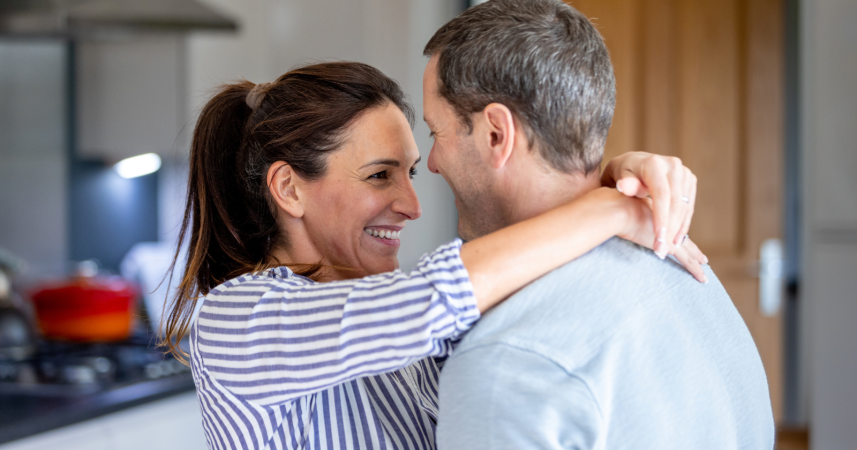
The wording varied—“doorway minute,” “welcome-home hug,” “first look,” “six-second kiss”—but the bones were identical: when we come back together, we stop and greet each other like we matter.
No multitasking. No shouting from the hallway. Eyes up. Bodies close.
Something warm said out loud. Sometimes a quick kiss, sometimes three deep breaths together, sometimes just “I’m happy to see you.”
It sounds too small to move the needle. It isn’t. It’s the switch that turns a house back into a home.
Why that tiny moment works (and keeps working)
As psychologist John Gottman has shown, strong relationships aren’t built on grand gestures—they’re built on “turning toward” the small bids for connection, repeatedly, over time.
That first hello is a built-in bid. You’re telling your partner with your attention, touch, and tone: you come first, everything else can wait.
Biologically, you’re downshifting.
Eye contact and affectionate touch release oxytocin, nudging stress hormones down. Your nervous systems sync. The day’s edges soften. When the greeting is reliable, your brain stops bracing and starts belonging.
Translation: two minutes of presence buys you hours of ease.
What the happiest couples actually do
None of these couples had perfect lives. Kids, deadlines, aging parents, kitchen-table budgets—you know the list. But they treated the first hello like a sacred checkpoint.
Here’s their playbook, repeated in different flavors:
-
Phones go face down. For 60–120 seconds, the outside world waits.
-
They close the distance. A hug, kiss, or hand squeeze. Real contact, not a drive-by.
-
They say one true thing. “I’m glad you’re here.” “You look tired; I’ve got dinner.” “I missed you.”
-
They preview the tone. “Let’s sit for five before we jump back in.” Or “I need ten to decompress, then I’m all yours.”
-
Then they move on—together. To homework, to dinner, to the dog who’s been doing zoomies since 4 p.m.
No couple mentioned scripting a TED Talk at the door. The point isn’t content. It’s attention.
The hospitality lesson I can’t unsee
I spent my twenties in luxury F&B, and the happiest marriages remind me of a great service team’s first minute before doors open.
In a kitchen, you don’t barge straight into chaos. You take a breath, taste the sauce, lock eyes with your line mate, and nod: we’re good? we’re good.
That tiny check-in sets the rhythm that carries you through the rush.
Home is similar. If you greet each other like teammates, everything that follows feels less like triage and more like choreography.
How we turned it into a habit at home
We stole what worked.
Our doorway minute looks like this: one kiss, three slow breaths with hands on each other’s backs, then one sentence that names reality—“Big day.
I’m excited to tell you, but after I change.” Or “I’m fried. Can we walk while dinner cooks?”
We still have messy evenings. But the mess lands differently because we’ve already said, “We’re on the same side.” And on the nights we forget?
We feel it.
The whole house runs just a little rougher, like a pan that didn’t preheat.
A few small upgrades that make it stick
If you want this to become your autopilot, try what the happiest couples taught me:
-
Anchor it to location. The greeting happens at the threshold—door, hallway, kitchen island. Same spot, same cue.
-
Create a micro-ritual. A “welcome home” playlist, the same goofy line, or a six-second kiss. (Six seconds is long enough to melt the armor.)
-
Make space for decompression. If one of you needs quiet first, the greeting includes that boundary: “I’m thrilled to see you; give me five to land.”
-
Let the kids see it. It teaches them what love looks like between adults: calm, warm, reliable.
-
Protect it when traveling. On the road, we “first hello” on FaceTime—camera on, eyes up, same breath, same words. It counts.
What the first hello is not
It’s not a performance. It’s not perfect. It’s not a test you can fail.
It is not the moment to litigate the day, scorekeep, or shove twelve decisions into sixty seconds. It’s a reunion. Business can follow. If something is simmering, one couple gave me a line I now keep in my pocket: “I’m so happy you’re home; can we park the tough thing for ten and then do it justice?”
Tenderness first, then logistics. It’s incredible how many fires never ignite when the first move is softness.
Finally, let it be small and let it be every day
Finally, every couple emphasized the same truth: the greeting works because it’s ordinary.
Not once a week. Not when you feel like it. Every day you can. Small things, often. It’s the espresso shot for your marriage—tiny, concentrated, and taken daily so the whole machine hums.
When you greet each other like this, you change the weather in your home. You tell your nervous systems, your kids, your future: here is a place where we arrive and are received. Here is a place where the first words are “I’m glad you’re here,” not “Did you remember the milk?”
If you want a simple way to strengthen the whole relationship, start at the threshold. Put your bag down. Put your phone down. Look at the person you chose and say—with your eyes, your hands, your breath—welcome home.
The rest of the night will make more sense.