
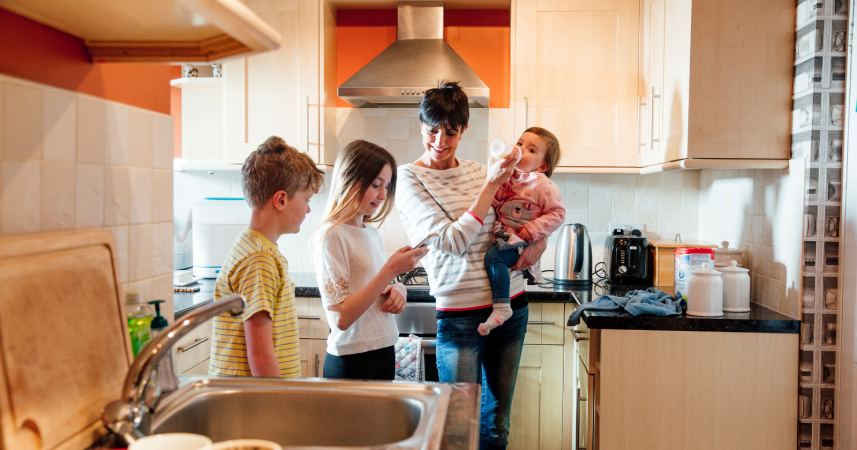
The items on lower middle class counters aren’t clutter—they’re systems that buy back minutes and sanity, every single day.
Autopilot gets a bad rap, until you’re a parent and it’s 7:14 a.m. and someone’s asking where the permission slip went while the toast burns.
Lower middle class kitchens are labs for this kind of everyday engineering.
The counters don’t just hold stuff; they hold systems. Things live out, not because there’s nowhere else to put them, but because they earn their square inches by shaving micro-minutes off the chaos.
If you’ve ever wondered why the same objects keep showing up in the same spots in the same homes, it’s because they’re doing the invisible work of a smoother week.
Here are 8 things I see again and again and how each one quietly keeps the family machine running.
1. The coffee maker that doubles as a morning clock
There’s usually a drip machine or pod brewer parked at the edge of the sink triangle, and it’s more than caffeine.
In fact, it’s schedule glue.
The auto-brew timer becomes the house’s alarm clock; the sound of the first drip means shoes should be on by the second cup. A small basket or mug tree nearby corrals filters, pods, and travel lids so no one is rummaging while half awake.
If you want a tiny upgrade without spending much, add a lidded sugar jar and a spoon rest.
The goal isn’t café cosplay. It’s one motion from bed to cup to door with zero scavenger hunts.
2. The fruit bowl that buys a better snack choice
You’ll almost always see a bowl of apples, bananas on a hanger, or a heap of clementines living in plain sight.
Visibility is strategy: what’s easiest gets eaten. The bowl does two jobs: it gives after-school grazers something decent to grab, and it lets parents clock what’s ripening so produce gets queued into dinner before it dies.
If you’re battling fruit flies or bruises, switch to a shallow, breathable bowl and keep a small “ripe soon” plate beside it.
That plate is your dinner prompt: bananas into smoothies, soft tomatoes into sauce, pears into a crumble. The counter becomes a gentle nudge, not a guilt pile.
3. The mail bowl and bill clip (a.k.a. paper triage)
Every kitchen has a paper gravity well.
Lower middle-class parents don’t pretend the avalanche isn’t coming, they stage for it.
One bowl or tray catches keys, loose coins, receipts; a magnetic clip or wall file nearby holds the stuff that actually needs action: bills, school forms, field-trip cash. The rule of survival is three piles: “pay,” “sign/return,” and “shred.”
Add a $5 pair of scissors and a cheap stapler to the bowl and you’ve turned a mess into a micro-office.
Want to make it sing?
Tape a sticky note with the week’s two due dates on the inside of the cabinet above it. That eye-level reminder has saved more late fees than any app.
4. The school command strip: calendar, pens, and the “last chance” basket
Right next to the fridge—prime real estate—you’ll find a magnetic calendar or whiteboard, a couple of dry-erase pens on a string, and a shallow basket labeled “return to school.”
That basket is where permission slips go once signed, library books sit once found, and the odd mitten waits for its bus reunion.
The counter underneath becomes a launchpad every morning: lunch bags assemble left to right, water bottles line up for inspection, and the day’s hand-offs migrate into backpacks.
If your mornings feel like a drill without a drill sergeant, mount two magnet clips and a whiteboard line for each kid: “Needs signature,” “Goes back tomorrow.” It’s not cute, but neither is discovering a fundraiser envelope under the toaster at 8:07.
5. The slow cooker or air fryer that buys a weeknight
Is it glamorous? No.
Does it save dinner? Constantly.
A slow cooker lives out because it turns a $6 bag of dry beans, a jar of salsa, and an onion into tacos without a babysitter. An air fryer earns its cord by taking freezer vegetables and a block of tofu from “why” to crispy in 14 minutes while homework happens.
Lower middle class counters prioritize appliances that remove standing time and guesswork. The secret is keeping a short list of “dump-and-done” recipes on a sticky note taped inside the nearest cabinet.
When the brain is a void, the cabinet whispers: beans + broth + spices 6–8 hrs low; potatoes + paprika 20 min; broccoli + lemon 8–10 min.
Dinner stops being a decision and starts being a setting.
6. The lunch box lane: bottles, bento, and the crumb brush
Reusable water bottles, bento boxes, tiny condiment jars—if they’re not within arm’s reach, they might as well not exist on a Tuesday morning.
Families keep them out because drying racks disappear them and cabinets hide them. A shallow bin or drawer-organizer on the counter keeps lids mated to bodies (marriages saved), and a cheap handheld crumb brush or mini vac sits next to it to reset the zone in 30 seconds.
If allergies or preferences are in play, color-code containers by kid so nobody ends up with someone else’s hummus.
Pro move: fill bottles the night before, park them in the fridge door, and the counter only hosts the quick assembly, not the whole production.
7. The snack zone that prevents the 5 p.m. mutiny
Two clear canisters: one for crunchy, one for sweet, plus a stack of small bowls or portion cups.
That’s it.
The counter earns its keep by making “yes” easy within limits. Parents in this income band know the 5 p.m. danger hour: blood sugar low, patience lower. A visible snack rule (“one from each bin before dinner”) buys time and sanity without turning the pantry into a locked vault.
Rotate contents based on sales and seasons: popcorn kernels you pop on the stove, pretzels, roasted chickpeas; then dried fruit, a jar of applesauce pouches, or a chia pudding cup.
You’re not building a store. You’re setting guardrails that kids can run themselves while you finish the pan on the stove.
8. The charging + catch-all corner that keeps departures calm
Phones, earbuds, a cheap power strip, maybe a watch charger - the corner outlet becomes a dockyard.
Beside it: a small tray for wallets, transit cards, and the key fob that vanishes when you’re already late. Lower middle class parents live on punctuality because grace windows are smaller; missing a train means losing an hour.
The counter is accountability: everything has a hook or a slot, and nothing migrates to the kitchen table where it will be buried under worksheets.
If your cords look like spaghetti, spend $8 on cord clips and label them with washi tape: MOM, DAD, KID. The five seconds you save at night become three fewer arguments in the morning.
Final thoughts
What lives on a lower middle class counter isn’t clutter; it’s choreography. Coffee cues the day. Fruit nudges better choices.
Paper has a parking spot. School has a launchpad. Dinner is a button, not a saga. Lunch gets a lane. Snacks get a system. Power has a dock.
When life asks a lot and budgets ask for proof, the counter becomes command central because every object earns its rent in minutes saved and decisions removed. If you want your kitchen to feel calmer without a renovation, steal one idea and make it visible. Put the thing you need at the height you live.
Tape the cue where your eyes already go. Autopilot isn’t laziness; it’s kindness you gave your future self at 7:14 a.m.












