It's about engaging your senses and creating an environment that works with your brain, not against it.

Add VegOut to your Google News feed. 
Ever notice how some days your home office feels like a creative dead zone?
You sit down, coffee in hand, ready to tackle the world... and nothing. The walls seem to close in, and that spark of inspiration stays frustratingly out of reach.
Well, here's the thing: your environment shapes your mindset more than you might realize. When your workspace feels stale, your ideas tend to follow suit.
The good news? You don't need a complete office overhaul or expensive furniture to transform that energy.
I've spent years tweaking my own workspace, testing what actually moves the needle and today, I'm sharing five simple adjustments that I think can turn your home office from a productivity desert into an inspiration oasis.
Ready to make your workspace work for you?
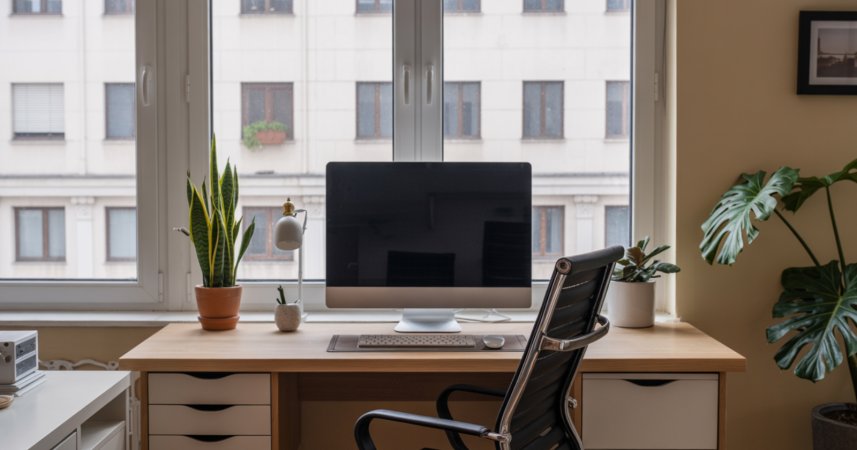
1. Bring nature to your desk
Remember that feeling when you step outside after being cooped up indoors all day? That instant relief, that mental clarity?
Well, research has suggested that just having a plant on your desk can give you some of the same benefits, reducing stress and anxiety.
I started with a single pothos plant (nearly impossible to kill, trust me). Now I've got three plants creating a mini jungle around my monitor.
The difference? Subtle but real. Those moments when I'm stuck on a problem, I find myself looking at the leaves instead of doom-scrolling.
Can't keep plants alive? Even a nature photo or a small desktop fountain can create that natural element your brain craves.
2. Let your nose do some work
What does inspiration smell like to you? For me, it's the scent of fresh coffee mixed with a hint of eucalyptus.
We often forget that our sense of smell directly connects to memory and emotion. That's why certain scents can instantly transport us or shift our mood.
Researchers in one study back this up noting that "Aromatherapy combined with music therapy had a significant effect on test anxiety, state anxiety, stress" .
I keep a small essential oil diffuser on my bookshelf. Peppermint for those sluggish afternoons, lavender when deadlines are making me tense, citrus when I need an energy boost. It's like having different productivity modes I can switch between.
Trust me, give it a shot!
3. Add art that actually speaks to you
Bare walls are creativity killers. They're like working inside a blank Word document - uninspiring and oddly pressure-inducing.
As Picasso said, "Art washes away from the soul the dust of everyday life". And in my experience, he wasn't wrong. The key is choosing pieces that resonate with you, not what looks good on Instagram.
I've got a mix on my walls - a vintage concert poster from a show I'll never forget, a print from a local artist I met at a farmers market, and yes, even some of my own amateur photography attempts. Each piece tells a story or sparks a memory.
Don't overthink it. That postcard from your last vacation? Frame it. Your kid's drawing that makes you smile? Up it goes.
The goal isn't to create a gallery - it's to surround yourself with visual reminders of what lights you up.
4. Rethink your lighting game
Ever wonder why you feel more creative in a coffee shop than under those harsh overhead lights? Lighting sets the entire mood of your workspace.
Most home offices suffer from what I call "interrogation room syndrome" - one bright overhead light that makes everything feel flat and lifeless.
The fix? Layer your lighting like you're creating a scene.
I ditched my ceiling light for a combination of sources: a warm desk lamp for focused work, LED strips behind my monitor to reduce eye strain, and a floor lamp in the corner for ambient glow. The difference was immediate - my office went from feeling clinical to cozy.
Natural light is still king, though. Position your desk near a window if possible, but perpendicular to avoid glare. Can't move your desk? Even a strategically placed mirror can bounce daylight deeper into your space.
5. Design for movement and flexibility
Last but definitely not least, static spaces create static thinking.
If you're sitting in the exact same position, staring at the exact same view for eight hours, your brain goes into autopilot.
To tackle this, I've set up what I call "work zones" - my main desk for focused tasks, a standing desk converter for calls, and a reading chair with a side table for brainstorming sessions. Even just rotating between sitting and standing keeps my energy flowing.
No room for multiple setups? Small tweaks work too. A lap desk lets you move to the couch occasionally. A wobble cushion on your chair keeps you subtly active. Even rearranging your desk items weekly can shake up your perspective.
The point is to build in reasons to move, shift, and see your work from different angles - literally.
Final thoughts
So there you have it - five tweaks that can transform your home office from uninspiring to energizing.
Notice what they all have in common? They're not about buying expensive furniture or doing a complete renovation. They're about engaging your senses and creating an environment that works with your brain, not against it.
Pick one change and try it this week. See how it feels. Then maybe add another. Your workspace should evolve with you, not stay frozen in time.
I've mentioned this before, but environment really does shape mindset. When you create a space that inspires you, the work that comes out of it changes too. Suddenly, Monday mornings don't feel quite so daunting.