
Some phrases instantly give away someone’s age, not by years, but by era. These eight classic boomer expressions once ruled conversations, but today they sound more nostalgic than natural. If you still say them, you might be living in a linguistic time capsule.
Every generation has its own language. The words we choose reveal not just our age, but the era our mindset is stuck in.
I’m not talking about slang — slang evolves fast.
I’m talking about the kind of phrases that quietly give away someone’s worldview, the ones that make you think, “Ah, this person hasn’t updated their internal software since 1987.”
Language shapes how we see the world. When we keep using outdated expressions, we often hold onto outdated ideas too.
Let’s look at a few of those telltale phrases — the ones that instantly reveal someone might be living mentally in another decade.
1) “Kids these days…”
If you’ve ever caught yourself saying this, take a breath. You might be showing your age — not in years, but in mindset.
“Kids these days” usually precedes a complaint: “don’t work hard,” “are glued to their phones,” “don’t respect tradition.”
But here’s the thing — every generation has said this about the next. Even Socrates supposedly complained that youth “love luxury and have bad manners.”
What’s really happening is that older generations view new behaviors through an outdated lens.
Change feels uncomfortable, especially when it challenges how we learned to measure value — productivity, discipline, hierarchy.
But younger generations aren’t lazy; they’re just operating in a different world. They question hustle culture, prioritize mental health, and expect transparency. That’s evolution, not decline.
If you hear “kids these days” coming out of your mouth, try replacing it with curiosity: “What are young people seeing that I’m missing?”
2) “Back in my day…”
This phrase always makes me smile because it’s both nostalgic and a little defensive.
Yes, the past had its charm — fewer distractions, slower days, maybe even a greater sense of community. But “back in my day” often ends up idealizing a time that was just as complicated as now, only with worse coffee and no Wi-Fi.
I get it. I grew up in the tail end of the analog era. There’s something grounding about remembering when plans were made by phone calls and mixtapes were actual tapes.
But I’ve also learned that nostalgia can distort reality.
The world keeps moving, and holding onto “the good old days” too tightly can prevent us from seeing what’s good right now.
Every era has its problems. The difference is that today’s are just more visible — and that visibility can lead to change.
3) “Why don’t you just call them?”
This one cracks me up every time.
I get where it comes from. For people who grew up before texting, calling someone was the obvious thing to do. It felt more real.
But for a lot of people today, an unscheduled phone call feels intrusive — like someone showing up unannounced at your door.
We live in a world where asynchronous communication rules. A text gives people space to respond thoughtfully, instead of putting them on the spot.
I’ve mentioned this before, but I’ve learned to adapt my communication style the hard way. I used to insist on calls for everything.
Now, I often ask, “Would you rather chat here or hop on a quick call?” Nine times out of ten, people choose text — and it’s fine.
It’s not about being anti-social; it’s about respecting how modern connection works.
4) “You just need to pull yourself up by your bootstraps”
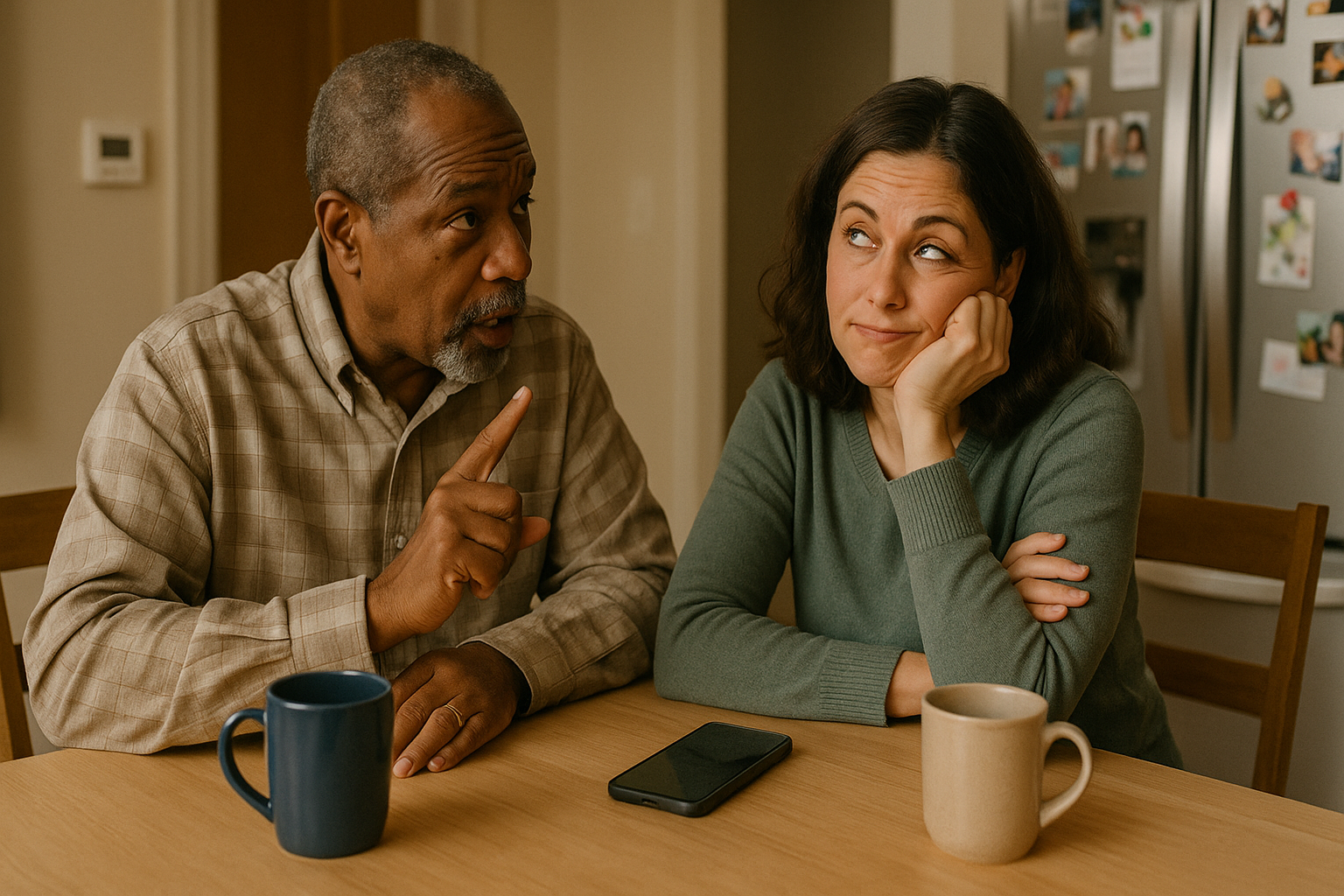
If there’s one phrase that defines the boomer mindset, it’s this one.
It’s rooted in the post-war idea that individual hard work is the only path to success — and if you’re struggling, you’re not trying hard enough.
But let’s be honest: the playing field isn’t level. Housing prices, student debt, job insecurity — none of these existed in the same way fifty years ago.
Telling someone to “just work harder” ignores the systemic realities that shape opportunity. It’s the verbal equivalent of yelling “swim harder” at someone in a storm.
The truth is, success today often depends on adaptability, networks, and emotional resilience — not just grit. We can still value hard work, but we have to pair it with empathy and awareness.
5) “That’s not how we used to do it”
This phrase usually shows up at work — and it’s the fastest way to stifle innovation.
It’s natural to feel uneasy when new tools or approaches threaten what you know. But clinging to the past doesn’t make you wise; it makes you resistant.
I’ve seen this in creative industries, especially in media. When streaming started to take off, a lot of old-school editors dismissed it as a fad. “Real music journalism lives in print,” they’d say.
Now? The most exciting conversations about music happen online — through podcasts, video essays, and community-driven platforms. The format changed, but the passion didn’t.
If you catch yourself saying, “That’s not how we used to do it,” try flipping it: “I wonder what I could learn from this new way.” It’s amazing how fast your perspective expands when you stop defending the old guard.
6) “Money doesn’t grow on trees”
Ah yes — the classic guilt line from every parent who lived through a recession.
It’s true that financial caution is valuable, but this phrase often carries fear-based energy. It’s less about saving money and more about transmitting anxiety.
What’s interesting is that today’s generation doesn’t reject financial responsibility — they just redefine it. Many are choosing values-driven spending, investing in sustainability, and rejecting consumerism altogether.
I think this shift is healthy. Growing up, money was tied to status. Now, it’s more about freedom and purpose.
When I left my corporate job years ago to write full-time, a relative told me I was being irresponsible. “Money doesn’t grow on trees,” they said.
But the freedom to choose my work gave me a different kind of wealth — time, creativity, and alignment.
Sometimes, letting go of scarcity thinking is the best investment you can make.
7) “You can’t teach an old dog new tricks”
This one might be the saddest of all because it’s self-limiting.
Whenever someone says it, what they’re really admitting is: “I’ve stopped trying.”
Neuroscience disagrees. Our brains remain capable of learning and rewiring well into old age. The key is willingness. The moment we believe we can’t change, we stop giving our brains a reason to adapt.
A friend of mine proved this beautifully. At 62, he decided to learn digital photography — something he’d once dismissed as “too complicated.”
Now, he runs a small online gallery and regularly outpaces twenty-somethings in creativity.
Age isn’t the barrier; ego is.
The people who stay young at heart are the ones who keep experimenting, even when it feels uncomfortable.
8) “If it ain’t broke, don’t fix it”
This phrase sounds practical, but it’s often code for complacency.
Sure, you don’t need to reinvent the wheel every day. But refusing to evolve just because something “works” is how things quietly become obsolete.
Think about it: how many companies, relationships, or personal habits stagnate because of this mentality?
When I first started writing professionally, I used to use the same approach for every article — same tone, same structure, same length. It worked… until it didn’t. Readers evolved. Platforms evolved. I had to evolve too.
Growth often means fixing things before they break. That’s how you stay ahead.
The quiet power of updated language
Words matter. The phrases we use reflect the beliefs we hold — and sometimes, they reveal the beliefs we haven’t updated in decades.
Letting go of these old expressions isn’t about shaming anyone. It’s about awareness. When we examine the language we use, we often uncover outdated assumptions hiding beneath.
If you recognize any of these phrases in your own vocabulary, don’t beat yourself up. Awareness is the first step toward change.
Language evolves because we evolve. Updating your mental dictionary isn’t just about sounding modern — it’s about staying open, adaptable, and aligned with the world as it is today, not as it once was.
After all, growth doesn’t come from repeating old scripts. It comes from rewriting them.
What’s Your Plant-Powered Archetype?
Ever wonder what your everyday habits say about your deeper purpose—and how they ripple out to impact the planet?
This 90-second quiz reveals the plant-powered role you’re here to play, and the tiny shift that makes it even more powerful.
12 fun questions. Instant results. Surprisingly accurate.