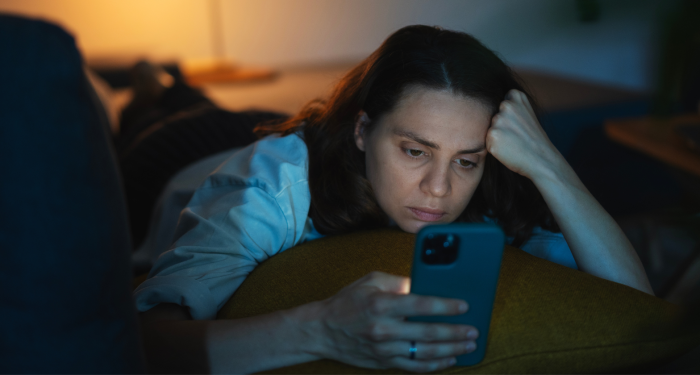
While her granddaughter sits inches away absorbed in a glowing screen, she discovers that the hardest part of modern grandparenting isn't competing with technology—it's the haunting realization that she's becoming a stranger in her own grandchild's world.

Add VegOut to your Google News feed. 
Last Sunday afternoon, I sat on my worn leather couch with my eight-year-old granddaughter tucked beside me. The autumn light filtered through the curtains, catching dust motes that danced like tiny fairies in the air.
I had just opened my mouth to begin the story of how her great-grandmother once saved an entire litter of kittens from a flooding basement when I noticed the telltale blue glow reflecting off her face.
Her fingers swiped methodically across the tablet screen, her eyes locked on whatever digital world had captured her attention. My words hung unspoken in the space between us, competing with the faint pings and swooshes emanating from her device.
This moment broke something in me. Not dramatically, not all at once, but in that quiet way that accumulates over time until you realize you've been carrying a grief you hadn't named.
We were sitting close enough that I could smell the strawberry shampoo in her hair, yet we might as well have been on different planets.
1) The invisible wall between generations
Have you ever tried to have a conversation with someone while they're scrolling through their phone? That slight delay before they respond, the distant "mm-hmm" that tells you they heard your words but not your meaning?
Now imagine that person is seven, or ten, or fifteen, and they're your grandchild who you see maybe once a month if you're lucky.
The thing is, I understand screens. After three decades of teaching high school English, I've watched technology transform from overhead projectors to smart boards.
I text, I video call, I even figured out Instagram to see my twenty-two-year-old grandson's photography. But understanding something and accepting it as the primary language of connection are two different beasts entirely.
What haunts me is the realization that my grandchildren are fluent in a language I'll never fully master, no matter how many apps I download or YouTube tutorials I watch.
They navigate digital spaces with the same ease I once rode my bike through neighborhood streets. Their friendships, their learning, their play, their comfort, all mediated through glass rectangles that fit in their palms.
2) Stories that can't compete with screens
When I was teaching, I used to tell my students that stories were humanity's oldest technology. Long before we had writing, we had narrative. We painted on cave walls, we gathered around fires, we passed down wisdom through tales that shapeshifted with each telling but kept their essential truths intact.
Now I find myself wondering if I've become obsolete technology myself. My stories don't have graphics or sound effects. They don't pause when you need a snack or replay the exciting parts on demand.
They require something that seems increasingly foreign: Sustained attention to another human being's voice.
During our library visits every other Saturday, I watch my grandchildren navigate between worlds. They'll lose themselves in a book for twenty minutes, then reflexively reach for a device.
The younger ones still get excited about story time, but I see their attention fracture when someone's phone buzzes nearby. It's nobody's fault, really. Their brains are wiring themselves for a world of constant stimulation, instant gratification, endless choice.
3) The loneliness of being present
Do you know what it feels like to be fully present with someone who isn't there with you? It's a particular kind of loneliness, sitting beside a child you love while they're absorbed in a screen.
You become acutely aware of your own physicality, your breathing, the weight of your hands in your lap. You notice things you might otherwise miss: The way they chew their lip when concentrating, how their foot taps unconsciously to some rhythm only they can hear.
Sometimes I wonder if this is how my own parents felt when I had my nose buried in a book at family gatherings. Except books eventually ended.
You closed the cover, returned to the room, rejoined the conversation. Screens never end. There's always another video, another game, another message, another universe to explore.
On our annual adventure days, I've made a rule: Devices stay in the car. The resistance I meet varies by age and temperament, but it's always there, that initial panic of disconnection.
Yet something magical happens around the two-hour mark. Their shoulders relax, their eyes start actually seeing what's in front of them, and suddenly we're having conversations that meander and loop back and surprise us both.
4) Finding connection in a digital age
Virginia Woolf once wrote that "the eyes of others our prisons; their thoughts our cages." But what happens when those eyes never meet yours, when those thoughts are shaped by algorithms you don't understand?
I've started adapting, not surrendering. When my grandchildren show me videos, I lean in and ask questions. What made them laugh? What would they do differently?
I've learned that commenting on their digital worlds sometimes opens doors to their inner ones.
My fifteen-year-old grandson recently showed me a video about urban exploration, which led to a conversation about fear, boundaries, and the time I snuck into an abandoned house as a teenager and nearly fell through the rotted floor.
The birthday letters I write for when they turn twenty-five have become my rebellion against the ephemeral nature of digital communication. Physical letters they can hold, reread, keep in a drawer or lose and find again years later.
I tell them stories about their parents as children, about the world as it was, about who they are becoming in my eyes. Whether they'll value these when the time comes, I don't know.
But the act of writing them by hand, of choosing paper that will age and yellow, feels like planting seeds in a garden I may never see bloom.
Final thoughts
That Sunday afternoon with my granddaughter ended differently than it began. I gently asked if we could have "old-fashioned time" for just ten minutes. She negotiated for five.
But in those five minutes, I told her about the kittens, about the basement, about courage that comes in unexpected moments.
Her eyes widened at the right parts. She asked if the kittens survived (they did). For those few minutes, we existed in the same story, breathing the same narrative air.
The saddest thing about being a boomer grandparent isn't really about the screens themselves. It's about the fear that we're becoming strangers to the children we love, that our stories will die with us because we couldn't find the bridge between their world and ours.
But perhaps the bridge isn't about choosing one world over another. Perhaps it's about those precious moments when we meet in the space between, however briefly, and remember that love speaks every language, even the digital ones we're still learning to understand.
What’s Your Plant-Powered Archetype?
Ever wonder what your everyday habits say about your deeper purpose—and how they ripple out to impact the planet?
This 90-second quiz reveals the plant-powered role you’re here to play, and the tiny shift that makes it even more powerful.
12 fun questions. Instant results. Surprisingly accurate.