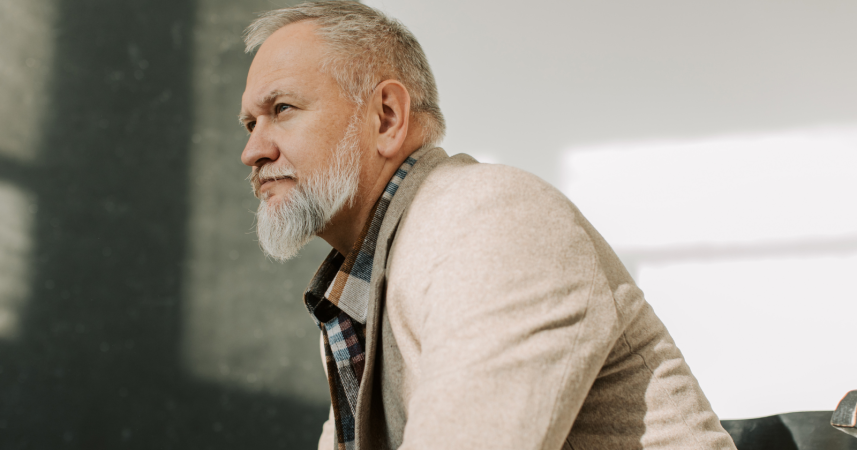
Beneath decades of "I'm fine" lies the crushing weight of a generation taught that needing help was weakness and sharing struggles was selfishness—until the performance became more exhausting than the problems themselves.

Add VegOut to your Google News feed. 
When I was forty-three and going through my divorce, I spent six months crying only in my car with the radio turned up loud enough that my kids wouldn't hear me when I pulled into the driveway.
I'd sit there for five minutes, sometimes ten, practicing my "everything's fine" smile in the rearview mirror before walking through the front door. This wasn't strength. This was the performance I'd been trained to give since childhood: never let your struggles spill over onto anyone else's plate.
Last week, a reader sent me a message that stopped me cold. She wrote, "I'm seventy-one and just realizing I've never once asked for help without apologizing first." I understood exactly what she meant.
Our generation was raised on a steady diet of stoicism disguised as virtue. We learned that good people handle their problems privately, that needing others makes you a burden, and that the ultimate sin was making someone else uncomfortable with your pain.
The inheritance of silence
Think about the messages we absorbed growing up. "Don't air your dirty laundry." "Nobody wants to hear your problems." "If you can't say something nice, don't say anything at all."
These weren't just etiquette lessons; they were instructions for emotional invisibility. We were taught that maturity meant suffering gracefully, preferably where no one could see.
I watched my own grandmother embody this philosophy throughout my childhood. She'd survived the Depression, lost a child to scarlet fever, and worked three jobs to keep her family fed, yet I never once heard her complain.
At the time, I thought this was pure strength. Now I wonder what it cost her to maintain that facade, what pieces of herself she had to bury to avoid inconveniencing anyone with her grief.
The truth is, this expectation hit different people in different ways, but it hit everyone. Men were told that tears were weakness, that providers don't crack, that real men solve problems instead of talking about them.
Women learned to minimize their needs, to say "I'm fine" when they were drowning, to apologize for taking up space even in their own lives. We all became masters at the art of pretending everything was manageable, even when it wasn't.
The weight of carrying it all alone
When I had to accept food stamps after my divorce, the shame nearly broke me. Not just the shame of needing help, but the deeper shame of potentially burdening the system, of taking resources someone else might need more.
I'd stand in the grocery line, praying no one I knew would see me pull out that card, terrified that my struggle might make someone else uncomfortable.
The irony is that keeping our hardships private doesn't actually protect anyone. It just creates a culture where everyone suffers in isolation, believing they're the only ones falling apart.
How many of us have sat in doctor's offices, minimizing our symptoms because we didn't want to be "one of those patients"? How many have stayed in unhealthy situations because asking for help felt like admitting failure?
During my husband's seven-year battle with Parkinson's, I became an expert at deflection. When friends asked how I was doing, I'd launch into updates about his medication adjustments or his physical therapy progress.
I could talk for twenty minutes about his condition without once mentioning that I hadn't slept through the night in months or that I sometimes sat in the bathroom with the water running just to cry without him hearing. The exhaustion of maintaining that performance was almost as draining as the caregiving itself.
Breaking the pattern starts with recognition
Have you ever noticed how we apologize for everything? "Sorry to bother you, but..." "I hate to ask, but..." "I know you're busy, but..."
We've internalized the belief that our needs are inherent impositions. We preface requests for help with apologies, as if needing support is something to be ashamed of rather than a fundamental part of being human.
The most insidious part of this conditioning is how noble it feels. We tell ourselves we're being strong, independent, considerate. We pride ourselves on not being "needy" or "dramatic."
But what we're really doing is denying ourselves the connection and support that makes life bearable. We're performing a version of strength that leaves us isolated in our struggles.
When I faced my breast cancer scare at fifty-two, something shifted. Sitting in that waiting room, potentially facing mortality, I realized how much energy I'd wasted trying to protect everyone from my reality.
The truth was going to exist whether I acknowledged it or not. My fear, my pain, my needs—they didn't disappear just because I refused to voice them. They just festered in silence.
The courage to be inconvenient
Learning to drop the mask takes tremendous courage, especially after decades of wearing it. Start small. The next time someone asks how you're doing, try answering honestly. Not with a dramatic monologue, but with simple truth: "Actually, it's been a tough week."
Watch what happens. Most of the time, people don't run away. They lean in.
I've discovered that vulnerability creates permission. When I finally started talking about the challenges of caregiving, other women began sharing their own stories.
When I admitted the shame I felt about my divorce, friends revealed their own struggles with stigma and judgment. Our honesty doesn't burden others; it frees them to be honest too.
This doesn't mean we dump our problems on everyone we meet. It means we stop treating our humanity like a shameful secret. It means asking for help without a preamble of apologies. It means acknowledging that sometimes life is hard, and that's not a character flaw or a personal failure.
Final thoughts
The role we were taught to play—the stoic, self-sufficient keeper of our own struggles—was always impossible to sustain. It asked us to be less than human, to deny the very connections that make life meaningful. If you're reading this and recognizing yourself, know that it's not too late to retire from that performance.
Your struggles don't make you a burden. Your needs don't make you weak. Your humanity doesn't require an apology. The most radical thing we can do at this stage of life might just be to stop pretending we're fine when we're not, to let ourselves be seen in all our messy, imperfect truth.
Because that's where real connection lives, in the spaces where we stop performing and start being real.
What’s Your Plant-Powered Archetype?
Ever wonder what your everyday habits say about your deeper purpose—and how they ripple out to impact the planet?
This 90-second quiz reveals the plant-powered role you’re here to play, and the tiny shift that makes it even more powerful.
12 fun questions. Instant results. Surprisingly accurate.