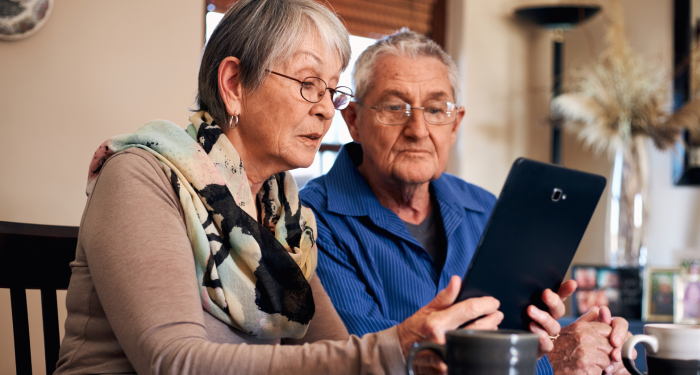
After months of finally mastering her banking app, she opened it one morning to find every button moved, every menu changed—and felt the unique fury of watching her hard-won digital independence vanish overnight at the whim of a designer who's never watched arthritis-stiffened fingers try to relearn where the "transfer" button went.

Add VegOut to your Google News feed. 
Last Thursday morning, I sat down with my coffee, ready to check my banking app like I'd done every morning for the past year.
I opened it up, and nothing was where it should be. The account balance that used to greet me at the top? Gone, hidden behind three taps and a swipe. The transfer button I'd finally memorized the location of? Vanished into some menu I couldn't find.
My hands literally shook with frustration as I stabbed at the screen, trying to find something, anything familiar. Twenty minutes later, I managed to check my balance, but not before seriously considering switching banks entirely.
The rage I felt wasn't just anger. It was a cocktail of humiliation, exhaustion, and the peculiar fury that comes from having your hard-won competence yanked away without warning or consent. And judging by the conversations I've been having lately with friends my age, I'm far from alone in this experience.
When muscle memory becomes your enemy
You know what nobody tells you about getting older? It's not that learning new technology is impossible. I've taken classes at the senior center, learned to video call my grandchildren across the country, and even figured out how to use most of my smartphone's features.
The real challenge is that just when you've finally mastered something, just when your fingers know exactly where to go without thinking, some twenty-something in Silicon Valley decides the whole thing needs a makeover.
My arthritis means every tap, every swipe, every gesture costs me something. So when I spend months training my stiff fingers to navigate an app efficiently, only to wake up one day and find everything rearranged, it feels personal. It feels like someone broke into my house and rearranged all my furniture while I slept. Sure, everything's still there, but now I'm bumping into walls in my own home.
The other day, my friend called me in tears because her grocery app had updated. She'd been so proud of herself for mastering online grocery shopping during the pandemic. She had her routine down perfectly.
Now? The search bar moved, the cart icon changed, and she couldn't figure out how to apply her senior discount anymore. She gave up and drove to the store instead, feeling defeated and old in a way that had nothing to do with her actual capabilities.
The invisibility of older users
Here's what I suspect: the people designing these updates have never watched a seventy-year-old navigate their app. They've never seen someone with reading glasses perched on their nose, squinting at tiny text that got even tinier in the update.
They've never witnessed the triumph on someone's face when they finally, finally figure out how to send a photo to their grandchild, only to watch that triumph evaporate when the photo button disappears in the next update.
Shakespeare wrote, "Lord, what fools these mortals be," and while he was talking about young lovers, I think it applies perfectly to app designers who think everyone wants constant change. What looks like innovation to them feels like sabotage to us.
I remember when I started learning Italian at 66, preparing for a trip I'd dreamed about for decades. The language app I used was perfect. Simple, clear, consistent. I made wonderful progress.
Then came the update that "gamified" everything with cartoon characters and confusing reward systems. I didn't want to collect gems or race against other users. I wanted to learn Italian. The app became so frustrating that I switched to books and in-person classes instead.
It's not about resistance to change
People love to paint those of us over 65 as technology-resistant dinosaurs who refuse to adapt. But that's not what this is about. I learned to play piano at 67, proving to myself that new skills have no age limit. I figured out video calling to stay connected with family. I've adapted to smartphones, tablets, and smart TVs. We're not afraid of learning.
What we're tired of is having to relearn the same things over and over again. It's like being forced to take the same college course every semester, but each time the textbook is in a different language and all the classroom furniture has been rearranged. You'd be frustrated too.
Every update feels like it's designed for people who have nothing but time and mental energy to spare. But when you're managing medications, doctor's appointments, and maybe caring for a spouse or grandchildren, the last thing you need is your pharmacy app suddenly hiding the refill button under three new menus.
The real cost of constant updates
What these designers don't understand is that for many of us, these apps aren't fun little toys. They're lifelines. Banking apps let us maintain financial independence. Medical apps help us manage our health. Communication apps keep us connected to family when distance or mobility issues separate us.
When you change these without warning, you're not just inconveniencing us. You're threatening our independence. You're making us feel incompetent in a world that already makes too many assumptions about what we can and cannot do.
I wrote in a previous post about finding purpose later in life, and part of that purpose, for many of us, involves staying current and connected.
But how can we do that when the ground keeps shifting under our feet? When every small victory with technology gets erased by someone who probably thinks they're helping by adding seventeen new features we never asked for?
Final thoughts
If you're under 65 and reading this, imagine if your car's steering wheel moved to the opposite side overnight, or if someone swapped all the keys on your computer keyboard while you slept.
That's what app updates feel like to us. We're not asking for the world to stop advancing. We're asking for designers to remember we exist, to consider that stability can be more valuable than novelty, and maybe, just maybe, to leave the important buttons where we've learned to find them.
Until then, I'll keep taking deep breaths, asking my grandchildren for help when I need it, and reminding myself that the rage I feel is completely justified. Because it is.