The moment you realize that pressing "0" repeatedly while shouting "HUMAN!" at your phone has become your most practiced retirement skill, you understand this isn't about technology—it's about being algorithmically erased from a world that once valued your voice.
Last week, I spent 47 minutes trying to reach my credit card company about a fraudulent charge.
Not 47 minutes on hold – 47 minutes navigating an automated system that kept promising my issue could be "quickly resolved online" while steadfastly refusing to connect me to anything with a pulse.
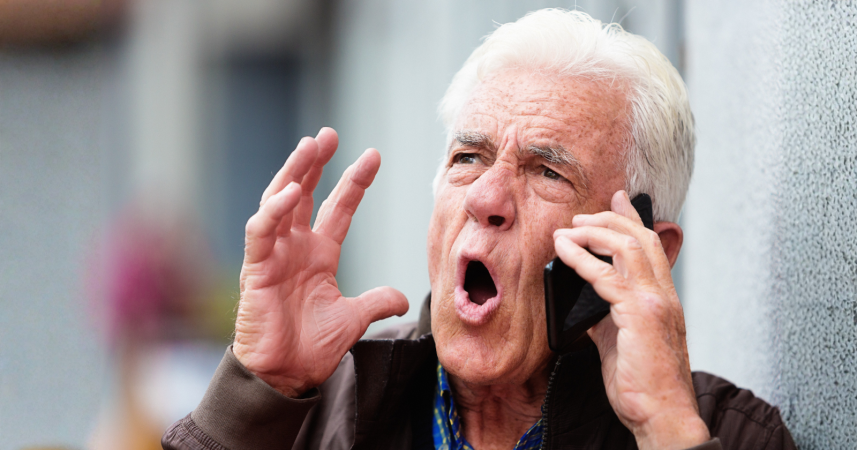
By minute 35, I was shouting "REPRESENTATIVE" at my phone like it was 1987 and volume could overcome technology. By minute 47, I hung up and felt something I hadn't expected: not just frustration, but genuine hurt.
The anger that comes with these systems after 60 isn't about technology. I can work a smartphone just fine, thanks. It's about suddenly becoming invisible in a world that used to see you as valuable enough to talk to.
When efficiency becomes erasure
Here's what younger folks might not understand yet: there's a particular sting to being deemed not worth a conversation that only sharpens with age.
When you're 30 and a company forces you through automated hell, you're annoyed. When you're 60-plus, you hear what they're really saying – your problems, your time, your very existence isn't significant enough to warrant human contact.
I ran a restaurant for 35 years. Even during the 2008 crash, when I was paying myself nothing to keep my staff employed, I never once considered replacing our host with a tablet.
Not because I'm some Luddite – I computerized our ordering system in the late 90s – but because I understood that sometimes people need to talk to people. Sometimes an 80-year-old regular needs to tell someone about her grandson while she orders her usual. Sometimes a confused customer needs more than a FAQ page.
Now I call my bank and get a robot asking me to describe my problem "in a few words" so it can "better assist" me by sending me to another robot. The few words I want to use would probably get me disconnected.
The compound interest of dismissal
This isn't my first rodeo with feeling dismissed. Started washing dishes at 16 in my uncle's diner, where the waitstaff looked through me like I was part of the dishwasher itself. Spent years being ignored by suppliers who'd rather deal with the owner than the manager. But those were people making individual choices to be jerks. This is different – it's systematic, algorithmic dismissal.
The phone systems are just the most obvious symptom. It's the grocery store that replaced four cashiers with self-checkout machines and one harried employee trying to help twelve confused customers at once.
It's the doctor's office that insists you use their patient portal for everything, even though the portal crashes every time you try to message about anything more complex than a prescription refill. It's being told that everything is "easier online" when what they mean is easier for them, not for you.
The message comes through crystal clear: your need for human interaction is an inconvenience we're actively working to eliminate.
The real cost of fake convenience
Three months ago, my internet went out. The automated system diagnosed it as a "temporary service interruption" and assured me service would resume within 24 hours. It didn't. Called back. Same diagnosis.
After four days of this digital runaround, I finally reached a human by selecting "add new services" instead of "technical support." Turns out a technician had disconnected my line by mistake while hooking up my neighbor.
Four days. Because no algorithm thought to ask, "Hey, has someone physically unplugged this guy?"
In the restaurant business, we had a saying: every system fails at the edges. That's where humans matter most – in the weird situations, the exceptions, the times when someone needs to think instead of follow a flowchart. But companies have decided it's cheaper to let those edge cases suffer than to pay someone to answer a phone.
What they don't calculate is the cost in human dignity. Every time someone my age has to navigate six menu options just to report that their medication didn't arrive, that's a small theft of dignity. Every time we're forced to explain our problem to a chatbot that responds with irrelevant canned responses, that's another tiny humiliation. These things add up.
Fighting back without becoming that guy
I've started lying to automated systems. Press 2 for sales? Sure, I'm buying. Say you're calling about a new account? Absolutely. I've learned that threatening to cancel services gets you to a human faster than actually needing help with existing services. The system has trained me to game it, which wastes everyone's time even more than just answering the phone would have.
But I refuse to become the stereotype of the angry older guy ranting about technology. That just gives them permission to dismiss us further. Instead, I'm strategic about it. I take my business to places that still answer their phones.
The local pharmacy instead of the chain. The credit union instead of the megabank. The family-owned hardware store where Tom still remembers what I bought last month and asks if that faucet repair worked out.
My son once told me, "I just wanted you to show up, Dad." Changed my whole perspective on what matters. Now I think about that with businesses too. Just show up. Just have someone there. Not a chatbot, not a menu tree that leads nowhere, not an AI that pretends to understand but doesn't. Just a person who can listen and respond like I'm worth their time.
Final words
The automated phone system that won't let you reach a human is a small indignity in the grand scheme of things. Wars are being fought. Climate's changing. Democracy's wobbling. I get it.
But these small indignities matter because they're symptoms of something larger – a world reorganizing itself around the assumption that human connection is inefficient and therefore unnecessary.
Those of us over 60 aren't just angry about the phone systems. We're angry about what they represent: being pushed to the margins of a world we helped build. But here's what I've learned from all those years in the restaurant business – every customer who gets ignored is a customer who finds somewhere else to eat.
Maybe it's time we all started finding somewhere else to take our business, our attention, and our remaining years. Somewhere that still believes we're worth talking to.
If You Were a Healing Herb, Which Would You Be?
Each herb holds a unique kind of magic — soothing, awakening, grounding, or clarifying.
This 9-question quiz reveals the healing plant that mirrors your energy right now and what it says about your natural rhythm.
✨ Instant results. Deeply insightful.

Gerry Marcos
Gerry Marcos is a food writer and retired restaurateur based in Vancouver, Canada. He spent more than thirty years running restaurants, starting with a small Greek-inspired diner that his parents helped him open after culinary school, and eventually operating three establishments across British Columbia. He closed his last restaurant in his late fifties, not from burnout but from a growing desire to think and write about food rather than produce it under pressure every night.
At VegOut, Gerry writes about food traditions, immigrant food stories, and the cultural memory embedded in how communities eat. His Greek-Canadian heritage gives him a perspective on food that is rooted in family, ritual, and the way recipes carry history across generations. He came to plant-based eating gradually, finding that many of the Mediterranean dishes he grew up with were already built around vegetables, legumes, and grains.
Gerry lives with his wife Maria in a house with a kitchen he designed himself and a garden that produces more tomatoes than two people can reasonably eat. He believes the best food writing makes you homesick for a place you have never been.
More Articles by Gerry