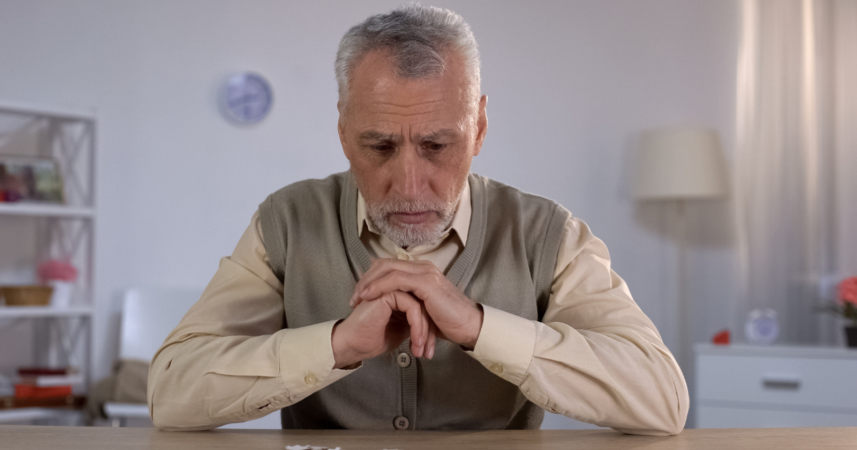
Behind every irritable elderly man lies decades of unspoken fears, trapped in a generation that taught them strength meant silence—until their bodies betray them and the only language they know for terror is anger.

Add VegOut to your Google News feed. 
Last week at the grocery store, I watched an elderly man snap at the cashier when she asked if he needed help carrying his bags.
"I'm not helpless," he muttered, struggling with the weight as he shuffled away. His wife touched his arm gently, and he jerked it back. I recognized that dance immediately. It wasn't rudeness. It was fear dressed up as anger, the only costume it knew how to wear.
After thirty-two years of teaching high school and now in my seventies myself, I've seen this pattern play out countless times. These men who've carried the weight of being everyone's rock, who've swallowed their fears for decades to be the protector, the provider, the one who fixes everything.
And now, when their bodies begin to betray them and uncertainty creeps in, they have no vocabulary for vulnerability. They've never learned the language.
The armor becomes the prison
Think about the messages we've given men for generations.
- "Big boys don't cry."
- "Man up."
- "Be strong for your family."
My own father, a mailman who knew everyone in town by name, once worked through pneumonia for two weeks because "the family needs the paycheck, and complaining won't change that."
He taught me about community and connection, but he also taught me, without meaning to, that real men don't admit weakness.
When my second husband was diagnosed with Parkinson's, I watched him wrestle with this same demon.
Here was a man who'd built houses with his bare hands, who'd coached Little League for twenty years, who'd been the one neighbors called when they needed help moving furniture or fixing a leak.
Suddenly, he couldn't button his own shirt. But instead of saying "I'm scared" or "I need help," he'd bark at me for hovering. He'd slam cabinets when he couldn't open a jar.
The fear had nowhere to go but sideways, emerging as irritation, frustration, anger at everything except what was actually terrifying him.
I understand this now in a way I didn't then. When you've spent four decades being the one who holds everyone else up, admitting you're falling apart feels like betraying your fundamental identity. It's not just pride. It's existential terror. Who are you if you're not the strong one?
What fear looks like when it can't speak
Have you ever noticed how many older men become increasingly difficult as they age? Family members shake their heads and say, "Dad's just getting grumpier with age," or "Grandpa's always been stubborn, but now it's worse."
We attribute it to personality calcifying, to the natural crankiness of aging. But what if we're missing the real story?
That irritability often spikes around health scares, mobility issues, retirement, the death of friends. These are moments of profound vulnerability, yet we expect men who've never practiced expressing fear to suddenly become fluent in it at seventy.
It's like asking someone who's never spoken French to suddenly deliver a speech at the Sorbonne.
During those seven years of supporting my husband through Parkinson's, I learned to read between the lines. When he snapped about the television being too loud, he was really saying he was frustrated that his hearing was going.
When he complained about the neighbors' yard, he was mourning his inability to maintain our own. When he picked fights about trivial things, he was terrified about the big thing neither of us wanted to name.
The cost of silence
Shakespeare wrote, "When sorrows come, they come not single spies, but in battalions." For men in their seventies who've never learned to process fear, those battalions are overwhelming.
Friends are dying. Bodies are failing. Independence is slipping away. And they're facing it all with emotional tools that haven't been updated since 1955.
The cost isn't just personal. It ripples out to everyone who loves them. Spouses become emotional punching bags. Adult children feel pushed away just when they want to help most.
Grandchildren remember Grandpa as angry rather than scared. The very families these men spent their lives protecting end up feeling hurt and confused by the walls that won't come down.
I made my own mistakes with this dynamic. After my first husband died, I leaned too heavily on my eldest son, telling him he was "the man of the house" when he was just fourteen.
I thought I was helping him feel important, giving him purpose. Instead, I was teaching him that his fears and needs came second to everyone else's. It took years of his own struggles for both of us to understand the weight I'd placed on his shoulders.
Learning a new language late in life
But here's what gives me hope: It's never too late to learn. In my husband's final days, something shifted. Maybe it was the proximity to the end, or maybe he just got tired of carrying all that armor.
But he started saying things like "I'm worried about you being alone" instead of criticizing my driving. He said "I'm scared of the pain getting worse" instead of complaining about the medication schedule.
Those moments of honesty, even though they came so late, transformed our last months together. Our children got to see their father not as invulnerable, but as human. They got to comfort him, to give back some of the strength he'd given them. It was a gift, even wrapped in sorrow.
I've written before about finding purpose in later life, and I believe one of the most profound purposes we can embrace is modeling vulnerability for the generations watching us.
When a grandfather can say "I'm scared" to his grandson, he's not showing weakness. He's showing that courage isn't the absence of fear but the honest acknowledgment of it.
Final thoughts
If you recognize your father, your husband, or yourself in these words, know that it's not about blame. These men aren't choosing to be difficult.
They're drowning in feelings they were never taught to swim through. Compassion, not criticism, is what's needed.
Sometimes the bravest thing we can do is help someone find the words they've never had, to sit with them in their fear even when it comes out sideways, to love them through the irritability to the scared human being underneath.
The strong ones deserve to be scared sometimes too. They've earned the right to say it out loud.