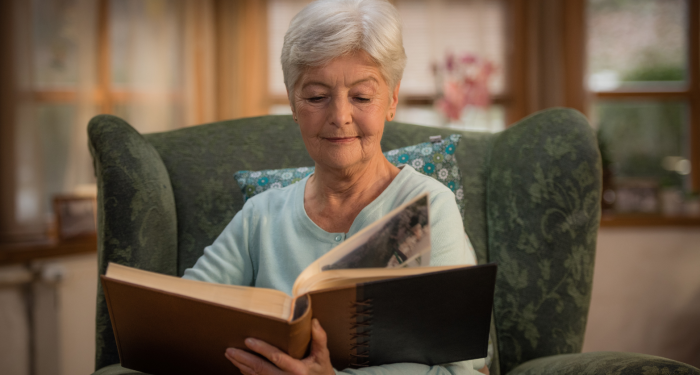
The moment I stopped dyeing my hair at 70, the flood of people calling me "brave" revealed an uncomfortable truth: we've made women's natural aging so taboo that simply existing without disguise has become an act of defiance.

Add VegOut to your Google News feed. 
Six months ago, I stood in the hair salon parking lot, keys in hand, and couldn't make myself go inside. My roots were showing silver against the auburn I'd maintained for twenty years, and something inside me just said "enough."
I drove home instead, looked in the mirror, and decided to let nature take its course. What followed wasn't the quiet transition I expected but rather a cascade of reactions that revealed something profound about how we view women and aging.
The word that kept coming up was "brave." Friends, acquaintances, even strangers in the grocery store would notice my emerging silver and tell me how courageous I was being.
At first, I accepted these comments graciously, but after the fifteenth or twentieth time, I started wondering: since when did accepting the natural color of my own hair require courage? We don't call men brave for going gray. We call them distinguished.
The strange rebellion of looking like yourself
When did we decide that a woman's natural aging process was something to be fought against rather than embraced? I think about this often now, watching the silver threads weave through what remains of my old color.
There's something almost subversive, apparently, about a woman in her seventies choosing not to disguise her age. But here's what strikes me most: we've normalized the disguise so thoroughly that removing it seems radical.
I spent decades in that salon chair every six weeks, reading magazines while chemicals processed on my scalp. It was as routine as grocery shopping, as expected as wearing shoes to work.
Nobody ever called me brave for maintaining that exhausting ritual. They simply saw it as what women do, what women must do to remain visible, valuable, acceptable.
The irony isn't lost on me. We live in an era that celebrates authenticity, that encourages people to "be themselves," yet when a woman actually does this in the most literal way possible by letting her hair be its authentic color, she's treated like she's staging some kind of protest.
I'm not protesting anything. I'm simply tired of pretending that time hasn't passed.
What the mirror teaches us about honesty
Have you ever noticed how much energy we spend trying to convince the world we're younger than we are? Not just the hair coloring, but the creams, the procedures, the careful lighting in our selfies. I understand the impulse completely.
For years, I participated in this elaborate performance, believing that my value was somehow tied to my ability to appear younger.
But something shifted when I retired from teaching. Maybe it was all those years watching teenagers struggle with their own identities, trying on different versions of themselves.
I realized I was still doing the same thing at sixty-six, still trying on an identity that no longer fit. The auburn hair had become a costume I was tired of wearing.
Now, when I look in the mirror, I see someone I recognize. Not the thirty-year-old I once was, not the fifty-year-old I tried to remain, but the seventy-year-old I actually am. There's a certain peace in that recognition, a settling into yourself that feels like coming home after a long, complicated journey.
The unexpected freedom of not apologizing for time
Virginia Woolf once wrote, "The beauty of the world has two edges, one of laughter, one of anguish, cutting the heart asunder." I think about this quote often when I consider aging because there is indeed anguish in watching yourself change, but there's also this unexpected edge of something close to joy.
Letting my hair go silver has taught me something about the burden of maintenance I didn't fully grasp while I was carrying it. Every six weeks, that appointment. Every morning, checking the roots. Every photo, wondering if the gray was showing. It occupied mental space I didn't realize I was sacrificing until I reclaimed it.
Now I think about other things. I spend those salon hours in my garden, hands deep in soil, watching things grow instead of trying to stop them from changing. I read more. I write more. I notice more. It turns out that when you stop spending energy on preventing the appearance of aging, you have more energy for actually living.
Why "brave" misses the point entirely
The people who call me brave mean well. They're recognizing, I think, that going against social expectations requires something. But framing it as bravery suggests that there's something frightening about looking your age, something that requires courage to face.
What does that say about how we view older women? What does it say about what we're teaching younger women?
I think about my former students sometimes, the young women who sat in my classroom worried about a bad hair day or a pimple, convinced that these small imperfections made them less worthy of attention or love.
What message does it send when their teacher, their mothers, their grandmothers spend thousands of dollars and countless hours trying to hide every sign that they've lived long, full lives?
The real act of rebellion isn't letting your hair go gray. It's the deeper choice to stop apologizing for the passage of time, to stop treating your own aging face and body as problems to be solved rather than as evidence of a life lived. It's deciding that you have worth beyond your ability to approximate youth.
Finding beauty in the silver threads
Do you know what I've discovered? Silver hair catches light differently than colored hair. It has dimension, variation, a kind of luminescence that my flat auburn never achieved.
There are strands of pure white mixed with steel gray and even some stubborn patches of my original dark brown. It's complex and interesting in a way that feels appropriate for someone who has lived seven decades on this planet.
Sometimes I catch my reflection unexpectedly in a shop window or a mirror, and for a split second, I see my mother. This used to frighten me.
Now it comforts me. She lived to eighty-nine with silver hair that she wore like a crown, never apologizing for her age, never trying to be anything other than what she was. I understand her better now.
Final thoughts
Yesterday, a woman stopped me in the bookstore to tell me she loved my hair. Not that I was brave, not that she could never do it herself, just that it was beautiful. She was probably in her forties, and I could see the telltale root line of her own color treatment.
I thanked her and almost said something about how she might consider letting hers grow out too, but I stopped myself. We each come to our decisions in our own time, or sometimes we don't come to them at all, and that's fine too.
What matters isn't whether we color our hair or not. What matters is recognizing that a woman choosing to look her age shouldn't be revolutionary.
It should be as unremarkable as breathing, as ordinary as morning coffee, as simple as looking in the mirror and seeing yourself clearly, silver threads and all, and knowing that you are exactly who you're supposed to be.