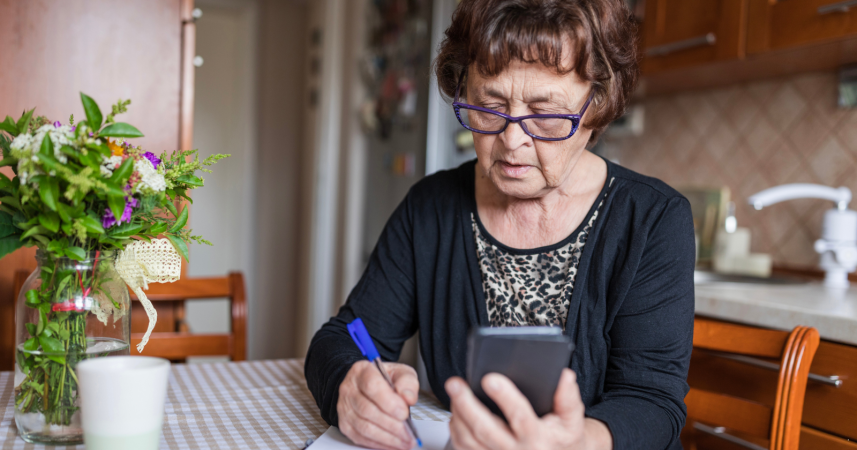
While her children fret about hackers breaking into her bedside drawer, she's discovered that the real modern nightmare isn't someone stealing her Netflix password—it's being locked out of her blood pressure medication because she can't remember if she capitalized the "B" in Biscuit2024!

Add VegOut to your Google News feed. 
Last week, I spent forty-five minutes on hold with my bank because I couldn't remember if the security answer for my mother's maiden name was "Smith" or "smith" or maybe even "SMITH." The automated system locked me out after three attempts, and there I sat, listening to muzzy hold music, wondering when exactly life became a series of digital hoops to jump through. My notebook was right there beside me, faithful as always, with every password neatly written in blue ink. But apparently, that's not how we're supposed to do things anymore.
My adult children have been staging what feels like an intervention about my password notebook. They speak in urgent tones about "data breaches" and "identity theft," as if the biggest threat to my wellbeing is a burglar who breaks in specifically to rifle through my nightstand for my Netflix login. Meanwhile, I'm over here trying to remember if I used "Biscuit2020!" or "biscuit2020?" for my pharmacy account, because heaven forbid I mix up the capitalization and get locked out of ordering my blood pressure medication.
The great password predicament
Here's what nobody tells you about getting older in the digital age: every single aspect of your life now requires a unique, complex password that must contain at least one uppercase letter, one number, one special character, and apparently the blood of a unicorn. Gone are the days when you could use your anniversary date for everything and call it good.
Now, my electricity company wants twelve characters minimum, my doctor's portal demands I change it every sixty days, and my grocery store app rejected "Password123!" for being too common. Too common! As if I'm trying to guard state secrets instead of my digital coupon collection.
I started my notebook in 2016, right around the time everything suddenly needed an online account. Want to pay your water bill? Create an account. Schedule a dentist appointment? Account. Check your grandson's soccer schedule? You guessed it. By page three, I had passwords for things I didn't even remember signing up for. What on earth is "MyHealthVault" and why did I apparently give it my social security number?
The truth is, technology has outpaced those of us who remember when a phone was something attached to the wall and "streaming" meant standing in a creek. We're told to embrace digital solutions, but nobody mentions that embracing them feels like wrestling an octopus while blindfolded.
Every website has different requirements, every app needs updating, and God help you if you accidentally click "forgot password" because then you're trapped in an endless loop of verification emails and security questions about the name of your first pet. (It was Whiskers, by the way, but did I capitalize it? Did I add a number? The mysteries of 2018 remain unsolved.)
When simple becomes complicated
You know what wasn't a security risk? The manila folder where I used to keep my bills, sorted by month, paid with checks that required nothing more than my signature. There was something deeply satisfying about writing that check, sealing the envelope, and knowing the task was complete.
Now, I log into six different portals to pay the same bills, each requiring me to remember not just passwords but usernames too. Is it my email? My account number? The username I created in 2017 when I was feeling creative and chose "MarleneSunshine73"?
My daughter recently tried to convert me to something called a password manager. She demonstrated it with the enthusiasm of someone who'd discovered fire, showing me how all my passwords could live in one magical place, protected by—wait for it—another password. "But what if I forget that password?" I asked. She looked at me like I'd asked what happens if gravity stops working. "You can't forget it, Mom. It's the only one you need to remember." Right. The only one. The single point of failure between me and my entire digital existence.
The wisdom of paper and ink
Here's what my notebook gives me that no app ever could: peace of mind. When the power goes out, my notebook still works. When my phone decides to update itself into oblivion, my notebook remains unchanged. When I wake up at 3 AM wondering if I paid the credit card bill, I can flip through actual pages and see my notes. Yes, "PAID 10/15" written in the margin might seem primitive, but it's never crashed, never needed updating, and never asked me to accept new terms and conditions.
There's also something to be said for the physical act of writing things down. After three decades of teaching, I know that the connection between hand and brain is powerful. When I write "Chase Bank - Biscuit2024$" in my notebook, I'm far more likely to remember it than if I let some digital vault squirrel it away in the cloud. The cloud! Another concept that makes me laugh. We're storing our most sensitive information in something we can't see, can't touch, and definitely can't understand, but my notebook in the drawer is the security risk?
Finding balance in a digital world
Don't get me wrong—I'm not completely resistant to change. I video chat with my grandchildren, I use GPS when driving somewhere new, and I even wrote about my adventures with online dating after becoming a widow. Technology has opened doors I never expected to walk through at this stage of life. But there's a difference between using technology and being enslaved by it.
The real challenge isn't remembering passwords; it's maintaining our humanity in an increasingly digital world. When every interaction is mediated by a screen, when every transaction requires digital authentication, we lose something essential. We lose the teller at the bank who knew your name, the handwritten notes, the ability to simply trust that things will work without seventeen layers of security.
Maybe the solution isn't choosing between digital and analog but finding a balance that works for each of us. My notebook might not be Fort Knox, but it's my system, and it works. If someone really wants to break into my house to steal my password to the library's online catalog, well, I suppose they really need those book recommendations.
Final thoughts
Last month, the power went out for six hours. My neighbor, thirty years younger and completely digital, couldn't access anything—her smart home had become remarkably dumb. Meanwhile, I paid my bills by candlelight, writing checks like it was 1995. My notebook never let me down.
Yes, I'll probably add a few more passwords to my collection before I'm done. Number 44 might be for whatever new portal my doctor's office decides I need. Number 45 could be for the app my grandchildren insist will change my life. But they'll all go in the notebook, in blue ink, right there in my nightstand drawer. Because the real security isn't in the method—it's in knowing that you have a system that works for you, aneurysm-free.
What’s Your Plant-Powered Archetype?
Ever wonder what your everyday habits say about your deeper purpose—and how they ripple out to impact the planet?
This 90-second quiz reveals the plant-powered role you’re here to play, and the tiny shift that makes it even more powerful.
12 fun questions. Instant results. Surprisingly accurate.