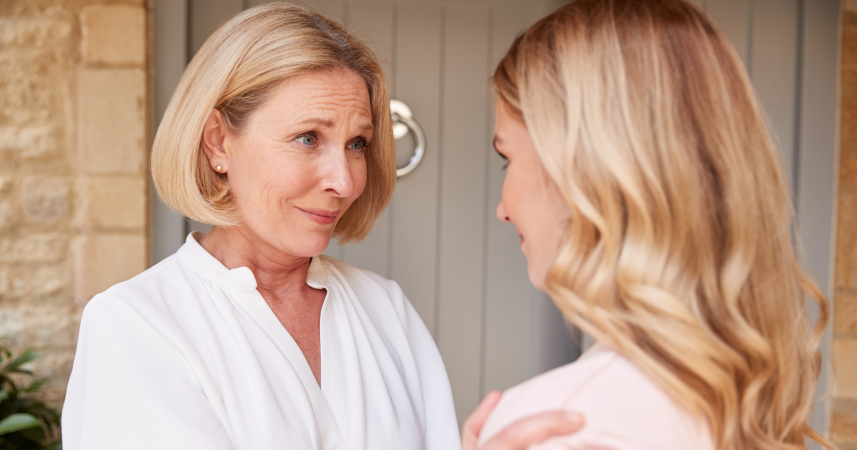
After six decades of wearing emotional armor I'd inherited from my father, I finally broke the family tradition and told my son the truth: I'd taught him that needing others meant failing at life, when really, I'd been failing at life by never needing anyone at all.
I sat across from my son in his kitchen, watching him pour coffee with the same precise movements I'd taught him years ago. Everything measured, everything controlled, everything perfect. That's when I finally said the words I'd been rehearsing in my head for months: "I'm sorry for teaching you that needing people makes you weak."
He stopped mid-pour. The coffee pot hung suspended between us like all the conversations we'd never had.
The inheritance nobody talks about
We pass down more than just eye color and stubborn chins to our kids. We hand them entire operating systems for how to exist in the world, most of it installed before they're old enough to question the programming. My son got my work ethic, my ability to function on four hours of sleep, and unfortunately, my deep conviction that asking for help is the first step toward complete collapse.
Growing up, my father's highest compliment was "You didn't need me today." Independence wasn't just valued in our house; it was the only currency that mattered. Broken arm? Walk it off. Heart shattered by your first breakup? Nobody likes a whiner. Need someone to talk to? That's what work is for—keeps your mind busy, keeps the feelings where they belong, which is nowhere.
I absorbed all of this like a sponge absorbs water, then squeezed it right back out onto my own kids. The cycle continued, neat and tidy, generation after generation of people who could handle anything except their own vulnerability.
Love dressed up as distance
The restaurant business was perfect for someone like me. Sixteen-hour days meant never having to sit still with uncomfortable feelings. There was always another crisis to handle, another fire to put out, another reason to be needed without ever needing anything myself. I convinced myself that working myself into the ground was love. Paying the bills was love. Never complaining was love.
What I didn't realize was that I was teaching my son that love looks like exhaustion. That it looks like one person holding everything together while everyone else gets to fall apart. He learned to be the strong one, the reliable one, the one who never needs a sick day or a shoulder to cry on.
When his relationship ended, he called me exactly once. "I'm handling it," he said, and I recognized my own voice coming through his mouth. He was handling it the way I'd handled my divorce—alone, efficiently, and with a kind of grim determination that mistakes survival for strength.
The moment the armor cracked
Three months ago, I watched my son at my granddaughter's soccer game. Another parent asked how he was managing everything with a demanding job. He smiled that smile I knew too well—the one that costs everything but gives away nothing—and said, "Oh, you know, we just keep going."
The other parent touched his arm gently and said, "But how are YOU?"
I watched my son's face cycle through confusion, panic, and then that familiar shutdown. "I'm fine," he said, but his voice cracked just slightly on the word "fine," and I saw myself at 35, at 45, at 55, insisting I was fine while drowning in plain sight.
That night, I couldn't sleep. I kept thinking about all the times he'd learned from watching me that "fine" was the only acceptable answer. That struggling meant failing. That needing support meant you weren't strong enough to deserve respect.
Unlearning the lies we live by
The apology didn't come easily. I must have started and stopped fifty times over the next few weeks. How do you apologize for giving someone the only tools you had, even when those tools were broken? How do you explain that what looked like strength was really just fear wearing a disguise?
But sitting in his kitchen, watching him pour that coffee with mechanical precision, I realized that not apologizing was just another form of the same disease—the inability to be vulnerable, to admit imperfection, to need forgiveness.
So I said it. I told him I was sorry for raising him to believe that his worth was tied to his ability to never need anyone. Sorry for modeling that love meant being useful rather than being present. Sorry for teaching him that emotions were something to manage rather than feel.
He set the coffee pot down and looked at me for a long moment. "I don't know how to not be this way," he said quietly.
"Neither do I," I admitted. "But maybe we could figure it out together."
The work that comes after the apology
Apologies aren't magic erasers. They don't undo decades of programming or instantly rewire our emotional circuitry. My son and I are both still learning what it means to need people without feeling like we're failing at life.
Last week, he called me at 10 PM just to talk about a rough day at work. This might not sound revolutionary, but for us, it was like learning a new language. He stumbled over the words, apologized three times for bothering me, and almost hung up twice. But he stayed on the line, and I listened without trying to fix anything or remind him how strong he was.
Progress looks different when you're unlearning survival mechanisms. Sometimes it's accepting help carrying groceries. Sometimes it's admitting you're overwhelmed before you hit the breaking point. Sometimes it's teaching your kids that strength includes knowing when you need support.
Final words
At 62, I'm finally understanding that the opposite of weakness isn't strength—it's connection. The armor I wore so proudly for six decades was really just a prison I'd built myself, bar by bar, out of every unshared struggle and unasked-for help.
My son and I are fumbling our way toward something better now. We're bad at it, honestly. We still reflexively say "I'm fine" when we're not. We still apologize for having feelings. We still treat vulnerability like a hot stove.
But we're trying. And maybe that's what love actually looks like—not one person holding everything together, but two people willing to risk being held.