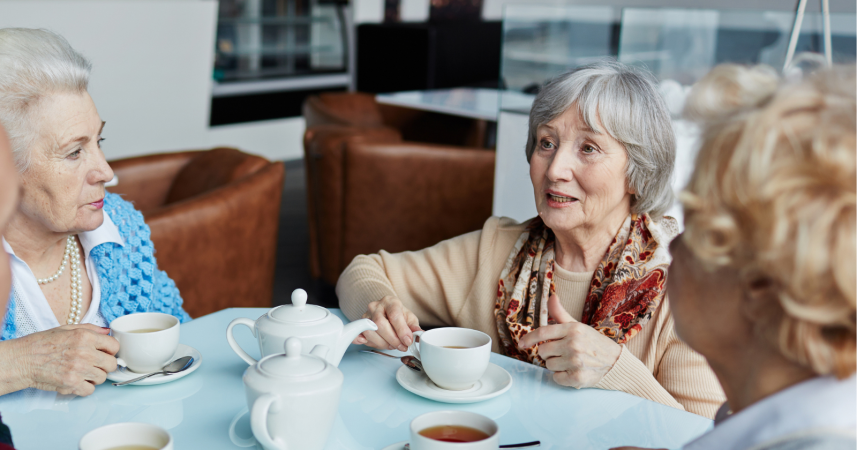
At family dinners where she once orchestrated every gathering and nurtured every person seated there, she now sits unnoticed—a ghost serving food to loved ones who talk around her as if she's become part of the furniture.

Add VegOut to your Google News feed. 
The dinner table stretches before you, laden with your grandmother's china and the roast you spent all afternoon preparing.
Laughter ripples around you, conversations overlapping like waves, your son telling his sister about his promotion while your husband chimes in with advice. Everyone is engaged, animated, connected to each other. And there you sit, invisible as the wallpaper, holding a serving spoon that might as well be a magic wand that made you disappear.
When I interviewed 40 retired women about their experiences with invisibility, I expected stories about being overlooked in stores, ignored by waitstaff, or dismissed in conversations with younger people. What I discovered instead broke my heart in ways I hadn't anticipated.
Twenty-seven of these women - more than two-thirds - told me their most painful moment of invisibility happened right at their own dinner table, surrounded by the people they love most.
The phenomenon of family invisibility
One woman described it perfectly: "I realized I had become the backdrop to everyone else's life. I was there, serving, cleaning, nodding, but no one actually saw me anymore. I was furniture that happened to move."
This invisibility doesn't announce itself dramatically. It creeps in slowly, like fog rolling across a landscape. First, your opinions get interrupted more often. Then your stories get cut short.
Eventually, conversations flow around you like you're a rock in a stream, and you find yourself clearing plates while everyone else continues talking, not even pausing when you leave the room.
The cruelest part? These aren't strangers dismissing us. These are the people we've nurtured, supported, and loved for decades. The children whose scraped knees we bandaged, whose college applications we proofread, whose weddings we helped plan. The spouses we've built entire lives alongside. When did we become invisible to them?
Why families stop seeing us
After teaching high school for 32 years, I learned that teenagers often see their parents as extensions of the household machinery - present, functional, necessary, but not quite three-dimensional people with inner lives and desires. I watched it happen with my own students and their parents, never imagining I'd experience it myself one day.
But there's something that happens when we retire, when our children become fully established adults, when we shift from being the active caregivers to something else entirely.
Our families unconsciously recategorize us. We're no longer the problem-solvers, the advice-givers, the ones with our fingers on the pulse of what matters. We become the generation that's sliding toward irrelevance, even in our own homes.
One woman told me her adult children would plan entire family vacations in front of her, discussing dates and destinations without once asking her opinion. "They'd already decided I'd be available and willing," she said. "Like I was a piece of luggage they'd remember to pack."
The dinner table as a microcosm
Why does the dinner table hurt most? Because it's supposed to be our domain, our gathering place, the heart of family connection. For many of us, we spent decades orchestrating these moments - teaching table manners, encouraging everyone to share their day, mediating sibling squabbles, creating traditions around Sunday dinners and holiday meals.
Virginia Woolf once wrote, "One cannot think well, love well, sleep well, if one has not dined well." But what happens when dining well means being present but unseen, when you're the ghost at your own feast?
I remember one Thanksgiving when my family was deep in conversation about technology I didn't understand, using acronyms I didn't recognize, referencing cultural moments I hadn't experienced. I sat there with my fork suspended halfway to my mouth, realizing I had nothing to contribute. When I tried to redirect the conversation to something more inclusive, my daughter patted my hand and said, "It's okay, Mom, you wouldn't get it anyway."
Breaking through the invisibility
Here's what those 40 women taught me: invisibility is not inevitable. It's a pattern we can interrupt, but it requires us to stop being polite about our own erasure.
Start by refusing to be the automatic server at meals. Sit down first sometimes. Let others figure out what's missing from the table. When conversations flow around you, insert yourself boldly. "Actually, I have thoughts about that." Don't ask permission to be part of the discussion you're hosting.
Several women told me they started sharing unexpected stories about themselves - not the familiar family legends everyone had heard before, but new revelations. One woman casually mentioned she'd been taking salsa lessons. Another announced she was writing a novel. The shock value alone made their families actually look at them, really see them, for the first time in years.
Reclaiming our space
I recently discovered Your Retirement Your Way, a course by Jeanette Brown that reminded me of something crucial: retirement isn't about fading into the background of other people's lives. It's about stepping fully into our own. Jeanette's guidance inspired me to stop waiting for my family to make space for me at the conversational table and instead claim that space unapologetically.
The course helped me understand that my identity exists far beyond my role as mother, wife, or even retired teacher. These retirement years aren't meant for becoming invisible; they're meant for becoming more visible than ever, just in different ways. I wish I'd had this perspective when I first retired, when I was still trying to fit myself into everyone else's narrative instead of writing my own.
After my second husband died, I spent six months barely leaving the house, becoming invisible even to myself. When I finally emerged, I promised myself I would never disappear again, not for anyone. That promise gets tested at every family gathering, but I keep it by remembering that my stories, opinions, and presence matter just as much as anyone else's at that table.
Final thoughts
To those 27 women who felt most invisible at their own dinner tables, and to every woman reading this who has felt that same hollow ache of being unseen by those you love most: you are not furniture. You are not background. You are not a supporting character in everyone else's story.
The next time conversations flow around you like you're not there, don't clear the plates. Don't smile and nod. Don't retreat into the kitchen. Plant yourself firmly in your chair, look your loved ones in the eye, and start talking. Tell them about the book you're reading, the dream you had last night, the adventure you're planning. Make them see you.
Because visibility isn't granted. It's claimed.
If You Were a Healing Herb, Which Would You Be?
Each herb holds a unique kind of magic — soothing, awakening, grounding, or clarifying.
This 9-question quiz reveals the healing plant that mirrors your energy right now and what it says about your natural rhythm.
✨ Instant results. Deeply insightful.
Marlene Martin
Marlene is a retired high school English teacher and longtime writer who draws on decades of lived experience to explore personal development, relationships, resilience, and finding purpose in life’s second act. When she’s not at her laptop, she’s usually in the garden at dawn, baking Sunday bread, taking watercolor classes, playing piano, or volunteering at a local women’s shelter teaching life skills.
More Articles by Marlene