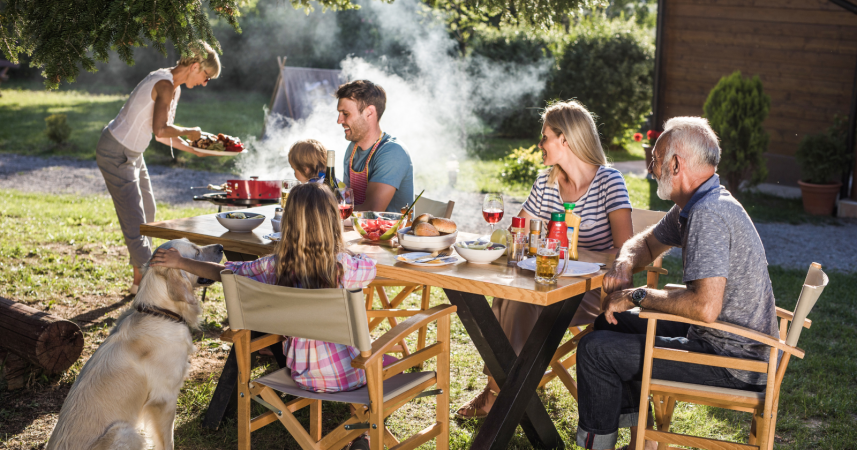
While your grandmother's recipe cards simply say "as usual," the real instructions for Sunday roast lived in her hands, her timing, and the thousand unwritten rules that could only be learned by standing beside her in a kitchen filled with steam and stories.

Add VegOut to your Google News feed. 
The smell of rosemary and thyme still takes me straight back to my mother's kitchen on Sunday mornings.
That particular alchemy of herbs mixing with beef fat, the windows steaming up from vegetables boiling on every burner, the sound of the oven door creaking open as she'd check the roast for the third time in an hour.
These Sunday rituals weren't just about food. They were masterclasses in patience, timing, and the kind of practical wisdom that only comes from standing beside someone who knows exactly what they're doing.
Last week, I tried to explain to my granddaughter over video call how to make Yorkshire pudding. "Just watch the batter," I said, but watching through a screen isn't the same as standing there, feeling the heat when you open the oven door, seeing how the batter should look when it hits the sizzling fat.
Some knowledge lives in our hands and our senses, not in recipes or YouTube tutorials.
1) The roast goes in fat side up, always
Nobody writes this down because everyone who stood in those kitchens just knew it. You score the fat in diamond patterns, not because it's pretty, but because it renders better that way. The fat protects the meat, bastes it as it cooks.
My mother would turn to me and say, "See how it's starting to crisp? That's when you know it's working." You learned by watching the transformation, not by reading temperatures on a digital thermometer.
2) Yorkshire puddings need drama and courage
The oil must be smoking hot. Dangerously hot. The kind of hot that makes you step back when you open the oven. I remember being eight years old, watching my mother pour batter into what looked like pools of liquid fire. "Never be timid with Yorkshires," she'd say.
The batter has to sizzle the second it hits the pan, or you'll end up with sad, flat pancakes instead of golden clouds. This isn't something you learn from a recipe that says "preheat oil."
You learn it from seeing someone brave enough to work with that fearsome heat, from hearing that explosive sizzle that tells you everything's exactly right.
3) Vegetables have their own hierarchy
Potatoes go in first, parboiled and roughed up with a fork so they'll crisp properly. Then parsnips, then carrots. Brussels sprouts never touch the roasting pan until the last half hour. Each vegetable has its moment, its perfect timing.
We learned this standing there, watching our mothers and grandmothers orchestrate this elaborate dance. They never consulted timers. They knew by smell, by sight, by the way a fork slid through a potato.
4) The gravy tells you everything about the cook
Real gravy starts in the roasting pan, with all those gorgeous burnt bits stuck to the bottom. You don't pour that flavor down the drain. You deglaze, you scrape, you coax every molecule of taste from that pan.
I spent years watching my mother make gravy without measuring anything.
A splash of wine here, a spoonful of flour there, whisking constantly over heat until it transformed into silk. "Feel how it coats the spoon?" she'd ask, handing me the wooden spoon. That's not something you can teach through a screen.
5) Resting meat is an act of faith
Every fiber of your being wants to carve that roast the moment it comes out of the oven. It smells like heaven. Everyone's hungry. But you wait. You tent it with foil and you wait, because rushing ruins everything.
The juices need time to redistribute. This patience, this restraint in the face of anticipation, was learned by watching generations of cooks stand firm against hungry families. "It'll be ready when it's ready," became a mantra we all internalized.
6) The table setting is part of the meal
Sunday roast meant the good plates, even when money was tight. It meant proper napkins, not paper towels. The gravy went in the boat that belonged to my grandmother, the one with the tiny chip on the handle.
These weren't rules written anywhere. They were absorbed through repetition, through helping set that table week after week, understanding that some meals deserve ceremony.
7) Leftovers are tomorrow's treasure
Nothing gets thrown away. The bones make stock. The leftover beef becomes Monday's hash or sandwiches for the week. Even the vegetable water gets saved for soup.
This wasn't just about frugality, though money was often tight. It was about respect for the food, for the effort, for the animal that gave its life. We learned this by watching our mothers save every scrap, transform every leftover into something new.
8) Timing is everything and nothing is precise
A three-pound roast doesn't always take the same time as another three-pound roast. You learn to read the signs: the smell that tells you the Yorkshire puddings are ready, the color of the potatoes that says they need turning, the way the meat feels when you press it.
These aren't skills you can download. They develop through years of Sunday observations, small adjustments, gentle corrections from someone standing beside you.
9) The conversation matters as much as the food
Sunday roast took hours to prepare, and during those hours, we talked.
Not the distracted multi-tasking conversation of today, but real talk, while peeling potatoes or stirring gravy. Problems got solved in those kitchens. Stories got told. Family history got passed down along with the techniques for perfect roast potatoes.
The meal was the excuse that kept us in the same room long enough for the important things to be said.
Final thoughts
When I found my mother's old recipe box after she passed, I realized how little was actually written down. "Roast beef" said one card, followed by: "As usual." The real recipes lived in her hands, in her timing, in the thousand small decisions she made without thinking.
They lived in the knowledge passed from her mother, and her mother's mother, in kitchens where daughters and sons learned by proximity, by presence, by the simple act of being there.
Now, with families scattered across countries, teaching my grandchildren through screens, I understand what we've lost. It's not just recipes or techniques. It's the patient transfer of wisdom that happens when generations share space, when knowledge moves from hand to hand, from heart to heart, one Sunday at a time.
If You Were a Healing Herb, Which Would You Be?
Each herb holds a unique kind of magic — soothing, awakening, grounding, or clarifying.
This 9-question quiz reveals the healing plant that mirrors your energy right now and what it says about your natural rhythm.
✨ Instant results. Deeply insightful.
Marlene Martin
Marlene is a retired high school English teacher and longtime writer who draws on decades of lived experience to explore personal development, relationships, resilience, and finding purpose in life’s second act. When she’s not at her laptop, she’s usually in the garden at dawn, baking Sunday bread, taking watercolor classes, playing piano, or volunteering at a local women’s shelter teaching life skills.
More Articles by Marlene