From rotary phones to cassette tapes, these forgotten skills live on in the hands of every boomer who can still perform them flawlessly decades later, like dormant superpowers waiting to bewilder younger generations.

Add VegOut to your Google News feed. 
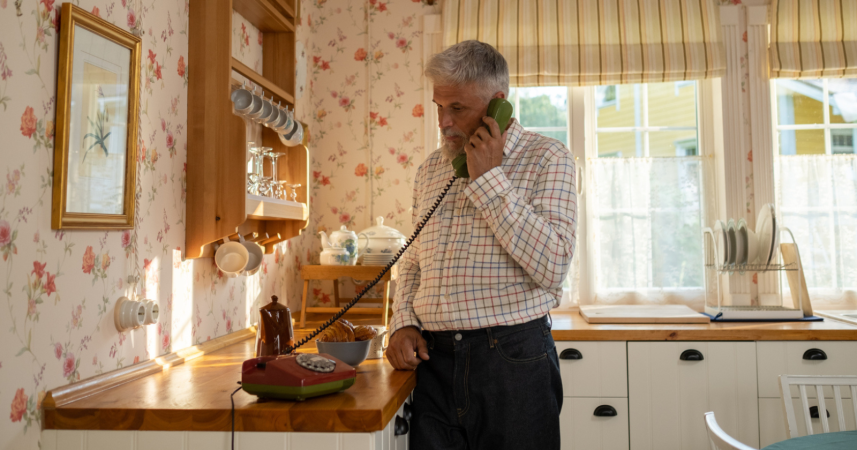
Last week, I was helping my daughter clean out her garage when I spotted an old rotary phone tucked behind some boxes.
Without thinking, my finger found its way into the dial, and I smoothly dialed my childhood home number — a number I haven't called in forty years.
My finger knew exactly how long to wait for each number to rotate back, the perfect pressure to apply, the rhythm of it all. It was like watching my hand perform a dance it had memorized decades ago, one that apparently never left.
That moment got me thinking about all the things our generation can still do without conscious thought, skills that younger folks watch with the same bewilderment I feel when my grandchildren navigate their phones with lightning thumbs.
These aren't things we practice or consciously maintain. They're movements and knowledge that the 1970s and early '80s etched so deeply into our muscle memory that our bodies remember even when our minds have moved on.
1) Dialing a rotary phone with perfect precision
There's something almost meditative about the way we can still dial those old phones.
Your finger knows exactly where to stop for each number, how to pull it all the way to the metal stopper, and most importantly, how to wait patiently for it to click back before dialing the next digit.
I watched my grandson try it once at an antique shop, and he kept lifting his finger too early, not understanding that the phone needed time to register each number.
But for us? Our fingers remember the weight of that dial, the specific resistance of the spring, even the slightly sticky feel of the plastic on humid days.
2) Threading a film projector in complete darkness
Remember school film days? That satisfying click when the film caught the sprockets just right? Many of us can still thread a 16mm projector blindfolded. Our hands remember the path: Around this wheel, through that gate, wrap around the bottom spool. It's all there, waiting in our fingertips.
The other day at a community center, they brought out an old projector for a presentation about local history.
The young coordinator was struggling with the manual when three of us simultaneously stood up and said, "Here, let me." We all laughed, recognizing kindred spirits who'd spent countless hours in darkened classrooms, threading film while students waited impatiently.
3) Finding the sweet spot on TV antenna rabbit ears
This one makes me smile every time. We all had our specific techniques: A little aluminum foil here, angle one ear northeast while standing on one foot, maybe hold it just so while everyone else watches the game.
Our hands still know that delicate dance of micro-adjustments, searching for that perfect spot where the static suddenly clears and Walter Cronkite's face appears.
It was part science, part art, and completely maddening, yet we developed an almost supernatural sense for it.
4) Speed-typing on a manual typewriter
The force required! Young people who learned on computer keyboards have no idea about the finger strength we developed. Each key needed a decisive strike, and you had to hit them with different pressures depending on their position.
The pinky keys needed extra oomph, while the pointer fingers could be gentler.
Our hands still remember the exact amount of force needed for each key, the swing of the carriage return, the satisfying ding at the end of each line.
When I encounter an old typewriter at an estate sale or museum, my fingers automatically position themselves in home row, ready to pound out a letter with the proper rhythm and force that only comes from years of practice.
5) Operating a manual transmission without thinking
Clutch, shift, gas — a three-part harmony our feet and hands perform without any conscious thought.
We can feel through the pedal exactly when the clutch engages, know by sound alone when to shift, and our left foot automatically hovers over that clutch pedal even in automatic cars.
I still find myself reaching for a phantom stick shift in my current car, especially when merging onto highways.
That coordination between feet and hands, listening to the engine's voice, feeling the car's needs through the seat — it's all still there.
6) Rewinding a cassette tape with a pencil
The perfect pencil had to be hexagonal, not round, for the best grip. We all knew the exact wrist motion needed for maximum speed without causing the tape to bunch up.
Clockwise, steady pressure, not too fast or the tape would crinkle. Even now, when I hold a pencil, sometimes my wrist wants to start that familiar circular motion. It's oddly soothing, like a meditation we never knew we were practicing.
7) Folding a paper map the right way
This is practically a superpower now. We can take a massive, unwieldy road map and fold it back to its original shape in seconds, every crease falling exactly where it should.
It's not just about following the existing folds — it's about understanding the logic of how maps were meant to collapse.
There's a specific order, a rhythm to it. Modern GPS users look at us like we're performing origami magic when we casually refold a map after checking something.
8) Setting the time on a digital watch with four buttons
Mode, set, adjust, mode again. Or was it mode, mode, set? Every digital watch was different, yet somehow our thumbs remember the secret combination for each one.
We can still navigate those tiny buttons without reading any instructions, understanding intuitively which button advances the hours, which does minutes, and how to avoid accidentally setting the alarm for 3 a.m.
9) Loading paper into a dot matrix printer
The satisfying snap when those holes lined up perfectly with the tractor feed wheels! We knew exactly how much slack to leave, how to fan the paper just right to prevent jams, and most importantly, how to tear off the perforated edges in one smooth, satisfying strip.
The sound alone — that distinctive screech and chatter — can transport us right back to home offices and computer labs of yesteryear.
Final thoughts
These skills might seem quaint or useless now, but they represent something larger: The deep learning that comes from daily repetition, from living in a world where things were mechanical and tactile.
Our hands carry the history of a time when technology required physical interaction, when devices gave us feedback we could feel and hear.
While I've embraced new technology (those senior center classes really did help!), there's something comforting about knowing these old skills are still there, dormant but ready, like old friends waiting to be remembered.
They're proof that what we learn with our hands and bodies stays with us in ways that what we learn with our minds sometimes doesn't.
What’s Your Plant-Powered Archetype?
Ever wonder what your everyday habits say about your deeper purpose—and how they ripple out to impact the planet?
This 90-second quiz reveals the plant-powered role you’re here to play, and the tiny shift that makes it even more powerful.
12 fun questions. Instant results. Surprisingly accurate.