From the woman who knows when your newspaper sits uncollected for too long to the man who clears storm drains at dawn, these self-appointed neighborhood guardians are quietly performing acts of care that keep our communities from unraveling—and we won't realize what we've lost until there's no one left to do them.

Add VegOut to your Google News feed. 
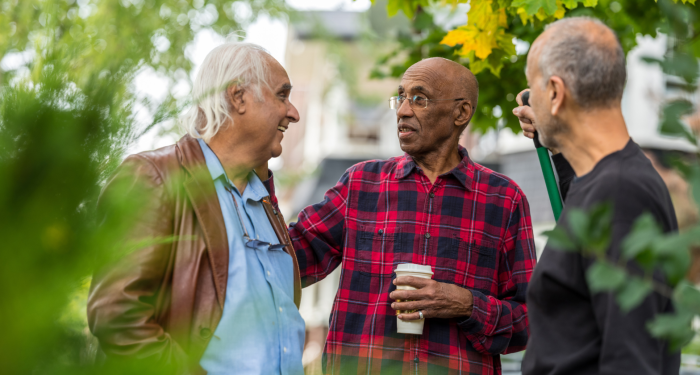
There's a gentleman three houses down who still rakes leaves from the storm drain every autumn morning.
No one asks him to do it. The city certainly doesn't pay him. When the wind blows hard in October, you'll find him out there at 7 AM with his ancient rake, clearing the grates so the street won't flood when the rains come. I wonder sometimes what will happen when he can't do it anymore.
This got me thinking about all the invisible threads that people over 70 weave through our neighborhoods, the quiet acts of care that hold our communities together in ways we barely notice until they're gone.
After decades of observing and participating in neighborhood life, I've noticed these patterns everywhere. They're the things that make a street feel like home rather than just a collection of houses.
1) They keep watch from their windows
You might not realize it, but there's probably someone on your street who knows exactly when you leave for work and when you get home. Not in a creepy way, but in that gentle guardian way that comes from years of living in one place.
They're the ones who notice when your newspaper sits on the driveway for three days, when a strange car has been parked outside too long, or when your teenager sneaks out at midnight.
My Thursday coffee companion does this. She sits by her front window with her crossword puzzle, and she's prevented at least two break-ins on our street just by calling neighbors when something looked off. The police won't do this. Security cameras can't think or care. But Eleanor can and does, every single day.
2) They remember everyone's story
Walk down any street with someone over 70 who's lived there for years, and you'll get a history lesson. "That house? The Johnsons lived there for forty years. Their son became a doctor." "See that oak tree? Planted when the Miller baby was born in '82." They're the living memory of the neighborhood, holding stories that would otherwise disappear.
This matters more than we think. When you know the stories, you care differently. You understand why the corner house has that unusual addition (their daughter used a wheelchair) or why there's always a light on in that upstairs window (Mr. Chen worked nights for thirty years and old habits die hard).
3) They maintain the commons without being asked
Besides my leaf-raking neighbor, there's a woman who plants flowers in the traffic circle every spring. Another gentleman trims the hedge that technically belongs to the city but blocks the stop sign if left alone. Someone else picks up litter during their morning walk, every single day, rain or shine.
None of them have to do this. The city should handle it, but budget cuts mean they don't.
These small acts of maintenance keep our neighborhoods from sliding into neglect. What happens when these self-appointed caretakers are gone? I've seen it in other neighborhoods: the slow creep of deterioration that makes a place feel unloved.
4) They serve as the informal information network
Before NextDoor and Facebook groups, there were people like Mrs. Rodriguez, who somehow knows everything happening within a five-block radius.
Need a plumber? She knows one. Wondering about that construction noise? She talked to the crew. Looking for your escaped cat? She saw it heading toward the park yesterday evening.
This human network catches things that digital networks miss. It operates on relationship and trust rather than algorithms. It includes people who aren't online. And unlike social media, it comes with context, nuance, and genuine concern rather than knee-jerk reactions and hostile comments.
5) They bridge the generations
At our annual block party, which I help organize, it's always the over-70 crowd who make sure the new families feel welcome. They're the ones who introduce the young couple to the family with kids the same age, who tell the teenagers about the elderly woman who might pay them to walk her dog.
They do this naturally, almost unconsciously, because they've watched the neighborhood evolve through multiple generations. They understand that communities need these connections to thrive.
Young families are often too busy to make these bridges themselves, and middle-aged folks are caught up in their career demands.
6) They keep traditions alive that no one else remembers
Why do we put luminarias out on Christmas Eve? Why does everyone park on one side of the street during the annual yard sale? Why do we all check on the Thompsons during heat waves? The over-70s know, and more importantly, they keep doing these things even when others forget.
These traditions might seem trivial, but they're the rituals that transform a collection of houses into a neighborhood. They create shared experiences and common ground. Once these tradition-keepers are gone, these practices often die with them, and something indefinable is lost.
7) They offer presence in an increasingly absent world
In our rush to get somewhere else, they're simply here. Available. Present. The retired teacher who's home when the school bus driver needs someone to take a sick child. The widower who sits on his porch and waves at everyone who passes by.
The couple who still walk their ancient dog three times a day and stop to chat with anyone who has time.
This presence is a form of community infrastructure we don't acknowledge. It makes streets safer, kids more secure, and isolated people less alone. It can't be replaced by apps or services because it's not transactional. It emerges from simply being there, year after year.
8) They hold space for grief and memory
When someone on the street dies, moves to assisted living, or faces tragedy, it's often the over-70s who remember. They send cards on the anniversary of a death. They ask about the adult child who moved away after the divorce. They water the roses that someone planted before they had to sell the house.
This might be the most invisible and irreplaceable thing they do: they bear witness to the full arc of human stories in a place. They hold the neighborhood's collective memory of both joy and sorrow.
Final thoughts
I started that little free library outside my home partly because I watched my older neighbors and learned from them about tending to the commons. Every time someone stops to browse the books, I think about all these invisible acts of care happening on every street, in every neighborhood.
We're losing something as this generation ages out of these roles. Not because younger people don't care, but because the conditions that created these neighborhood stewards - staying in one place for decades, having time after retirement, knowing your neighbors deeply - are increasingly rare.
Perhaps recognizing these contributions is the first step toward finding new ways to weave these essential threads of community care. Or perhaps we'll only fully understand their value when there's no one left to rake the leaves from the storm drain on October mornings.