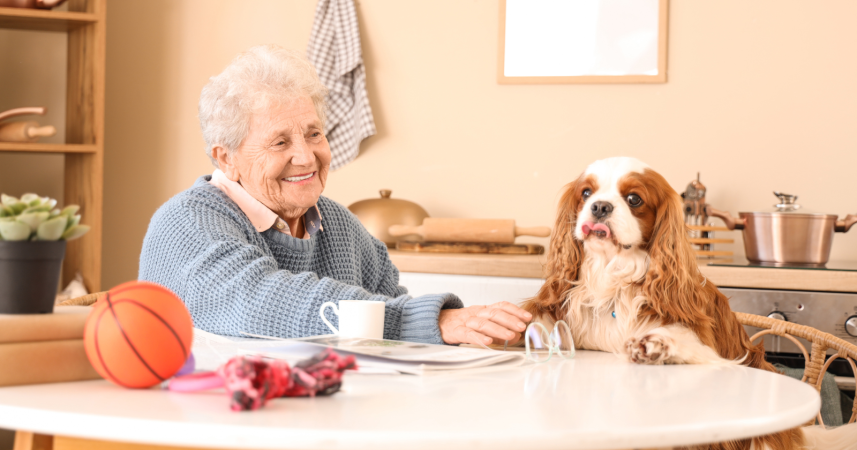
From specialized peanut butter collections to emergency paper towel stations in every drawer, peek inside the bizarre kitchen reality of dog owners who've unknowingly transformed their culinary spaces into part treat-dispensary, part veterinary clinic.

Add VegOut to your Google News feed. 
Walk into any dog owner's kitchen and you'll notice something peculiar.
Between the artisanal olive oils and the good wine glasses, there's an entirely different ecosystem happening.
One that makes perfect sense to those of us with four-legged roommates but leaves everyone else scratching their heads.
I discovered this firsthand last week when a friend stopped by for coffee.
She opened my kitchen drawer looking for a spoon and froze.
"Why do you have three different types of peanut butter?" she asked, genuinely confused.
Before I could answer, she spotted the collection of rubber toys drying on the dish rack next to my French press.
Welcome to the reality of sharing your culinary space with a dog!
Your kitchen becomes command central for more than just meal prep; it's treat headquarters, toy storage, and sometimes even a makeshift vet clinic.
After three years of this beautiful chaos with my rescue mutt, I've learned that certain kitchen items become absolutely essential when you have a dog.
Items that would make zero sense to anyone who hasn't experienced the joy of stepping on a wet kibble piece at 6 AM.
1) Multiple jars of peanut butter (none for human consumption)
Remember when peanut butter was just for sandwiches? Those days are long gone.
In my pantry right now, there are four jars of peanut butter:
- The organic unsalted one for Kong stuffing.
- The cheap generic brand for hiding pills.
- The xylitol-free "special occasion" jar that costs more than my wine.
- The one I actually eat, buried somewhere in the back.
The thing is, each serves a specific purpose in the complex world of dog parenting.
That Kong-stuffing jar? It needs to be thick enough to stay put but not so expensive that you cry when your dog goes through half a jar in a week.
The pill-hiding variety needs to be extra sticky and preferably the kind your dog goes absolutely nuts for.
My non-dog friends think I've developed some sort of peanut butter addiction.
The truth is much simpler and slightly more embarrassing.
Three of those jars belong to someone who licks his own butt.
2) A dedicated pill pocket station
Show me a dog owner's kitchen, and I'll show you a corner that looks like a tiny pharmacy merged with a deli counter.
We've all been there: The vet hands you a bottle of pills with instructions to "give twice daily with food" and you naively think you'll just toss it in their bowl, then you watch your dog expertly eat around every single pill like they're performing surgery.
Enter the pill pocket station.
Mine lives next to the coffee maker and includes cream cheese, lunch meat, those overpriced commercial pill pockets that work exactly once before your dog figures them out, and a selection of soft cheeses that I tell myself I bought for entertaining.
The evolution of pill-giving technique is something that would fascinate anthropologists.
You start confident, maybe even cocky.
By day three, you're wrapping pills in prosciutto and questioning who really owns whom.
3) Cleaning supplies in every drawer
Before I had a dog, I kept paper towels under the sink like a normal person.
Now? They're stationed throughout the kitchen like fire extinguishers.
There's the main roll on the counter, obviously.
But there's also the emergency stash in the junk drawer, the backup roll in the pantry, and what I call the "oh no" collection under the breakfast bar.
Here's what non-dog people don't understand: Disasters happen at the speed of dog.
One second you're peacefully drinking coffee, the next you're dealing with what can only be described as a pumpkin puree explosion.
How did it happen? Where did they even find pumpkin puree? These are questions for another time.
Right now, you need paper towels (lots of them).
The enzyme cleaner collection is equally impressive.
Different formulas for different situations, because apparently dog ownership means becoming an amateur chemist who specializes in biological warfare cleanup.
4) The treat hierarchy system
Open my pantry and you'll find what looks like a specialty pet store exploded.
There's the everyday training treats (small, cheap, bought in bulk), the medium-value treats for practicing recalls in the backyard, the high-value treats that only come out for vet visits or nail trims, and the ultra-premium, freeze-dried, single-ingredient treats that cost more per ounce than good sushi.
Each has its place in the complex behavioral economy I've created.
You can't use the good stuff for basic commands, or they lose their power, but you also can't expect your dog to come running back from chasing a squirrel for a piece of their regular kibble.
I've become that person who reads ingredient labels on dog treats more carefully than on my own food ("No, these won't work, they have too much filler...").
Meanwhile, I ate cereal for dinner last night.
5) More ice than a cocktail bar
My freezer's ice maker works overtime, and not because I'm hosting parties.
Dogs, I've learned, think ice cubes are nature's perfect toy.
They're crunchy, they're cold, they slide across the floor in amusing ways, and they eventually disappear.
It's like magic: Some dogs just like regular ice, while mine requires what I call "flavor cubes."
Chicken broth frozen in fun shapes or diluted bone broth with berries, because plain water is apparently for peasants.
The ice cube ritual has become so embedded in our routine that my dog now appears every time he hears the freezer door.
The sound of ice dropping into a glass is his version of a dinner bell.
6) The Kong cleaning station
That bottle brush next to my sink? Not for bottles.
Kong toys are wonderful until you realize that cleaning peanut butter out of them requires tools typically reserved for laboratory equipment.
I have brushes in sizes that would make a dentist jealous.
The cleaning process has become a ritual unto itself: Soak, scrub, rinse, inspect with a flashlight to make sure you got everything, repeat.
It's like doing dishes for someone who can't appreciate the effort but will definitely notice if you missed a spot.
7) Strategic food elevation systems
Every flat surface in my kitchen has been evaluated for its height and dog-accessibility rating.
The microwave is also prime real estate for defrosting meat, away from counter-surfing criminals.
The top of the refrigerator has become valuable storage space.
Even my nice knife block has been relocated to prevent any unfortunate investigative licking.
You develop a constant awareness of elevation.
Can the dog reach this if they really try? What if they stand on their hind legs? What if they somehow develop opposable thumbs overnight? These are the questions that keep us up at night.
8) The emergency vet kit
Finally, tucked in a corner of my kitchen lives what I call the "situation box."
Hydrogen peroxide for those times they eat something they shouldn't have, canned pumpkin for digestive issues, special electrolyte solution, a thermometer I hope to never use, and phone numbers for the regular vet, the emergency vet, and poison control.
It's the kitchen equivalent of a panic room, filled with things you pray you'll never need but feel better having within reach.
Final thoughts
Looking around my kitchen now, I realize it tells the story of a life shared with a ridiculous, wonderful creature who thinks cat poop is a delicacy but won't eat a carrot unless it's organic.
Yes, my kitchen has been colonized by dog paraphernalia and, yes, I probably have more treats than human snacks at any given time.
However, this chaos is the tax we happily pay for unconditional love and endless entertainment.
Every peanut butter jar, every strategically placed paper towel roll, every ice cube demanded at 11 PM is part of the beautiful, messy symphony of dog ownership.
Non-dog people might not understand why we need three different types of treats just for Tuesday, but they also don't get to experience the joy of a tail wag that could power a small city, just because you opened the freezer door.