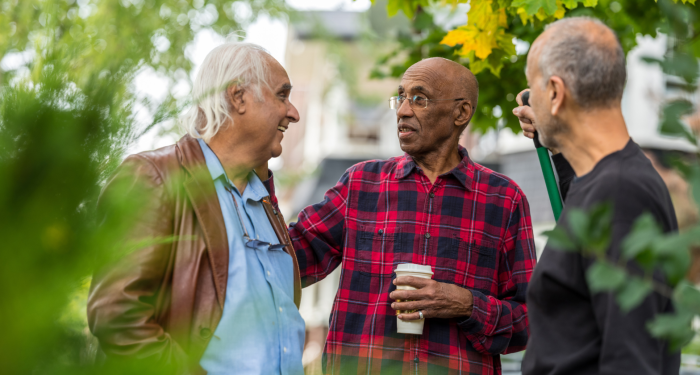
These timeless character traits that older generations swear by aren't about grand gestures or public recognition—they're the small, invisible acts of decency that happen when nobody's watching, like returning a shopping cart in the rain or remembering your barista's name.

Add VegOut to your Google News feed. 
Last week at the grocery store, I watched a twenty-something return a shopping cart in the pouring rain, not to the corral right next to his car, but all the way back to the store entrance where an elderly woman was struggling to find one.
He didn't know I was watching.
The woman didn't even thank him.
But something about that simple act made me think of my father, a mailman who knew everyone in town by name, and how he'd always said the measure of a person isn't what they do in the spotlight, but what they do in the shadows.
Every generation thinks the next one lacks something essential about character.
But after 32 years teaching high school English, I learned that teenagers are often far wiser than we give them credit for.
Still, there's something to be said for those core values that seem increasingly rare, the ones that show up not in grand gestures but in quiet moments when nobody's keeping score.
1) They return the shopping cart every single time
You know the type.
The parking lot could be empty, it could be raining sideways, they could be running late for something important, but that cart goes back where it belongs.
Not abandoned between cars, not shoved onto a median.
Back where it goes.
Because somewhere along the line, someone taught them that convenience isn't an excuse for making someone else's job harder.
I remember teaching this to my own children when they were small.
One day my daughter asked why we had to walk "all the way back" when everyone else just left their carts wherever.
"Because," I told her, "someone has to collect all those carts in the heat, in the cold, in the rain. And that someone matters."
2) They write thank you notes that mean something
Not the perfunctory "Thanks for the gift" variety, but real ones.
The kind that mention the specific book you gave them and how it reminded them of a conversation you had three months ago.
The kind that arrive weeks after a dinner party mentioning the recipe they'd love to have for that incredible soup.
These aren't performative gestures; they're evidence that someone taught them to really see the effort others make on their behalf.
3) They hold doors without making it weird
There's an art to this that goes beyond simple courtesy.
They hold the door without flourish or expectation, equally for the CEO and the janitor, for someone two steps behind or twenty.
They don't make you run to catch the door they're holding, and they don't let it close in someone's face just because that person is technically "too far away."
It's awareness without performance, consideration without keeping score.
4) They put their phone away when someone's talking
Really away. Not face down on the table where it still buzzes and lights up.
Not in their hand but "totally not looking at it." Away.
Because someone taught them that presence is a gift, and dividing your attention is like giving someone a present with half the contents missing.
Have you ever tried to have a meaningful conversation with someone whose eyes keep drifting to their screen?
It's like trying to hug a ghost.
The people raised right understand that the person in front of them matters more than the possibility of something more interesting happening elsewhere.
5) They know how to apologize without caveats
"I'm sorry I hurt you." Period.
Not "I'm sorry, but you have to understand..."
Not "I'm sorry you feel that way."
Just clean, simple ownership of harm caused, intentional or not.
This might be the rarest quality of all, because it requires both humility and strength, a combination that seems increasingly scarce.
I learned this lesson the hard way when I had to fail a student I genuinely liked.
She was bright, funny, engaged in class, but she simply hadn't done the work.
When her parents came in angry, my first instinct was to defend myself, to explain all the chances I'd given her.
Instead, I said, "I'm sorry this is disappointing.
I know she's capable of the work."
That simple acknowledgment of their pain, without excuses, changed the entire conversation.
6) They remember the names of service people
The barista who makes their coffee, the person who cuts their hair, the woman who cleans their office.
They use these names naturally, not as some sort of performance of virtue, but because they genuinely see these people as people.
My father modeled this every single day on his mail route.
He didn't just know names; he knew whose daughter was getting married, whose son was deployed, whose mother was ill.
This isn't about being a social butterfly.
It's about recognizing that every person you encounter has a full, complex life, and acknowledging that reality with the simple dignity of using their name.
7) They clean up their own messes, literal and metaphorical
Spill coffee in the break room?
They clean it up immediately, even if no one saw it happen.
Say something thoughtless in a meeting? They circle back to fix it.
Make a mistake that affects someone else? They own it before anyone has to point it out.
This isn't about perfectionism; it's about taking responsibility for your impact on the world, however small.
8) They give credit generously and take blame quietly
Watch someone in a meeting say, "Actually, that was Sarah's idea" when they could have easily claimed it.
Notice the manager who says "I should have been clearer" when a project goes wrong, instead of throwing their team under the bus.
These people understand that lifting others up doesn't diminish them, and that true strength often looks like taking the hit when you could deflect it.
Final thoughts
Character isn't built in grand moments but in the thousand small choices we make when no one's watching.
The young man with the shopping cart in the rain?
He reminded me that these values aren't extinct, just sometimes harder to spot in our increasingly isolated world.
The truth is, being raised right isn't about perfection or rigid rules.
It's about understanding that we're all connected, that our actions ripple outward in ways we may never see, and that how we treat people when there's nothing to gain says everything about who we really are.