While millennials and Gen Z have modernized funeral practices with digital tributes and casual attire, they've unknowingly abandoned seven meaningful traditions that helped previous generations transform raw grief into healing through the simple power of showing up, staying present, and sharing the burden together.

Add VegOut to your Google News feed. 
Last month at my cousin's funeral, I watched my twenty-something nephew scroll through his phone during the eulogy. He wasn't being disrespectful, not really. He was looking up a Bible verse the minister had mentioned, wanting to understand it better.
But something about that moment struck me. The way we approach death, mourning, and remembrance has shifted so dramatically between my generation and his, and I can't help but wonder what we're losing in translation.
Funerals have always been about more than just saying goodbye. They're cultural touchstones, moments where we collectively pause to honor a life and confront our own mortality. But as I've attended more services over the years (too many, if I'm being honest), I've noticed certain traditions quietly disappearing.
These aren't just empty rituals we're abandoning. They're practices that helped us process grief, build community, and find meaning in loss.
1) Bringing homemade food to the family
Remember when every funeral meant casserole dishes lined up on kitchen counters? When I lost my second husband after his long battle with Parkinson's, my freezer was full for months with lasagnas, soups, and mysterious foil-wrapped packages labeled in careful cursive.
Each dish came with a story, a memory, a connection. Now, people send DoorDash gift cards or Venmo money for takeout. Don't get me wrong, those gestures are kind and practical.
But there's something profoundly different about eating a meal someone made with their own hands while thinking of your loss. Food prepared with intention carries comfort in a way that restaurant delivery never quite can.
2) Sitting with the body at viewings
The open casket viewing seems almost antiquated now, doesn't it? Younger generations often find it morbid or unnecessary, opting for closed caskets or cremation without viewing. But those hours spent sitting with the deceased serve a purpose beyond tradition.
They give us time to accept the reality of death, to move from knowing someone is gone to understanding it in our bones. When my sister died of ovarian cancer at just 58, those quiet moments beside her helped me process what my mind couldn't quite grasp. Death becomes less abstract when you witness its stillness.
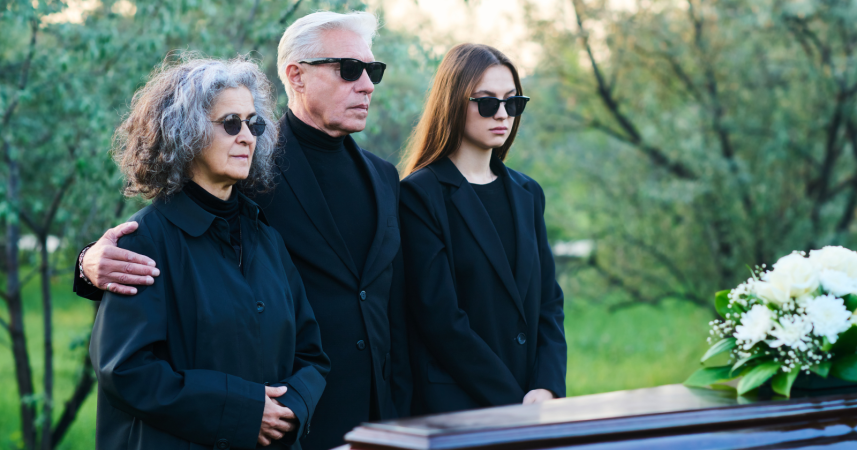
3) Wearing formal black attire
These days, funeral attire runs the gamut from business casual to jeans. The strict black dress code feels oppressive to many younger mourners, who prefer "celebrations of life" with bright colors.
Yet there was something powerful about that sea of black, a visual representation of collective mourning.
It marked the day as different, sacred even. When everyone dressed the part, it created a container for grief, a shared acknowledgment that this wasn't just another Thursday. We were united in loss, and our clothes reflected that solidarity.
4) Staying for the entire service and burial
Have you noticed how funeral attendance has become almost cafeteria-style? People drop in for the parts that fit their schedule, maybe the service but not the burial, or vice versa. The commitment to seeing the entire process through, from funeral home to graveside, has largely disappeared.
But those long hours together served a purpose. They forced us to slow down, to sit with discomfort, to support each other through the hardest parts. Grief doesn't operate on our timeline, and neither should our presence for those who mourn.
5) Sharing stories aloud during the service
Video tributes and slideshow presentations have largely replaced the tradition of spontaneous storytelling during services. While these multimedia presentations are beautiful, something gets lost when we trade live voices for recorded images.
The trembling voice of a friend sharing an unexpected memory, the laughter that bubbles up through tears when someone recalls a funny moment, the way stories build on each other in real-time - these spontaneous offerings create a living memorial that no slideshow can capture.
They remind us that memory itself is communal, built and rebuilt through our collective telling.
6) Writing physical sympathy cards
Facebook condolences and text messages have become the norm, replacing handwritten sympathy cards sent through the mail. But those physical cards served multiple purposes. Writing them forced us to pause, to really consider our words.
Receiving them gave grieving families something tangible to hold onto, to read and reread during those long, lonely nights. I still have every card from my husband's funeral, tied with a ribbon in my closet. Sometimes I take them out and read them, feeling less alone in my memories.
Can you say the same about a Facebook comment?
7) Gathering at the family home after the service
The post-funeral gathering at someone's home has given way to restaurant receptions or, often, nothing at all.
People scatter immediately after the service, eager to return to their lives. But those informal home gatherings, with their cluttered kitchen tables and mismatched chairs dragged in from every room, created space for the real work of mourning to begin.
Stories emerged that couldn't be told in church. Laughter finally felt permissible. Children ran between adults' legs, reminding us that life continues even in death's shadow.
Final thoughts
I'm not suggesting we return to every tradition for tradition's sake. Some practices needed updating, and grief shouldn't be performative. But in our rush to make death more convenient, more palatable, more efficient, we've lost some of the very things that helped us heal.
True mourning requires time, presence, and community. It asks us to be uncomfortable, to show up when we'd rather look away, to mark death as significant through our actions, not just our words.
Perhaps the question isn't whether we should resurrect these old traditions, but rather what new rituals we might create that serve the same essential purposes: bringing us together, helping us process loss, and reminding us that love persists even after death.
Because if there's one thing I've learned through all my losses, it's that grief shared is grief transformed. And that transformation, however we achieve it, is worth preserving.
What’s Your Plant-Powered Archetype?
Ever wonder what your everyday habits say about your deeper purpose—and how they ripple out to impact the planet?
This 90-second quiz reveals the plant-powered role you’re here to play, and the tiny shift that makes it even more powerful.
12 fun questions. Instant results. Surprisingly accurate.