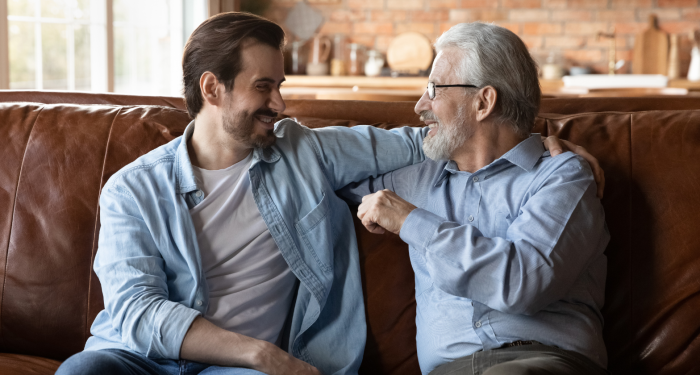
When a man grows up without seeing affection, love often becomes something he does rather than something he shows—until he learns there’s a difference.
The way we experience love as children shapes how we give and receive it as adults.
For many men, growing up in a home where affection wasn’t openly shown leaves a lasting imprint.
If they never saw their parents hug, hold hands, or express warmth through words, they often enter adulthood without a clear model of what healthy emotional connection looks like.
This doesn’t mean they’re incapable of love—it just means they may express it differently, often in subtle or guarded ways.
These patterns aren’t always obvious to them, and they might not even realize how deeply their upbringing influenced their behavior.
Here are eight common traits men tend to display when they grew up in an environment where affection was rarely or never expressed.
1. He struggles to say “I love you” out loud
For some men, those three words feel like a foreign language.
It’s not that they don’t feel love—it’s that they never heard it modeled in their home growing up.
As a result, saying “I love you” can feel awkward, forced, or even scary.
He might show love through actions instead, like fixing something that’s broken or making sure you get home safely.
But the verbal expression of love feels vulnerable, and vulnerability wasn’t something he saw normalized as a child.
Over time, this can create misunderstandings in relationships where a partner craves more verbal affirmation.
With patience and trust, he can learn to say the words, but it takes conscious effort and practice.
2. He has a hard time initiating physical affection
When hugs, kisses, or even casual touches weren’t part of his childhood, physical closeness can feel unnatural.
He may not think to hold your hand in public or wrap his arms around you when you’re sad—not because he doesn’t care, but because it simply doesn’t occur to him.
It’s like a muscle that was never exercised, so it feels stiff and awkward at first.
Sometimes, he’ll freeze up when physical affection is offered to him because it triggers discomfort he doesn’t fully understand.
Partners often mistake this for rejection, when in reality, it’s unfamiliarity.
With gentle encouragement and clear communication, he can learn to give and receive touch in a way that feels safe for both of you.
3. He shows love through problem-solving rather than comfort
Instead of offering hugs or comforting words, he jumps straight to solutions.
If you’re upset, he may immediately try to fix the problem rather than simply listening and being present with you.
This stems from not seeing emotional support modeled in his childhood home.
In his mind, taking action is showing love—he just doesn’t realize that sometimes people need empathy more than answers.
This can lead to frustration if a partner feels unseen or emotionally unsupported.
With awareness, he can learn to balance problem-solving with validation and compassion.
It’s a skill that requires practice, but it can transform his relationships.
4. He feels uncomfortable with public displays of affection
Holding hands at the park, a quick kiss before parting ways, or even a hand on your back in a crowded room—these gestures might seem simple to you, but to him, they feel overly exposed.
Growing up in a home where affection wasn’t visible taught him to keep love private and contained.
He may feel self-conscious or even anxious about showing tenderness in front of others.
This discomfort doesn’t mean he doesn’t care—it’s just deeply ingrained conditioning.
Over time, with trust and reassurance, he may become more comfortable showing small signs of affection publicly.
But it usually happens gradually, not all at once.
5. He has difficulty expressing his needs
When emotions weren’t openly discussed growing up, learning to express them in adulthood can feel like trying to read a map in a foreign language.
He may struggle to articulate what he’s feeling or what he needs in a relationship.
Instead, he might shut down, get quiet, or even become irritable without explaining why.
This isn’t a lack of care—it’s a lack of emotional vocabulary.
Because vulnerability wasn’t modeled for him, sharing his inner world feels risky and confusing.
With patience and guidance, he can learn to identify and express his emotions in healthier ways.
6. He equates providing with loving
Many men who grew up without visible affection learned to show love through responsibility rather than tenderness.
He might focus on paying bills, fixing things around the house, or working long hours to provide for his family.
These actions are his way of saying, “I love you,” even if he never actually says the words.
While providing is valuable, it can sometimes create imbalance if emotional connection is missing.
Partners may feel cared for financially but lonely emotionally.
Helping him understand that love is more than practical support can lead to deeper intimacy.
7. He struggles to receive affection without feeling guilty
When you grow up without affection, receiving it as an adult can feel foreign—almost like you don’t deserve it.
He may tense up when complimented or deflect when you show him kindness.
Instead of soaking in love, he might downplay it or push it away.
This often comes from deep-seated beliefs formed in childhood, where love wasn’t freely given or modeled.
Overcoming this requires building trust and slowly unlearning the idea that affection must be earned.
With time, he can begin to accept love as something natural and deserved.
8. He has an independent streak that makes connection tricky
When emotional warmth wasn’t part of childhood, self-reliance often takes its place.
He may pride himself on never needing help and struggle to let others in, even when he deeply cares for them.
This independence can make him seem distant or detached, especially in relationships that require vulnerability.
It’s not that he doesn’t want closeness—he just never learned how to depend on others safely.
With patience and understanding, he can learn that leaning on someone isn’t weakness—it’s part of building true intimacy.
But that lesson takes time and consistent reassurance.
The bigger picture
Men who grew up without seeing affection aren’t doomed to repeat the same patterns forever.
These behaviors are learned—and anything learned can be unlearned.
The key is awareness.
Once he understands where these tendencies come from, he can make conscious choices to express love differently.
With patience, communication, and support, these men can create healthier, more emotionally fulfilling relationships.
And in doing so, they often break the cycle for the next generation, modeling the kind of love they never saw but always needed.