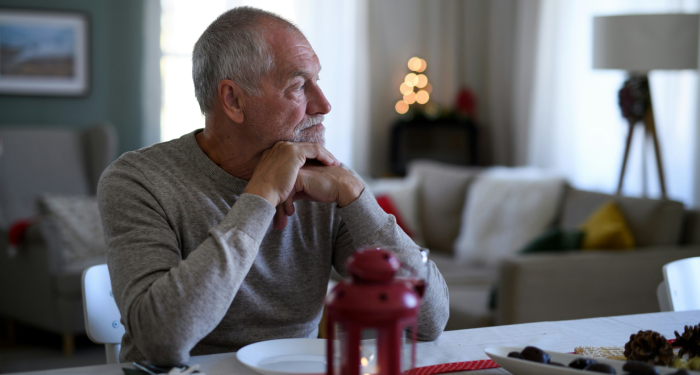
Nobody warns you about three o'clock — that specific silence that fills a room when the day has run out of structure and is simply waiting for bedtime to give it an ending, and the question underneath it that retirement asks of you every single afternoon until you find a way to answer it.

Add VegOut to your Google News feed. 
Nobody tells you about three o'clock.
They tell you about the grief. They tell you about the loneliness, the health, the money, the way your knees will one day make their own decisions about your life. They tell you to stay active, stay connected, take up something new, and they say it with the brisk cheerfulness of people who still have somewhere to be at three in the afternoon. What they don't tell you is about the specific quality of the silence that fills a room when you look up from whatever you've been doing and realize the day has run out of structure and is now simply waiting for bedtime to give it an ending.
What shall I do now.
Not a crisis. Not a breakdown. Just a thought, said to an empty room, on an ordinary Tuesday, that somehow carries the weight of everything.
I've been retired for six years. I have a garden I've tended for thirty, a piano I'm still learning badly, a watercolor class on Tuesdays, literacy students I tutor twice a week, a supper club on Wednesdays that is really about the talking and only officially about the food. By any account I am a woman with a full life. And still, at three o'clock on certain days, I stand in my kitchen and feel the question land in the room like something dropped.
It took me a long time to understand what the question was really asking.
For thirty-two years I taught high school English, and the thing about teaching — the thing that nobody outside it quite grasps — is that the structure is total. Every hour is spoken for. Every transition is managed. From the moment you walk into the building until the moment you leave, the day moves you rather than the other way around. There is always something that needs doing, always someone who needs something from you, always a reason the next hour cannot be wasted because twenty-three teenagers are waiting to find out if you've prepared something worth their time.
I didn't know I was running on that structure until it stopped. I thought retirement was something you settled into gradually, like a new house. What I found instead was a sudden and disorienting silence where the day's momentum had been. I was free in a way I had wanted for years and the freedom felt, in those first months, less like release and more like being set adrift in a very quiet room.
The three o'clock thought arrived early, and it has never entirely left.
What I've come to understand about it — slowly, and not without resistance — is that it isn't really about three o'clock. It's about meaning. About the difference between a day that happens to you and a day that you happen to. For most of my working life, meaning was structural. It came with the job, with the children who needed feeding and getting to school, with the ten thousand small urgencies that filled the hours and left no room for the question of whether any of it mattered. It mattered because it was required. The requirement was the meaning.
Retirement removes the requirement. And then you find out, sometimes standing at a kitchen counter on a Tuesday afternoon, whether there's anything underneath it.
I think this is the thing that catches people — not the loss of income, not the loss of routine, but the loss of the automatic answer to the question of what you're for. The job answered that question every morning without being asked. So did the children, when they were young and needed everything. So, for a long time, did my husband. And when one by one those structures fell away, the question was still there, waiting. It had just been very patient.
The honest answer, in those first years, was that I didn't know what I was for. I had skills, habits, relationships, a garden that needed tending. But skills and habits are not the same as purpose, and I had spent enough years teaching literature to know the difference. The characters who frightened me most in novels were never the ones facing dramatic suffering. They were the ones who had simply run out of reasons. Who moved through their days doing the reasonable things and felt, underneath all of it, the low steady hum of a life that had lost its argument for itself.
I recognized that hum. I heard it at three o'clock.
What I did about it was imperfect and slow and I won't dress it up as a programme, because I distrust programmes and I think most people my age have earned the right to distrust them too. I started writing personal essays, badly at first and then less badly. I signed up for Italian classes at the community center and sat in the back row like an anxious student, which was humbling and also, unexpectedly, wonderful. I began tutoring adults who were learning to read and discovered that an hour spent helping someone decode a sentence they couldn't have managed the week before was enough to make the whole day feel like it had been worth having.
None of this solved the three o'clock problem entirely. There are still days when the question arrives and I don't have a good answer for it. But I've learned something about those days that I wish someone had told me earlier: the silence after the question is not necessarily emptiness. Sometimes it's just space. And space, if you don't panic and fill it immediately with noise or busyness or the television, can become something you choose what to do with rather than something that happens to you.
The hardest thing about being retired — harder than the health, harder than the loneliness, harder than sleeping alone in a bed that used to hold two people — is the daily, unstructured confrontation with the question of who you are when nothing is required of you. When there is no bell, no class waiting, no one who needs you to have your answer ready before they arrive.
Most of us have never had to answer that question before. We were too busy.
Three o'clock comes every day. I've started to think of it less as an accusation and more as an invitation — though I won't pretend it always feels like one. Some days I put the kettle on and sit with it. Some days I go out to the garden, even when there's nothing that needs doing, because it turns out that the garden doesn't have to need me in order for me to need it.
And some days I write. About the question itself, and what it costs to sit with it, and what it slowly, unevenly teaches you about the shape of a life when all the scaffolding has come down and what's left is just you, and the room, and the afternoon light, and the choice of what to do next.
That choice, I've come to believe, is not the consolation prize for a life that's winding down.
It's the point.
What’s Your Plant-Powered Archetype?
Ever wonder what your everyday habits say about your deeper purpose—and how they ripple out to impact the planet?
This 90-second quiz reveals the plant-powered role you’re here to play, and the tiny shift that makes it even more powerful.
12 fun questions. Instant results. Surprisingly accurate.