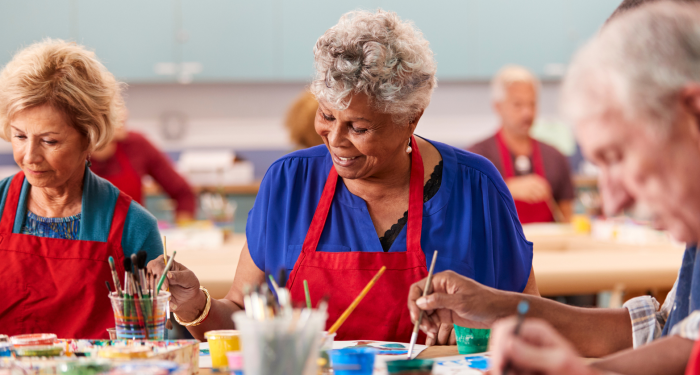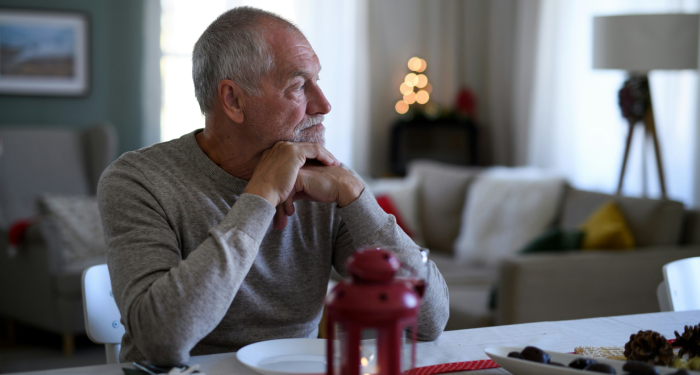
The loneliness epidemic has a face we keep refusing to look at - and it's not the one lit up by a phone screen.

Add VegOut to your Google News feed. 
Pick any headline about loneliness from the last five years and there's a good chance it's pointing at a young person staring at a screen.
And sure, there's data there. Gen Z reports high rates of loneliness. Social media is complicated. The always-online life has tradeoffs nobody fully understands yet.
But here's what those headlines consistently get wrong.
Young people grew up building digital community. For better or worse, they know the tools. They found their people in Reddit threads at 2am, built friendships in Discord servers, organized entire social lives over group chats. The technology was their playground before it became complicated.
The loneliest people in the country aren't the ones who grew up with phones.
They're the ones who grew up with neighbours.
And then watched both disappear in the same decade. And replaced neither. Because the infrastructure that made casual daily human contact effortless was quietly demolished and rebuilt as something that requires a login, a password, and a comfort with digital spaces that nobody ever actually taught them.
The infrastructure that built casual human contact
There's a concept in urban planning and sociology called "third places." Not home. Not work. The pub. The library. The church hall. The corner shop where the guy behind the counter knew your name and your usual and asked about your hip surgery without being prompted.
For an entire generation, daily life was scaffolded by these spaces. You ran into people. Not because you planned it, not because you opened an app and sent a request, but because you showed up and they showed up and proximity did the rest.
Robert Putnam documented the collapse of this social fabric in his book Bowling Alone back in 2000. He was already describing a trend well underway. The bowling leagues were emptying. The union halls were closing. The local associations that once gave people a reason to leave the house on a Tuesday evening were quietly becoming irrelevant.
What replaced them?
Largely, nothing you can walk to.
The digital replacement came with a barrier to entry
Here's the part that consistently gets glossed over.
When physical community started to disappear, it got replaced, at least partially, by digital community. And for people who were young enough when that transition happened, it worked out reasonably well. They adapted. They migrated. They rebuilt.
For people who were already in their fifties, sixties, or seventies when the shift accelerated, the replacement required an entirely different skill set. A login. A password. A smartphone interface that redesigns itself every six months. A learning curve that assumes you have someone nearby and patient enough to help you figure it out.
I've mentioned this before, but one of the most consistent findings in behavioral science is that friction kills behavior. Small barriers that feel trivial to one person can be genuinely insurmountable for another. It's not about intelligence. It's about fluency, and fluency takes time and repetition and, usually, someone who cares enough to sit with you while you figure it out.
For someone who learned to socialize by showing up, by knocking on a door, by being a regular somewhere, the digital version of showing up is not intuitive. And the world largely moved on before anyone stopped to teach them.
My grandmother volunteers at a food bank every Saturday morning. She knows every regular there by name. She's been doing it for years. That's her third place. But outside of that one morning a week, her social infrastructure is thinner than it would have been at any other point in her adult life. In a way that would have been almost unthinkable fifty years ago, when her street alone would have provided a dozen low-stakes human interactions before noon.
Neighborhoods stopped being social spaces
When did you last knock on a neighbor's door for a non-emergency reason?
Suburbanization, car dependency, and changing work patterns didn't just reshape where we live. They reshaped the baseline level of human contact we get without trying. The accidental encounter. The wave across the fence. The brief conversation outside the post office that wasn't scheduled and didn't need to be.
I live in a walkable part of Los Angeles where people actually sit outside and the farmers market on Saturday morning is a social event as much as it is a food shop. It's not perfect, but I can have half a dozen low-stakes human interactions on a Saturday without planning any of them.
Most of the country isn't built like that. And the people who watched their version of it get dismantled over thirty years didn't get a vote.
The drive-through replaced the diner. The big box store replaced the hardware shop with the guy who remembered which bolt you needed last spring. The neighborhood bar closed and became something else entirely. Each of those changes removed one more place where an older person could be a regular. Where they had a role. Where someone expected them.
Retirement removes the last social scaffolding
For a lot of people, work is where the bulk of daily social contact actually happens. Not because work friendships are necessarily the deepest, but because they're the most consistent and the most effortless. You see the same people every day. There are built-in conversation starters. There's structure.
Then retirement happens and the structure disappears overnight.
For a younger person, losing a job is hard but their social life usually exists independently of their work. Friendships maintained over text, communities maintained online, plans that don't hinge on the 9-to-5.
For someone who spent forty years building their daily social world around a workplace, retirement can function like a slow erasure. This is especially true for men, who research consistently shows have fewer close friendships and fewer non-work social ties than women across almost every age group studied.
The math isn't dramatic at first. One less reason to leave the house. One less person who checks in on a Tuesday. One less place where you're expected. But it compounds, quietly, over months and years, in ways that are easy to miss from the outside.
There's a grief dimension nobody really addresses
This isn't just about missing community in some abstract sense. It's about watching something you understood completely become unrecognizable.
You knew how to be a neighbor. You knew how to be a regular. You knew how to run into someone at the post office and turn it into fifteen minutes of conversation that neither of you planned for and both of you needed.
That world is gone. And unlike younger generations who never had it in the first place, older people are grieving something specific. A fluency. A set of social skills that the world simply stopped rewarding.
Behavioral science has a concept for this: contextual identity. The idea that who we are is partly defined by the contexts we inhabit. Strip those contexts away and people don't just feel lonely. They feel like a reduced version of themselves. Like a skill set without an application.
That's a different kind of loneliness than anything a 24-year-old scrolling at midnight is experiencing. Both are real. But they're not the same.
What this actually asks of us
I'm not arguing that young people don't struggle with loneliness. They do.
But the conversation about loneliness needs to make room for the specific, structural, largely invisible crisis happening among people who are older, who lost their social world in slow motion, and who were handed a digital replacement that was never designed with them in mind.
That means building neighborhoods with actual third places rather than optimizing everything for cars and convenience. It means designing technology with older users as a genuine priority rather than an afterthought. It means treating intergenerational contact as infrastructure, not charity.
And sometimes it means simpler things than any of that.
My grandmother once drove six hours to bring me soup when I had the flu during college. Six hours, no text ahead, she just came. That casual, unconditional willingness to show up, to be someone who expected something of you, is something our generation absorbed from hers. Maybe it's time to start returning it.
Call. Visit. Be the person who shows up without waiting to be asked.
The bottom line
The loneliness crisis isn't primarily a story about phones. It's a story about infrastructure. About what happens when the physical and social scaffolding that made everyday human contact effortless gets dismantled and rebuilt as something that requires a learning curve and a decent WiFi connection.
The generation that grew up with neighbours lost both the neighbours and the infrastructure that produced them. They didn't build a replacement, not because they didn't want connection, but because nobody showed them how and the world stopped waiting.
That's worth more than a headline. It's worth actually doing something about.