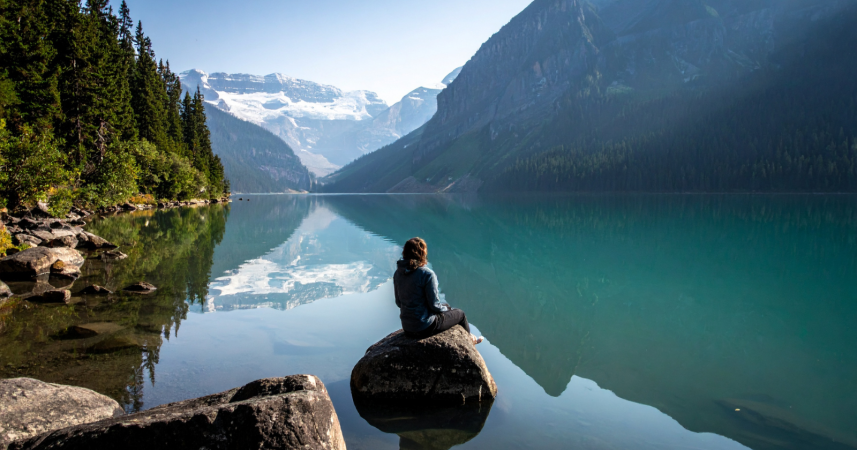
The pull some people feel toward water isn't nostalgia or personality quirk — there's a specific neurological reason for it, and the intensity of what you feel says something real about how your brain is wired.
I remember the first time I stood at the edge of the Gulf of Thailand and felt the particular kind of quiet that water produces in me.
Not silence, exactly. The ocean isn't silent. But something in my head went still in a way that nothing else reliably managed.
I'd been in Bangkok for a few weeks by then, still carrying all the noise of a career I'd walked away from, a decade of kitchen adrenaline and service precision and the relentless forward motion of a life built on output. And standing there at the water's edge, that whole architecture of tension just... released. Without effort. Without intention.
I didn't think much of it at the time. I assumed it was the holiday effect, the contrast doing the work. But over three years of living near water, returning to it the way you return to something you need rather than something you merely enjoy, I started to suspect there was something more specific happening.
It turns out there is. And the science behind it is more interesting than you might expect.
What your brain is actually doing near water
Marine biologist Dr. Wallace J. Nichols spent years building the scientific case for what he called the Blue Mind — a term he defined as a mildly meditative state of calm, peacefulness, and satisfaction that the brain enters when it's near water.
What makes his work compelling isn't the conclusion, which most people intuitively sense anyway, but the mechanism. Nichols drew on neuroscience research involving EEGs and fMRI imaging to show that proximity to water triggers a genuine neurochemical response in the brain. The senses receive the particular combination of stimuli water provides — the rhythmic sound, the visual movement, the smell, the negative ions in coastal air — and the brain responds by releasing a constellation of feel-good chemicals: dopamine, serotonin, oxytocin, and endorphins alongside GABA, which is the brain's primary calming neurotransmitter.
But the mechanism goes deeper than just a chemical hit. Nichols and the neuroscientists he worked with identified something called involuntary attention — a state the brain enters in natural environments where it doesn't have to actively concentrate to stay engaged. Most of our waking lives are spent in a mode of directed attention, consciously pushing focus toward tasks, problems, decisions, notifications, other people's needs. That kind of sustained mental effort is exhausting in ways we rarely notice until it stops.
Water, because it's a predictable but constantly changing environment, creates what neuroscientist Michael Merzenich described as a normalizing background. The brain can relax its vigilance. It gets the gentle stimulation it needs to stay present without the cognitive demand that most environments place on it. And in that space, something that runs almost constantly in modern life, the low-grade hum of mental overload, gets switched off.
That's what you're feeling when you stand at the edge of the ocean and the noise in your head goes quiet. It's not metaphor. It's neuroscience.
Why some people feel it so much more intensely
Here's where it gets personal. Because not everyone has the same experience of water. For some people it's pleasant. For others it's almost visceral — a pull, a relief, something bordering on need.
The research suggests the difference comes down to what you're carrying when you arrive at the water's edge.
A large-scale study published in Scientific Reports, drawing on data from over 16,000 people across 18 countries, found that regular visits to blue spaces were most strongly associated with positive wellbeing and reduced mental distress — and that the relationship was consistent across cultures, climates, and demographics. But what the data also points toward is that the people who benefit most from blue space tend to be those carrying the highest baseline cognitive and emotional load.
In other words, the more noise your nervous system is running in the background, the more powerfully water interrupts it.
This maps onto something I've observed informally across years of watching people in high-pressure environments try to decompress. During my time in luxury hospitality I worked alongside people who were functioning at an extremely high level every day, chefs running dangerous kitchens, event managers holding dozens of moving parts together, service directors who had to read every room they walked into. The ones who gravitated most intensely toward water, whether that was the sea on a day off or even just a long bath, tended to be the people who were also the most emotionally attuned. The most responsive to atmosphere. The ones who felt things more than the people around them did.
That's not coincidence. A highly sensitive nervous system, one that picks up more, processes more, and holds more at any given moment, has more to release when it finally gets permission to let go. Water gives it that permission faster and more completely than almost anything else.
The default mode network and why it matters
There's another layer to this worth understanding. Nichols' work points to the role of the default mode network, the part of the brain that activates during rest, reflection, and mind-wandering. Most people spend very little time in this state. They're always consuming, doing, reacting. The default mode network, which is associated with creativity, self-reflection, empathy, and the integration of experience, barely gets airtime.
Water reliably activates it. The gentle, repetitive, predictable but never boring quality of moving water, whether it's waves, a river current, or rain on a lake surface, is one of the few external stimuli that consistently nudges the brain out of reactive mode and into reflective mode.
This is why so many writers, artists, and deep thinkers have historically sought out water. It's not romantic convention. It's that water does something specific to the thinking mind that almost nothing else replicates as efficiently. It puts you back in contact with yourself.
I do some of my clearest thinking on a long walk near water. Not because I'm trying to think. Because I've stopped trying, and in that space something useful tends to surface on its own. Anyone who's had a breakthrough in the shower or while swimming has experienced a mild version of this. The brain, freed from the demand to perform, starts doing its best work.
What to do with this information
Finally, the practical question: if water has this documented effect on the nervous system, what's the most useful thing to do with that knowledge?
The obvious answer is access. If you feel the effect of water strongly, treat time near it as maintenance rather than luxury. Not a reward for getting through a hard stretch, but a regular input, like sleep or exercise, that keeps the system running better. The people I know who do this deliberately, who build water into their week rather than waiting for it to appear, report something consistent: the clarity doesn't just happen at the water. It lingers. Their baseline is different.
The less obvious answer is attention. Most people walk along a waterfront with a podcast in their ears or a phone in their hand, which is a bit like going to a good restaurant and eating while reading your email. The effect is diminished by the directed attention you're pulling away from it. The research on blue space benefits applies to genuinely present engagement with water, not just physical proximity to it.
Nichols, in the final years of his life, talked about Blue Mind as something close to a survival skill for the modern nervous system. Given the pace and volume of information the average person processes daily, the demand on directed attention has never been higher. Water, as a reliable and accessible means of releasing that load, deserves to be taken more seriously than it usually is.
I think about those early mornings in Bangkok, walking the long way to the market because the route passed the river. I didn't have a theory for it then. I just knew I felt better afterward. Calmer, clearer, more present in my own skin. Now I understand why. And the knowing, it turns out, makes me protect the habit even more.
The bottom line
The calm you feel near water isn't in your imagination, and it isn't simply about getting away from things. It's a documented neurological response: a chemical shift, a change in attentional state, a reactivation of the parts of the brain that modern life systematically suppresses.
The people who feel it most intensely tend to be the people with the most to release. That's not a weakness. It's a signal. And water, in whatever form you have access to it, is one of the more elegant ways the nervous system has of reminding you what it actually needs.
Listen to it.
If You Were a Healing Herb, Which Would You Be?
Each herb holds a unique kind of magic — soothing, awakening, grounding, or clarifying.
This 9-question quiz reveals the healing plant that mirrors your energy right now and what it says about your natural rhythm.
✨ Instant results. Deeply insightful.

Adam Kelton
Adam Kelton is a writer and culinary professional with deep experience in luxury food and beverage. He began his career in fine-dining restaurants and boutique hotels, training under seasoned chefs and learning classical European technique, menu development, and service precision. He later managed small kitchen teams, coordinated wine programs, and designed seasonal tasting menus that balanced creativity with consistency.
After more than a decade in hospitality, Adam transitioned into private-chef work and food consulting. His clients have included executives, wellness retreats, and lifestyle brands looking to develop flavor-forward, plant-focused menus. He has also advised on recipe testing, product launches, and brand storytelling for food and beverage startups.
At VegOut, Adam brings this experience to his writing on personal development, entrepreneurship, relationships, and food culture. He connects lessons from the kitchen with principles of growth, discipline, and self-mastery.
Outside of work, Adam enjoys strength training, exploring food scenes around the world, and reading nonfiction about psychology, leadership, and creativity. He believes that excellence in cooking and in life comes from attention to detail, curiosity, and consistent practice.
More Articles by Adam