The loneliness of an empty house is at least honest — it doesn't pretend to be anything other than what it is. But the loneliness of a crowded room is a lie told by your surroundings, and there is a particular kind of suffering in being invisible to thirty people who all know your name.

Add VegOut to your Google News feed. 
The loneliest I have ever felt was not alone in my house at two in the morning. It was not the first Christmas after my husband died, when I set one place at the table and then moved to the sofa because I couldn't look at it. It was not the long months of grief when the world felt muffled and far away and I went six days once without speaking to another person out loud.
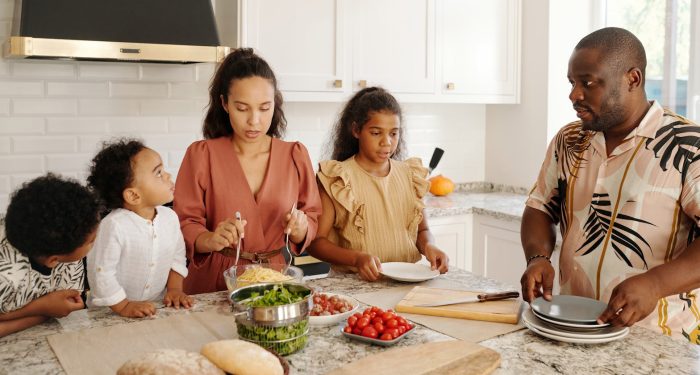
It was at my grandson's birthday party, surrounded by thirty people, holding a paper plate, sitting on a kitchen stool while the room moved around me like water around a stone.
Nobody spoke to me for forty-five minutes. I counted, eventually, the way you count things when you need the numbers to make it real rather than something you imagined. Forty-five minutes in a room full of people who knew my name, in a house where I had changed nappies and read bedtime stories and stood at the kitchen sink doing dishes at midnight so the morning would be easier for my daughter. Forty-five minutes of being present and invisible at the same time, which is its own specific kind of suffering that I don't think has ever been properly named.
And then Grace walked past me. Twice. Without making eye contact.
She wasn't being cruel. I want to say that clearly, because this isn't a story about a cruel daughter. Grace is warm and capable and loves me in ways I don't always make it easy to receive. She was hosting. The room was loud, the children were everywhere, there were people she hadn't seen in months who needed her attention and a cake that needed candles and the ordinary beautiful chaos of a child's birthday unfolding in every direction at once. She walked past me because she was busy, and I happened to be in the way, and the mental load of the afternoon had simply not included me.
I know all of that. I knew it on the stool.
It didn't help.
What I felt, sitting there with a plate of food I wasn't eating, was something I've been trying to find the right word for ever since. It wasn't anger. It wasn't self-pity, or not only that. It was closer to a kind of erasure — the sensation of having become, in that room full of people who were connected to me by blood and history and decades of shared life, entirely beside the point. A background detail. Furniture that happened to be breathing.
The other adults in the room were parents in their thirties and forties, friends of my daughter and son-in-law, people whose lives overlapped in the ways that lives do at that age — children in the same schools, houses in the same neighbourhoods, the same exhausted conversations about the same exhausted things. They had a language I didn't speak anymore, not because I'd forgotten it but because I'd graduated out of it twenty years ago and there was no shared vocabulary to replace it. I had nothing to offer the conversation about sleep schedules or school catchment areas or the particular stress of a kitchen renovation. And they had nothing to ask me, because asking would have required a curiosity about a life that looked, from the outside, like it was mostly behind me.
So nobody asked. And I sat on the stool and held the plate and watched my grandson open presents, and I smiled when I was supposed to smile, and I thought about how strange it is to be loved in theory by a roomful of people and feel, in practice, completely alone.
I have thought about why it hurt as much as it did, and I think it's this: the loneliness of an empty house is honest. It doesn't pretend to be anything other than what it is. You are alone, the house is quiet, the aloneness is the condition and you make your peace with it or you don't. But the loneliness of a crowded room is a lie told by your surroundings. It promises connection and withholds it, and the withholding lands differently than simple absence because it comes with an audience. You cannot even have the dignity of your solitude. You have to perform being fine in front of thirty people while feeling the specific cold of not mattering to any of them.
I've raised two children. I've stood at the front of a classroom for thirty-two years and never once felt like I wasn't in the right room. I've buried a husband, survived a cancer scare, built a life more than once from materials that weren't nearly enough. I know who I am. And I sat on that stool and felt, for forty-five minutes, like someone who used to be a person.
What I did with it, eventually, was leave. Not dramatically — I wasn't ready to make it a thing, and Grace didn't deserve a scene at her son's birthday. I kissed my grandson, found my coat, told her I was tired and that the party was wonderful, and drove home. She texted later to say thank you for coming. I said of course. Neither of us said what had happened, partly because it was nothing and partly because it was everything, and that is the kind of contradiction that doesn't survive being spoken aloud.
What I've been sitting with since is not resentment. It's a question. About what it means to be a person in the later chapters of a family's life — not the centre of it, not even close to the centre, but somewhere in the outer rings, loved but not quite seen, present but not quite needed. About whether that invisibility is something that happens to you or something you participate in. About how many times I've made myself easy to overlook because asking to be seen felt like too large a demand to place on people who were already carrying so much.
A woman in my widow's group said something once that I've never forgotten. She said that the cruelty of getting older isn't the things you lose. It's discovering which rooms you've quietly stopped belonging to without anyone telling you. Without even a door closing. Just a gradual, gentle, completely unintentional drift toward the edges of things.
I think she was right. I think the kitchen stool was the edge.
I'm not sure what I want to do with that knowledge yet. Say something, probably, when the time is right and the moment can hold it. Not as an accusation but as a truth between a mother and daughter who have managed harder truths than this. Something like: I felt invisible on Saturday, and I don't think you knew, and I don't think you'd want me to feel that way, and I'd rather tell you than carry it.
That's the conversation I'm building toward.
In the meantime I keep coming back to my grandson's face when he opened the book I brought him, the way he looked up at me before he'd even finished pulling off the paper, already knowing it was going to be something worth reading because I'd told him, every other Saturday at the library, that books were where you kept the best parts of yourself for safekeeping. He looked at me like I was the person who understood something nobody else in the room did.
For that moment, I wasn't on the edges at all.
I'm holding onto that. It turns out that one moment, if it's the right one, is sometimes enough to make forty-five minutes on a kitchen stool worth having survived.
If You Were a Healing Herb, Which Would You Be?
Each herb holds a unique kind of magic — soothing, awakening, grounding, or clarifying.
This 9-question quiz reveals the healing plant that mirrors your energy right now and what it says about your natural rhythm.
✨ Instant results. Deeply insightful.
Marlene Martin
Marlene is a retired high school English teacher and longtime writer who draws on decades of lived experience to explore personal development, relationships, resilience, and finding purpose in life’s second act. When she’s not at her laptop, she’s usually in the garden at dawn, baking Sunday bread, taking watercolor classes, playing piano, or volunteering at a local women’s shelter teaching life skills.
More Articles by Marlene