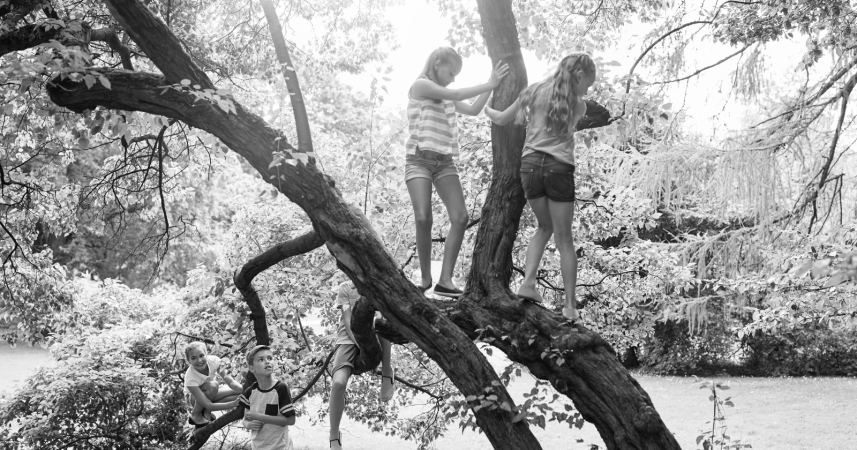
From climbing trees without helmets to disappearing all day with just a "be home by dark," the childhood freedoms of the 60s and 70s created a generation who learned life's most valuable lessons in the spaces between adult supervision.

Add VegOut to your Google News feed. 
The other day, I watched a young mother hover anxiously as her ten-year-old played on monkey bars, ready to catch him if he fell.
Later that afternoon, I found myself thinking about how my sisters and I would disappear after breakfast during summer vacation, our mother's only instruction being to come home when the streetlights came on. Two different worlds, two different childhoods, separated by just a few decades.
If you were lucky enough to grow up in the 60s or early 70s, you experienced a kind of freedom that seems almost mythical to today's parents. We weren't more loved or less protected than children today. But we were given something precious: the space to figure things out for ourselves, to make mistakes without an audience, and to discover who we were when nobody was watching.
1. Walking or biking everywhere alone
Remember when your bike was your passport to the world? Mine was a hand-me-down from my oldest sister, spray-painted blue to cover the rust spots. From age seven or eight, I'd ride it everywhere - to the library, the corner store, my friend's house three neighborhoods away. No helmets, no GPS trackers, no scheduled check-ins.
This wasn't neglect. It was trust. And more importantly, it taught us navigation, both literal and metaphorical. We learned to read the world around us, to notice when something felt off, to problem-solve when we took a wrong turn. Today's children, shuttled from one supervised activity to another, miss out on these small adventures that build confidence one pedal stroke at a time.
2. Playing outside until dark without supervision
"Be home before dark" was the universal parenting motto of our generation. Between those morning goodbyes and evening returns stretched hours of unsupervised possibility. We built forts in vacant lots, played elaborate games of hide-and-seek that spanned entire neighborhoods, and yes, sometimes got into minor trouble that taught us major lessons.
What did those long, unstructured hours give us? The ability to entertain ourselves, for one thing. But more than that, we learned to navigate social dynamics without adult intervention. When conflicts arose - and they always did - we had to figure it out ourselves. No parent swooping in to mediate, no teacher enforcing fairness. Just kids learning the delicate art of compromise, the sting of exclusion, and the power of making amends.
3. Having a paper route or odd jobs from a young age
By twelve, most kids in our neighborhood had some kind of job. Paper routes were the gold standard - up before dawn, delivering newspapers in all weather, collecting payment door-to-door on Saturdays. I helped our elderly neighbor with her garden for fifty cents an hour and thought I was rich.
These weren't just about earning money for candy or comic books. They were our first taste of real responsibility. If you didn't deliver those papers, people noticed. If you didn't show up to help Mrs. Henderson with her tomatoes, you lost the job. We learned that our actions had consequences beyond disappointed parents - they affected our reputation in the community.
4. Using the library as your internet
Need to know something? Better hope the library was open. I spent countless afternoons in our town library, a beautiful old building that smelled of dust and possibility. The librarian, Mrs. Palmer, would point me toward the right section, but after that, I was on my own.
This forced us to become researchers, to develop patience, to learn that knowledge required effort. We couldn't just Google an answer and move on. We had to flip through card catalogs, scan indexes, read through entire encyclopedia entries to find what we needed. Sometimes we'd spend hours looking for information and come up empty-handed. But in that searching, we often discovered things we weren't looking for - and that kind of serendipitous learning seems rare in today's algorithm-driven world.
5. Making phone calls without parental mediation
There's something about calling someone on a rotary phone, not knowing who might answer, that builds character. We had to ask politely if our friend could come to the phone, make small talk with their parents, leave coherent messages. No texting to avoid awkward conversations, no caller ID to screen calls.
I still remember the nerve-wracking experience of calling to ask about a babysitting job when I was thirteen. My palms were sweating as I dialed, and I'd written out what I planned to say on a piece of paper. That simple phone call taught me more about professional communication than any class could have.
6. Handling bullies and conflicts without adult intervention
This is a delicate topic, I know. Nobody wants children to suffer. But there was something valuable in learning to handle difficult people without immediately involving adults. We developed strategies, formed alliances, learned when to stand our ground and when to walk away.
I'm not romanticizing bullying - it could be brutal and damaging. But for most of us, dealing with playground politics without constant adult oversight taught us resilience and problem-solving skills that served us well in adult life. We learned that not every slight required intervention, that sometimes the best response was no response, and that we were stronger than we thought.
7. Having access to "inappropriate" content that taught life lessons
We found things we probably shouldn't have - a discarded magazine in the woods, an R-rated movie at a friend's house whose parents weren't home, books our parents wouldn't have chosen for us. Without the internet's endless stream of content, these discoveries felt significant, even dangerous.
But here's what's interesting: because this content was rare and usually consumed with friends, it became a shared experience that we'd process together. We'd discuss, question, and often laugh at what we'd found. It was a more gradual, social introduction to adult themes than today's solitary scrolling through unlimited online content.
8. Being unreachable for hours at a time
Can you imagine? Hours when your parents had absolutely no idea where you were or what you were doing. No cell phones, no tracking apps, no constant check-ins. If something went wrong, you had to figure it out or find a payphone.
This taught us self-reliance in its purest form. We couldn't call for help at the first sign of trouble. Got lost? Figure out how to get home. Bike broke down? Walk it back or find someone with tools. Scraped your knee? Wash it off in someone's garden hose and keep playing.
Final thoughts
I'm not suggesting we were better or tougher than today's kids - we simply grew up in a different world with different rules. And yes, that world had its dangers and downsides. But those everyday freedoms gave us something irreplaceable: the confidence that comes from navigating life's small challenges alone, the creativity born from boredom, and the independence that only comes from being truly on your own sometimes.
Perhaps the lesson isn't to recreate the past but to find ways to give children today their own versions of these freedoms - spaces where they can be unsupervised, challenges they must solve alone, and the chance to discover who they are when nobody's watching. Because independence, like most valuable things in life, can't be taught - it must be experienced.